
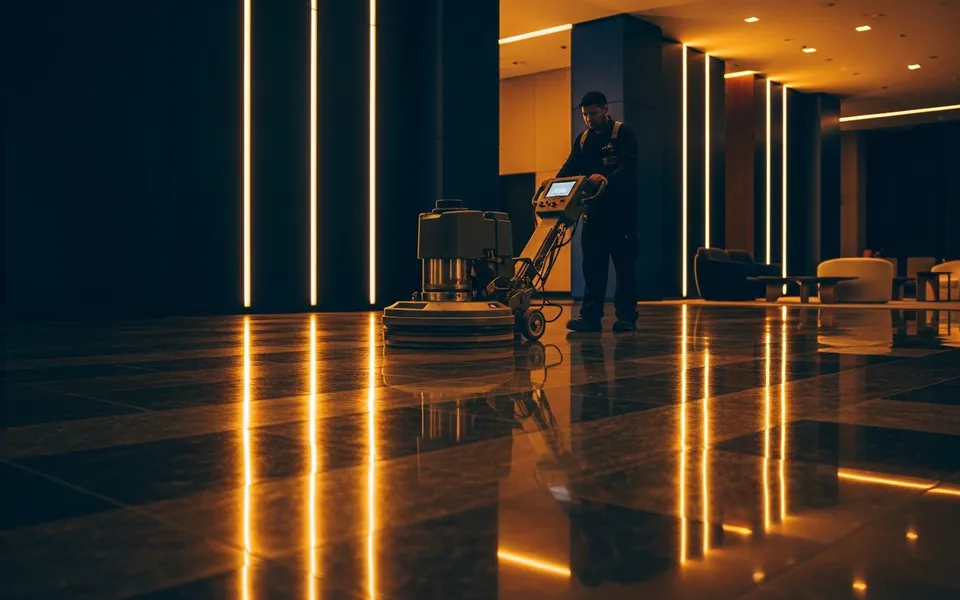
Commercial floor care for Burlington property managers.
Burlington winters degrade lobby floors quickly — salt tracked in from Lakeshore Rd waterfront paths, grit from downtown Brant St sidewalks, and heavy commuter traffic through Alton Village and Downtown high-rise entrances — and a scheduled floor care program extends replacement cycles by years rather than months.
The GTA winter floor damage cycle hits Burlington buildings on a predictable November-through-April window, and the geography of the city concentrates the worst of it in a few specific corridors. Waterfront condos along Lakeshore Rd absorb a combined salt and sand load — road salt from the arterial itself and beach-path sand tracked in from the waterfront trail — that abrades finish coatings faster than an inland building on the same schedule would experience. Downtown Brant St professional offices and mixed-use buildings absorb salt from a heavily-treated pedestrian corridor where sidewalk crews and neighbouring property salt applications overlap. Polished stone lobbies, hardwood entry vestibules and LVT common areas all show the damage in different ways: stone dulls and etches under salt residue, hardwood loses finish gloss under abrasive grit, and LVT accumulates a fine haze from salt film that vacuuming does not remove. By April, floors that received a full strip-and-wax in October often look several years older than they are — and the damage is in the finish layer, meaning it is reversible with the right spring restoration program.
Alton Village and Downtown high-rise lobbies face a compounding traffic problem: dense residential populations moving through single lobby entrances during morning and evening peaks create uneven finish wear patterns — heavier in the traffic lane, lighter at the edges — that require machine buffing and periodic strip-and-rewax to level out rather than top-coat maintenance alone. Retirement residences in Roseland and Millcroft carry a different requirement: floor finishes must sit within a specified slip-resistance range for residents using walkers, canes and wheelchairs, and both over-built and under-maintained finishes present hazards from opposite directions. Medical and dental offices scattered through Burlington's professional corridors need sealed vinyl and polished concrete finishes that stay compatible with the disinfection protocols the space runs on, and industrial-flex properties along Harvester Rd and the QEW service corridor need sealed concrete and epoxy floors that hold up against dock traffic, forklift wear and warehouse chemical exposure.
What's included for Burlington buildings
Floor care scope is defined by surface type and condition, not by a single generic program. VCT and LVT in common corridors, lobbies and back-of-house areas need strip-and-wax programs that remove the accumulated finish layer — typically two to four coats of wax depending on the cycle — and re-apply fresh finish to a specified build. Polished concrete in newer Burlington lobby builds and industrial-flex tenancies needs a diamond polishing or honing program maintained on a defined cycle, with a penetrating sealer applied to protect the surface between visits. Natural stone in higher-end Downtown and waterfront condo lobbies — marble, granite and porcelain — requires stone-safe cleaning chemistry and periodic honing or crystallization polishing rather than standard floor wax, which builds up as a plastic-looking film that obscures the stone. Hardwood entry vestibules need dedicated hardwood cleaners and a recoat cycle scoped to the finish system already in place.
Carpet extraction covers corridor carpeting in mid-rise buildings, amenity rooms and common seating areas. Hot-water extraction pulls out embedded salt, sand and traffic residue that vacuuming does not reach and restores appearance and hygiene to the standard high-traffic common areas require. Winter matting programs — commercial-grade entrance matting placed and maintained through the November-through-April salt season — are among the highest-return floor care investments a Burlington building can make: effective matting removes a large share of salt and grit at the entry point and dramatically slows finish degradation through the worst months. Sealed concrete and epoxy floor upkeep for industrial-flex properties covers dock and warehouse floor scrubbing, epoxy touch-up planning and periodic re-seal cycles. Every scope closes with a photo-verified completion report. Related interior work like sealed vinyl detail cleaning and disinfection-compatible product selection is coordinated with the building's janitorial scope so the two trades don't work against each other.
Managing Burlington's winter salt damage season
The November-through-April window is when floor damage accumulates fastest, and it is also when most Burlington buildings have the least flexibility to take lobbies and corridors out of service for full strip-and-wax operations. The practical program is a winter salt neutralization approach that runs through the season and a spring restoration cycle that resets the floor once the salt window closes. In-season, that means a maintained commercial matting program at every entrance, floor-safe salt neutralizer applied to daily-cleaned lobbies to break down chloride residue before it etches the finish, and increased daily damp-mop frequency at the highest-tracking entries — the ones on Lakeshore Rd, Brant St and the downtown transit-adjacent buildings.
The post-salt spring floor restoration in April or early May is where the program pays back. The decision framework runs: deep-scrub and top-coat if the finish is dulled but intact; strip-and-rewax if the finish has broken through in traffic lanes; hone-and-polish or refinish for stone and hardwood surfaces that show etching or wear-through. Skipping the spring restoration and relying on top-coat maintenance through summer compounds the problem — coats applied over salt-degraded base coats bond poorly and strip inconsistently on the next cycle, requiring more aggressive work and more material later. We document pre-strip condition, coats removed and final coat count on every Burlington floor care visit so the program record stays complete. Lobbies that also need surface repairs — cracked tile, damaged LVT plank, grout replacement — can fold into a repairs and maintenance scope so both trades work in sequence on one mobilization. The GTA salt damage lobby flooring resource walks through the full decision framework in more detail.
Floor care for Burlington retirement residences, medical offices and industrial-flex
Retirement residences in Roseland and Millcroft have floor care requirements that intersect directly with resident safety: the finish build on corridor and common area floors must sit within the slip-resistance range appropriate for residents using walkers, canes and wheelchairs. An over-built wax finish can be slippery when fresh; an under-maintained finish that has worn through to bare substrate is a slip hazard from the opposite direction. We work within the building's specified slip-resistance requirements, note any out-of-range observations in the completion report, and schedule visits so floors are fully dry and safe before residents re-enter — coordinated with meal schedules and activity programming as standard practice. Non-slip finishes are prioritized on the finish selection where the building has flexibility.
Medical and dental offices in Burlington's professional corridors need sealed vinyl and polished concrete finishes that remain compatible with the disinfection protocols in daily use — floor products that leave residue or react with common clinical disinfectants create problems that show up weeks later, not on the day of application. Product selection on these scopes is coordinated with the office's infection-control practice. Industrial-flex properties on Harvester Rd and the QEW service corridor run on sealed concrete and epoxy floor systems that need periodic re-seal cycles, dock-area scrubbing that removes ground-in tire rubber and forklift residue, and epoxy touch-up planning for worn transition zones. The floor care service page covers scope-by-surface in more detail, and why MBS and the health and safety practice cover the operational standards that apply across every scope.
Burlington-specific factors
- Downtown Burlington and Alton Village high-rise lobbies with polished stone, hardwood and LVT surfaces absorb heavy winter salt damage through the November-through-April window from arterial and pedestrian salt loading.
- Waterfront condos along Lakeshore Rd face a combined salt and beach-path sand infiltration load that accelerates finish abrasion beyond standard GTA rates and requires reinforced entryway matting depth.
- Downtown Brant St and Fairview professional offices run sealed concrete, LVT and carpet mixes that need coordinated strip, extraction and re-seal scheduling rather than a single generic program.
- Retirement residences in Roseland and Millcroft require floor finishes maintained within specified slip-resistance ranges for residents using walkers, canes and wheelchairs.
- Industrial-flex properties on Harvester Rd and the QEW service corridor run sealed concrete and epoxy floor systems with dock-area wear and re-seal cycle requirements that differ from lobby and corridor floor care programs.
Floor Care in Burlington — questions property managers ask
How often should a Burlington condo lobby on Lakeshore Rd receive a full strip-and-wax?
For a high-traffic lobby on a Lakeshore Rd or downtown Brant St corridor building, a full strip-and-wax twice per year — October pre-winter and April or early May post-winter — is the baseline program. Lower-traffic lobbies in sheltered Alton Village or Millcroft buildings may extend to an annual cycle. The October pre-winter treatment starts the salt season with a fresh finish build; the April post-winter treatment removes accumulated salt damage and resets the floor for the remainder of the year. A mid-winter maintenance buff and top-coat pass can be added for very-high-traffic buildings without a full strip operation.
What is a winter salt neutralization program and does it actually reduce floor damage in Burlington?
A winter salt neutralization program combines commercial-grade entrance matting placed and maintained through the November-through-April salt window, floor-safe salt neutralizer applied during daily cleaning to break down chloride residue before it etches the finish, and increased damp-mop frequency at the highest-tracking entries. For Burlington buildings on Lakeshore Rd, Brant St and downtown transit-adjacent corridors, the combined program removes a significant share of the salt and grit before it reaches the finish layer and dramatically slows degradation through the worst months. Matting depth and replacement cadence are scoped to each entrance's traffic level — undersized or unmaintained matting collects salt and becomes a transfer surface rather than a barrier.
Can you strip and refinish marble or natural stone lobby floors in Burlington downtown high-rises?
Yes. Natural stone lobbies in Downtown and waterfront Burlington condo builds require stone-specific cleaning chemistry and, depending on the stone type, diamond honing or crystallization polishing to restore and maintain gloss. We do not apply standard floor wax to natural stone — wax build-up on marble or granite produces a plastic-looking film that obscures the stone's natural appearance and is difficult to remove. Stone polishing and sealing programs are scoped per building based on the stone type, current condition and the gloss and protection level the building management specifies.
How is the post-salt spring floor restoration decision made — deep-scrub, hone-and-polish, or full refinish?
The decision framework runs by surface and condition. For VCT and LVT: deep-scrub and top-coat if the finish is dulled but intact through traffic lanes; strip-and-rewax if the finish has broken through and exposes the substrate in traffic zones. For polished concrete: re-hone and re-polish if the surface is etched but the polish system is intact; full re-polish cycle if the sealer has broken down. For natural stone: crystallization or diamond honing depending on the stone type and etch depth. For hardwood: buff and recoat if the finish film is intact; refinish if wear-through has exposed bare wood. We assess each surface during the April walk-through, document the pre-restoration condition photographically and scope the work per surface rather than as a single blanket program.
What slip-resistance considerations apply to floor care at Burlington retirement residences?
Retirement residences in Roseland and Millcroft have residents whose mobility, balance and footwear differ from standard residential condo occupants, making floor finish slip-resistance a safety consideration rather than only an aesthetic one. An over-built wax finish that is slippery when fresh, or a worn finish that exposes bare substrate in high-traffic zones, both present slip hazards in different ways. We maintain floor finishes within the slip-resistance range specified by the building's management, document any out-of-range conditions in the completion report and prioritize non-slip finish selections where the building has flexibility. Scheduling floor care visits to ensure surfaces are completely dry before residents re-enter — coordinated with meal schedules and activity programming — is standard practice.
Protect Burlington's lobby floors through another GTA salt season.
Tell us about your building. Full quote in 48 hours, guaranteed.
Serving Toronto, Mississauga, Brampton, Vaughan, Markham, Richmond Hill and the entire GTA.