
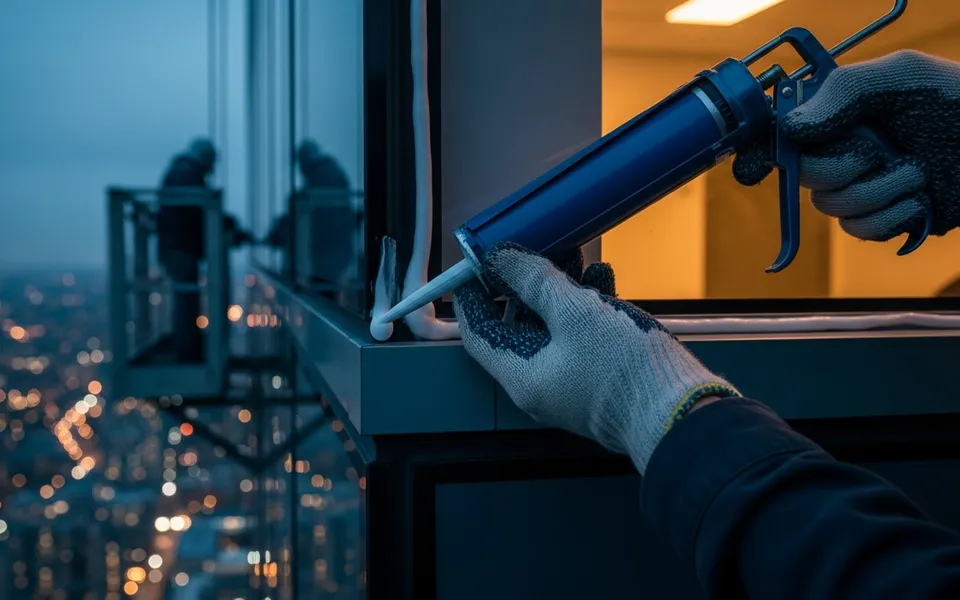
Commercial caulking and sealant replacement for Mississauga buildings.
Mississauga's freeze-thaw cycle and lakeshore salt exposure accelerate sealant failure on windows, control joints and penetrations — and failed caulking is the single most preventable source of water ingress, energy loss and interior damage on any GTA commercial building.
Port Credit and Lakeview waterfront buildings face a compounding sealant stress that inland Mississauga properties don't: lakeshore wind-driven rain and spray, high humidity from lake-effect weather patterns, and the same freeze-thaw cycling that affects all GTA buildings — but with accelerated moisture exposure during every wet-weather event. Caulking beads on south- and west-facing elevations of waterfront condos can reach the end of their service life significantly faster than the same product on a sheltered north-facing wall. The Lakeshore Rd and QEW salt corridor adds a chemical degradation factor: brine penetrates micro-cracks in aging sealant, expanding them with each freeze cycle until the bead is no longer watertight. By the time the interior paint begins to show moisture staining, the sealant failure has typically been present for two or more winters.
The Square One and Hurontario corridor's newer high-rise stock presents a different but equally important sealant challenge: curtain-wall buildings with high-performance silicone sealants require re-inspection and spot replacement on a defined cycle, not an emergency-response basis. A failed sealant bead at floor 12 of a curtain-wall building in Cooksville or Mississauga City Centre produces water tracking that can appear three floors down and two units over — making the source difficult to trace without a systematic elevation inspection. Buildings 10 or more years old in this corridor should run a documented sealant inspection and replacement program rather than waiting for leak calls.
What's included for Mississauga buildings
The scope starts with a documented elevation assessment: a Working at Heights trained technician reviews every window perimeter, door frame, control joint and penetration accessible from the exterior. Each finding is photographed with the defect clearly visible, categorized by severity — failed and immediately requiring replacement, degraded and due within this maintenance cycle, or serviceable and monitor — and compiled into a prioritized replacement list. You receive the full assessment before any replacement work begins, with no obligation to proceed through MBS if you want to price the work elsewhere.
Replacement work cuts out the failed bead completely — surface-over repairs are not part of our program, because applying new caulk over a compromised bead traps moisture and fails within one freeze-thaw season. Surfaces are prepared, primed where required by the product specification, and re-sealed with commercial-grade products matched to the substrate: silicone for curtain-wall glass joints, polyurethane for concrete control joints, modified sealants for window-to-wall transitions on masonry buildings. Before-and-after photos are taken at each location and included in the completion report alongside the defect photos from the assessment. If the elevation work reveals issues that extend beyond sealant — spalled concrete, deteriorated masonry, damaged frames — those are flagged for exterior inspections follow-up.
Freeze-thaw and lakeshore factors for Mississauga sealant life
Ontario's freeze-thaw cycling is the primary driver of sealant degradation on any GTA commercial building. Mississauga typically sees dozens of freeze-thaw cycles per winter, and the Lakeshore Rd and QEW salt corridor accelerates the process: brine infiltrates micro-cracks in aging sealant during wet conditions, and the subsequent freeze expands those cracks beyond the sealant's elasticity range. The result is a bead that appears visually intact but has lost adhesion on one or both sides and is no longer keeping water out. Post-pressure-washing — when the sealant has been cleaned but before re-sealing — is an ideal time to run a sealant assessment, because clean surfaces reveal failures that are invisible under accumulated dirt and grime.
Retirement residences in Erin Mills and Streetsville, and mid-rise buildings from the 1960s and 70s in Cooksville and Mineola, often have polyurethane or oil-based sealants that have exceeded their design service life. These buildings typically need a full perimeter replacement rather than spot repair — the sealant stock is uniformly degraded rather than discretely failed at individual locations. Planning a full-perimeter sealant replacement on one of these buildings is a budget-cycle project, not an emergency repair, and the assessment report gives the property manager and condo board the documentation to plan and approve it through the normal capital expenditure process.
Combining sealant work with other Mississauga exterior services
Caulking and sealant work is most cost-effective when it shares a site mobilization with other exterior services. Window cleaning visits that produce a photo-verified completion report routinely flag sealant failures observed from the elevation — when that report triggers a sealant replacement scope, having the crew already familiar with the building's access requirements and elevation layout reduces mobilization cost and time. Exterior painting scopes on Mississauga buildings — particularly stucco and concrete repaints on older Cooksville and Mineola mid-rises — always include full sealant assessment and replacement before coating, because applying paint over failed sealant produces premature coating failure at exactly the locations that need it most.
Buildings running a master service agreement with MBS route sealant findings directly to a replacement scope under the same account manager and the same COI, without a separate tender process. For property managers who want the full exterior picture before committing to individual scopes, the free Building Health Report delivers a prioritized, photographed condition assessment covering sealants alongside all other exterior components — giving the building board or condo corporation a ranked fix list with documented evidence rather than a contractor's verbal report.
Mississauga-specific factors
- Port Credit and Lakeview waterfront buildings face lakeshore wind-driven moisture and lake-effect humidity that accelerate sealant degradation on south- and west-facing elevations beyond typical GTA rates.
- The QEW and Lakeshore Rd salt corridor exposes bead sealants to brine infiltration during wet-weather events, expanding micro-cracks through freeze-thaw cycling until adhesion fails entirely.
- Square One and Hurontario corridor curtain-wall high-rises require systematic sealant inspection on a defined cycle — not emergency response — because failed beads on upper floors can track water to units several floors below.
- Older mid-rise buildings from the 1960s and 70s in Cooksville and Mineola often have polyurethane sealants past their service life, typically requiring full-perimeter replacement rather than spot repair.
- Retirement residences in Erin Mills and Streetsville have strict access protocols during sealant assessment and replacement work to protect residents from exterior crew activity.
Caulking & Sealants in Mississauga — questions property managers ask
How do I know if my Mississauga building's caulking has failed if there are no visible interior leaks yet?
Interior water staining is a lagging indicator — by the time it appears, the sealant has typically been failing through one or more winters. Early signs visible from the exterior include sealant beads that have pulled away from one or both sides of the joint, cracking or crazing across the bead surface, and discolouration at joint edges where moisture is tracking in. A Building Health Report or a dedicated sealant assessment from a Working at Heights trained technician identifies failures at the elevation level before they produce interior damage. This is especially relevant on Port Credit waterfront and QEW-corridor buildings where salt exposure accelerates the degradation timeline.
Can you replace sealant on a curtain-wall building in the Square One corridor?
Yes. Curtain-wall buildings require silicone sealant at glazing joints and are assessed and re-sealed using products matched to the curtain-wall system. The replacement process cuts out the existing bead, preps the substrate, applies a backer rod where required by the joint depth, and installs a fresh silicone bead tooled to profile. Before-and-after photos are taken at each location. If the assessment reveals frame or gasket issues beyond sealant scope, those are flagged for exterior inspections follow-up.
Do you surface-apply caulk over existing failed sealant to save cost?
No. Surface-over applications trap moisture between the old and new bead and fail within one freeze-thaw season — sometimes sooner on lakeshore and salt-corridor buildings. Our program cuts out the failed bead completely, preps the substrate and installs a full-depth replacement. It costs more upfront than a surface-over patch but delivers a sealant joint that performs to its full rated service life rather than requiring re-work within a year.
How do we budget for full-perimeter sealant replacement on an older Mineola or Cooksville mid-rise?
The sealant assessment report categorizes every joint as failed, degraded this cycle, or monitor — giving your board and property manager a prioritized scope with photographic evidence. This is the documentation format most condo corporations and property managers use for capital expenditure approval through their annual reserve fund process. We provide the assessment and quote at no obligation, so the board can make a fully informed budget decision before any replacement work begins. Flat-rate multi-year contracts are available for buildings that want to integrate sealant programs into their ongoing master service agreement.
Seal Mississauga's freeze-thaw damage before the next winter.
Tell us about your building. Full quote in 48 hours, guaranteed.
Serving Toronto, Mississauga, Brampton, Vaughan, Markham, Richmond Hill and the entire GTA.