
Commercial repairs and maintenance for Oakville property managers.
The punch list that piles up between capital projects — drywall patches in Uptown Core high-rise corridors, door hardware in Old Oakville waterfront condos, ceiling tile in Kerr Village offices — clears faster when one crew handles all of it in a single scheduled visit.
Oakville's commercial and multi-residential buildings generate a steady backlog of minor common-area repairs that don't warrant a full trade dispatch and fall outside the janitorial scope — drywall scuffs and holes in corridor walls, door closers that need adjustment on unit entries, bulletin board and signage repairs in amenity rooms, cracked light fixture covers, sticking hardware on service doors, and interior caulking touch-ups at unit doorframes. On a 30-storey Uptown Core condo or a Bronte waterfront mid-rise, items like these accumulate across floors faster than any single trade's scheduling allows, and the property manager's choice is typically between dispatching a separate trade for every minor fix or letting the list grow until it becomes a visible maintenance problem the board notices.
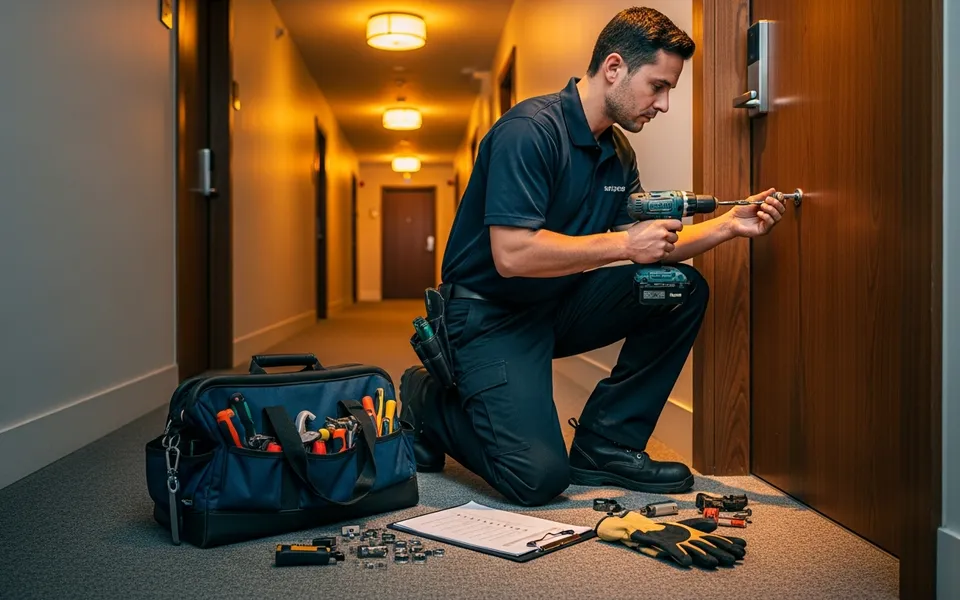
Scheduled maintenance visits that clear the full building punch list in a single mobilization are the answer most Oakville property managers eventually arrive at — but the challenge is finding a service provider who carries the full range of minor repair skills rather than specializing in a single trade. MBS maintenance visit crews are multi-skilled and equipped to handle drywall, door hardware, interior caulking, minor fixture work, signage and small carpentry on the same visit, working from a pre-submitted punch list that the property manager builds through normal day-to-day observations. The crew arrives prepared for every item on the list, not just the items that fall within a narrow trade scope, and the visit closes with a photo-verified completion report.
What's included in Oakville maintenance visits
The typical Oakville commercial building punch list includes some combination of: drywall repairs in corridors, elevator lobbies and amenity rooms (scuff removal, hole patching, skim-coat of damaged areas, spot painting to match); door hardware (closers, hinges, locksets, push plates, kick plates, magnetic hold-opens); interior caulking touch-ups at floor-wall junctions in lobbies, at unit doorframe bases, around plumbing fixture trim in common washrooms; fixture replacements (broken light fixture covers, damaged bathroom accessories in amenity washrooms, elevator cab panel repairs); bulletin board and signage mounting or replacement; and minor carpentry items like baseboard reattachment, cabinet door rehang and drawer hardware in amenity kitchens.
The scope is built from the property manager's punch list, submitted in advance of the visit. This is the system that makes multi-skill maintenance visits work: the crew prepares for every item before arriving, carries the right materials and hardware, and clears the list in one visit rather than returning multiple times for items that weren't scoped. Every visit closes with a photo-verified completion report documenting what was completed, before and after where relevant, and any items on the list that require a separate licensed trade or additional scope. The report becomes the maintenance record for your property files and supports the reserve-fund vs operating-budget distinction most boards need to see documented.
Maintenance visit cadence for different Oakville building types
The appropriate maintenance visit frequency depends on the building's age, tenant type, traffic level and how aggressively items are being added to the list. Uptown Core and Trafalgar Road high-rises with 200 or more units and steady resident turnover typically generate enough punch list items to justify monthly maintenance visits — or biweekly visits during periods of high move-in traffic or post-renovation cleanup. Old Oakville and Bronte waterfront condos generate a different but consistent load: moisture-related interior caulking touch-ups where lakefront humidity accelerates joint failure, corridor patching from constant elevator lobby traffic, and door hardware wear on units facing prevailing lake winds.
For Winston Park, Cornwall Rd and QEW industrial-flex properties, the common-area maintenance scope is smaller — shared lobby, warehouse office, common washrooms, dock door hardware, bollard paint touch-ups — but the list accumulates on the same cycle. Quarterly maintenance visits are often appropriate for these buildings, covering all accumulated items in one scheduled mobilization rather than issuing a separate work order for each minor repair. Buildings on a janitorial program with MBS have their janitorial crew feeding maintenance-flagged items into the punch list as they are observed on regular cleaning visits, so the maintenance visit arrives with a pre-populated list rather than starting from scratch each time.
Integrating repairs with other Oakville building services
Minor repairs are the connective tissue between the larger-scope building services — the items that are too small for a dedicated trade dispatch but accumulate into a significant deferred maintenance backlog if left alone. Janitorial crews identify them. Window cleaning crews flag exterior-adjacent issues. The maintenance visit crew clears them. Under a master service agreement with MBS, all three communicate through the same account manager and the same documentation system, which means findings from one service crew flow into the maintenance punch list rather than sitting in a verbal report that never gets actioned. Retirement and medical office buildings across Glen Abbey and Iroquois Ridge benefit particularly from this — grab-bar installation, handrail hardware and resident-safe scheduling are coordinated by one point of contact rather than three.
For items that grow beyond minor repair scope — a corridor drywall section that requires full replacement rather than patch repair, a door frame that has shifted and requires carpentry beyond what a maintenance visit covers, an active plumbing leak or electrical panel issue that requires a licensed trade, or an interior painting scope that follows after all the drywall repairs are done — those are escalated to a dedicated scope and quote from the same account manager. Interior painting scopes that follow on a maintenance visit are already priced against the condition the maintenance crew documented, so there are no surprises when the painter arrives to finish the surfaces. The full service catalogue is at repairs & maintenance.
Oakville-specific factors
- Uptown Core and Trafalgar Road high-rise condos generate dense common-area punch lists — plumbing accessory swaps, drywall, door hardware and elevator lobby cosmetics — that accumulate across floors faster than most single-trade dispatch cycles can address.
- Old Oakville and Bronte waterfront condos experience moisture-related interior caulking failure and corridor patching needs on a shorter cycle than inland buildings, driven by lakefront humidity and elevator lobby foot traffic from waterfront amenity use.
- Kerr Village and Cornwall Rd professional office buildings generate a consistent tenant-improvement patch-and-paint load between leases — hardware, ceiling tile and drywall punch-list items that need turnover before the next tenant walkthrough.
- Glen Abbey, West Oak Trails and Iroquois Ridge mixed-use properties generate steady post-inspection punch-list execution work after annual reserve-fund and fire-inspection reports flag minor items that fall outside licensed-trade scope.
- Winston Park and QEW industrial-flex properties generate dock door repair, bollard paint touch-ups and warehouse office punch-list items that quarterly maintenance visits address more efficiently than issuing separate work orders for each repair.
Repairs & Maintenance in Oakville — questions property managers ask
How do I submit the punch list for an MBS maintenance visit at my Oakville building?
The punch list is submitted to your account manager in advance of the scheduled visit — typically by email or through the building's service log. The list should describe each item by location (floor, room, surface) and type (drywall hole, door closer, broken fixture cover). The crew reviews the list before arriving, prepares materials and carries what is needed for each item. Items that weren't on the advance list but are discovered during the visit are either addressed if materials are on hand or added to the next visit's list with a note in the completion report. See the full process at repairs & maintenance.
Can the maintenance crew handle grab-bar installation at an Oakville retirement or medical office building?
Yes. Grab-bar installation and handrail hardware work is a standard maintenance visit item across Oakville retirement residences and medical office buildings in Glen Abbey, Iroquois Ridge and along Trafalgar Road. The crew coordinates resident-safe scheduling with the building manager — visits sequenced around meal times, activity programs and clinic hours so residents and patients are not disrupted. Substrate is verified before installation (blocking or appropriate anchors for drywall, tile or concrete), and each installation is documented in the completion report with location and hardware model for the property's health and safety file.
What items on a typical punch list fall outside the maintenance visit scope and need a licensed trade?
Plumbing beyond fixture accessory replacement (active leaks, pipe replacement, valve replacement), electrical beyond lamp and ballast swap (panel work, wiring), HVAC work, elevator machine-room work, and structural or exterior envelope repairs fall outside the standard maintenance visit scope and require a licensed electrician, plumber or specialty trade. When the maintenance crew encounters an item that falls outside their scope, it is documented in the completion report with a description of what was observed, so the property manager can dispatch the appropriate licensed trade with a clear written description rather than an undocumented verbal report.
Can MBS maintenance visits be combined with interior painting on the same Oakville mobilization?
Yes, and this is often the most efficient approach for corridor or lobby refreshes in Oakville buildings. The maintenance crew addresses drywall repairs, hardware items and caulking touch-ups first, and the interior painting crew follows after the repair work is complete and cured. Under the master service agreement, both crews are dispatched and sequenced by the same account manager under one mobilization schedule. The completion report covers both scopes, and the paint work is documented against the repaired substrates so future reserve-fund reviews have a full record.
How does MBS handle the distinction between reserve-fund and operating-budget repairs at Oakville buildings?
Every maintenance visit completion report separates items by scope and cost so the property manager can allocate them to the correct budget. Recurring minor repairs — drywall patching, door closer adjustment, caulking touch-ups, hardware replacement of items with a short life cycle — are typically operating-budget items. Larger scope items the crew identifies but doesn't address on the visit — full corridor drywall replacement, door frame carpentry, extensive lobby refresh — are documented separately for reserve-fund consideration. The report format supports the property's contact with the board at annual budget planning without requiring the manager to re-sort the items.
Clear Oakville's punch list before it becomes a deferred maintenance problem.
Tell us about your building. Full quote in 48 hours, guaranteed.
Serving Toronto, Mississauga, Brampton, Vaughan, Markham, Richmond Hill and the entire GTA.