
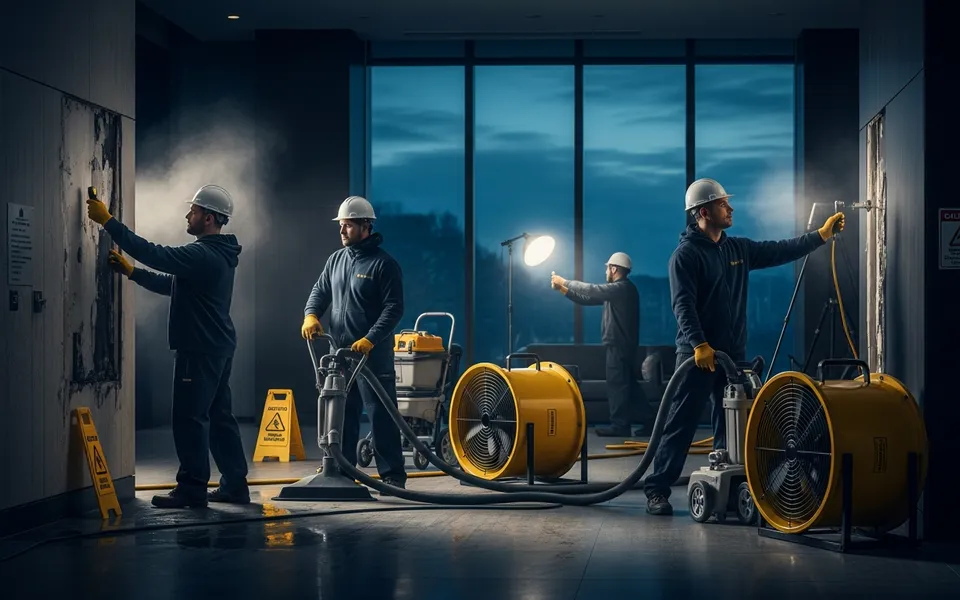
24/7 emergency & disaster recovery for Vaughan buildings.
When a pipe bursts in a VMC tower at 3 a.m. or a warehouse roof fails during a January ice storm, Master Building Services dispatches 24/7 — insured, photo-documented, and already under the same master agreement as the rest of your building.
Vaughan's inland climate creates emergency event conditions that lakeside GTA cities experience less severely. Deep-freeze events in Vaughan hit harder, hold longer, and arrive without the moderating buffer of Lake Ontario. January and February in Vaughan regularly produce overnight lows that stress building mechanical systems beyond their design assumptions — exposed water supply lines in parking garages, balcony-adjacent plumbing in VMC high-rises, and uninsulated pipe runs in older Woodbridge commercial buildings all become burst-pipe candidates in the deep-cold windows that the 400-corridor corridor experiences every winter. A single pipe failure in a high-rise stack can activate standpipes, flood mechanical rooms, and push water through four to six floor assemblies before building staff reach the shut-off. By the time a VMC building manager gets the 3 a.m. call, the damage is already multi-floor.
Vaughan's industrial corridor adds another emergency profile. Large-footprint warehouse buildings on low-slope or flat roofs in the 400 and 407 corridor can accumulate ice damming during freeze-thaw events in a way that overwhelms drainage capacity before the condition is visible from inside. The first sign of the problem is water moving through the roof membrane — which often means inventory damage or tenant equipment exposure before any building staff see the condition on the interior. Fire events in multi-tenant industrial parks spread through shared HVAC and plenum spaces with a speed that demands an immediate restoration response — not a business-day crew mobilization. For all of these scenarios, the emergency response partner's availability at the moment of the call determines the outcome. 24/7 dispatch is the baseline standard, not a premium tier.
What's included for Vaughan buildings
The 24/7 emergency service for Vaughan buildings covers flood extraction and burst-pipe response, fire and smoke remediation, mould removal, and ice dam and winter weather damage response for all building types — VMC high-rise condos, Woodbridge and Concord mid-rise residential and commercial, 400-corridor industrial-flex and warehouse, and Maple, Thornhill, and Kleinburg properties. Every emergency job opens with a documented hazard assessment before crews begin work, every visit is photo-documented throughout, and every job closes with a photo-verified completion report — ready to hand directly to your insurer, your board, or your condo corporation's records.
Because Master Building Services covers interior services including repairs and maintenance and interior painting, the follow-on work after an emergency — drywall, hardware, finish work — is coordinated by the same account manager on the same invoice. You are not hiring a second contractor to finish what the restoration crew stabilized. For Vaughan property managers overseeing the full building portfolio, that single-partner model means the incident record stays clean: one vendor, one photo-verified report, one account manager from the first call to the last coat of paint.
Vaughan's emergency season — what triggers a call
Vaughan's deep-freeze emergency window runs from late December through mid-February, with the highest-risk events concentrated in the January cold snaps that the GTA's inland areas experience with regularity. Exposed water supply lines in VMC parking garages — where the unheated parking structure drops to outdoor ambient temperatures during extended cold — are the most common source of burst-pipe events in new high-rise condo buildings. Older Woodbridge commercial buildings with uninsulated pipe runs in accessible above-ceiling spaces in exterior walls are a second high-risk profile. The moment a pipe bursts, the response timeline starts: every hour of water movement through a floor assembly before extraction begins adds to the drying time, the mould risk, and the repair scope. Same-day dispatch on the first call is the correct response — not a business-day morning estimate.
The freeze-thaw cycle that makes Vaughan's winters harder than Toronto's also creates a specific mould profile. Water that enters a wall cavity in January during a freeze event often doesn't migrate to the interior surface until March or April as temperatures rise — meaning mould remediation demand in Vaughan mid-rises and high-rises often peaks in spring, not during the winter event itself. Property managers who see water staining appearing in spring on walls that were not obviously wet in winter are often dealing with winter moisture that is now expressing. The remediation calendar for Vaughan runs later into spring than Toronto or Mississauga, and 24/7 dispatch is the right response regardless of the season.
Insurance documentation and the Vaughan building record
Vaughan condo corporations and commercial property managers operate under compliance requirements that make documentation as important as the response itself. The insurer needs a record of what happened, what was done, and what state the building was in when the work closed. The condo board needs a report it can review at the next meeting. The property management company needs an incident file that holds up to scrutiny. Master Building Services produces that record on every emergency job: a documented hazard assessment at the start, photo-documentation throughout, and a photo-verified completion report at the end. Crews are WSIB Covered and Fully Insured ($5M Liability), and the COI and WSIB clearance are on file under your master service agreement before any emergency occurs.
Emergency calls that come through your master service agreement bypass the standard quote SLA entirely. Same-day dispatch is the standard for active emergency events — floods, burst pipes, fire, smoke, and active mould situations. Your account manager is the single point of contact for updates throughout the response — coordinating with your building staff, your condo security, and the restoration crew simultaneously, so your team is not bridging between vendors while managing residents and documenting the incident. Learn more about how the master service agreement eliminates the vendor-discovery problem on your worst operational days.
Vaughan-specific factors
- Vaughan's inland deep-freeze events hit harder and hold longer than lakeside GTA cities — January cold snaps regularly push exposed parking-garage supply lines and uninsulated pipe runs in older Woodbridge buildings past their design assumptions.
- The VMC high-rise corridor's large-footprint parking garages, with sections that reach outdoor ambient temperatures in sustained cold, are a specific burst-pipe risk profile that property managers new to the Vaughan market often underestimate.
- Vaughan's freeze-thaw cycle concentrates winter moisture inside wall cavities that don't express as interior water staining until spring thaw — meaning mould remediation demand in Vaughan peaks in April and May, months after the winter event.
- 400-corridor industrial warehouses with large low-slope or flat roofs are at elevated ice-dam risk during freeze-thaw events that overwhelm drainage capacity before the condition is visible from the building interior.
Emergency & Disaster Recovery in Vaughan — questions property managers ask
How fast can you dispatch to a burst-pipe event in a VMC high-rise at 3 a.m.?
Emergency calls to Master Building Services trigger same-day dispatch — not next-business-day scheduling. For active flood events in Vaughan's VMC corridor, crews mobilize on the call. Your account manager coordinates the response and keeps your building staff and security updated throughout, so you are not managing communication between the restoration crew and the board while water is still moving through floor assemblies. WSIB Covered and Fully Insured ($5M Liability) credentials are on file before the call — there is no credentialing delay mid-crisis.
We found mould on interior walls in spring — is this a Vaughan freeze-thaw issue and can you remediate it?
Yes on both counts. Mould appearing on Vaughan interior walls in spring — after a winter with no obvious water event — is often the result of moisture that entered a wall cavity during a January or February freeze-thaw cycle and migrated to the interior surface as temperatures rose in March and April. This pattern is more common in Vaughan than in lakeside GTA cities because the inland freeze-thaw cycle drives more moisture into wall assemblies. Mould removal is covered under the emergency and disaster recovery service. Work begins with a documented hazard assessment, proceeds with full photo-documentation, and closes with a photo-verified completion report for your insurer and condo board. Follow-on drywall and finish work is coordinated by the same account manager under the same master agreement.
Can you respond to a fire or smoke event at a 400-corridor industrial building outside business hours?
Yes. Fire and smoke remediation for Vaughan industrial buildings — including 400 and 407 corridor multi-tenant industrial-flex and warehouse properties — is within the 24/7 emergency scope. Smoke from a contained kitchen or mechanical fire travels through shared HVAC and plenum spaces rapidly, and the remediation window opens immediately: delay in odour extraction compounds penetration into finished surfaces and structural materials, increasing scope and cost. Emergency calls trigger same-day dispatch at any hour. The photo-documented response record is available for your insurer and any tenant disruption documentation that the event requires.
What documentation do you produce for our insurer and condo board after a Vaughan emergency event?
Every emergency job produces three records: a documented hazard assessment completed before work begins, photo-documentation throughout the response, and a photo-verified completion report at close-out. The completion report includes the scope of work, the state of the area at handback, and the credentials of the crew on site. Crews are WSIB Covered and Fully Insured ($5M Liability), and your master service agreement keeps the COI and WSIB clearance current in your compliance file automatically — so your insurer and board have everything they need without you assembling documents after a crisis. For Vaughan condo corporations with specific board reporting requirements, we can format the completion report to match your incident documentation template.
Does the 24/7 emergency coverage include Woodbridge, Thornhill, and Kleinburg — or only the VMC area?
The 24/7 emergency response covers all of Vaughan — VMC, Woodbridge, Concord, Maple, Thornhill, and Kleinburg — as well as the full GTA including Toronto and Mississauga. Your master service agreement covers all Vaughan locations under one contract, one account manager, and one monthly invoice regardless of which part of the city your building is in. Same-day dispatch is the standard across the full service area — not just the VMC core.
Emergency line — 24/7 dispatch for Vaughan buildings.
Floods, burst pipes, fire, smoke, and mould bypass the standard quote SLA. Emergency requests get same-day dispatch. If you are setting up coverage before the next cold snap, tell us about your building and we will have you under a master service agreement before the season turns.
Serving Toronto, Mississauga, Brampton, Vaughan, Markham, Richmond Hill and the entire GTA.