
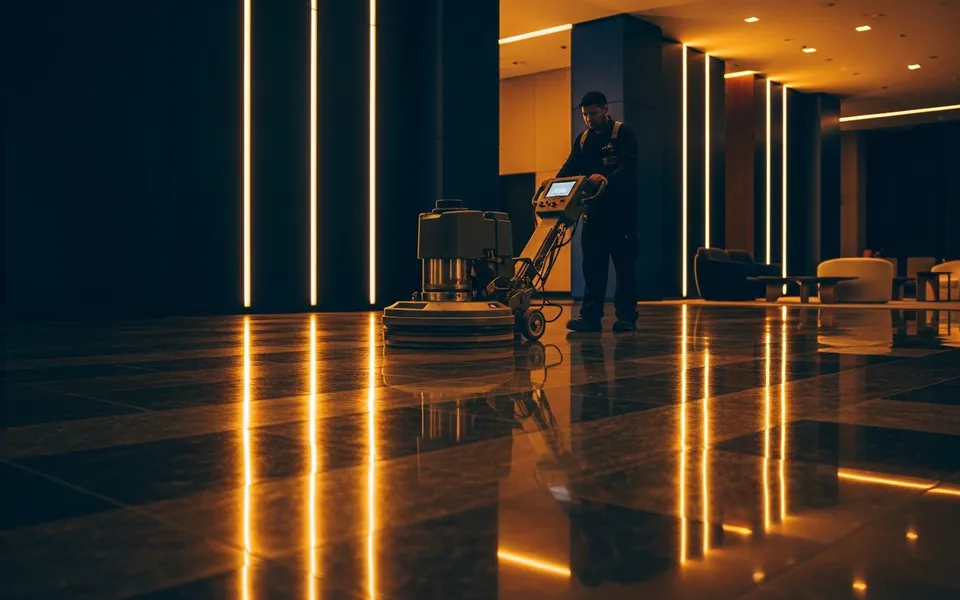
Commercial floor care for Vaughan buildings — lobby stone, VCT strip-and-wax, carpet extraction and winter matting.
Vaughan's longer salt season and harsher inland winters shorten lobby floor life faster than the GTA average — and a scheduled floor care program is the difference between a surface that meets its design life and one that needs replacement years early.
Lobby and common-area floors in Vaughan commercial buildings face a performance challenge that compounds through the winter season. Vaughan's inland location means deeper overnight lows, more freeze-thaw cycles, and a salt season that runs from early November through late March — longer than Toronto's lakeside buffer allows. Every resident entering a VMC condo lobby, every tenant arriving at a Woodbridge office building, and every worker walking into a 400-corridor industrial front office tracks in a mixture of road salt, sand, and de-icing grit that conventional entrance mats do not capture fully. Over a five-month winter, that abrasive soil load works through wax coatings on VCT tile, scratches polished stone, grinds surface fibres in carpet, and migrates across the floor plan to every high-traffic zone in the building. Without a floor care program calibrated to the Vaughan winter reality, the floor finish degrades faster than the annual budget allows for replacement.
The visual impact of a poorly maintained lobby floor is the first impression that determines whether Vaughan residents and prospects feel confident about the building they're entering — or skeptical about what the management company is doing. In the VMC corridor, where competing new condo towers are visible from every entrance and where the building's presentation directly supports unit values, the lobby floor condition is a material factor in the building's competitive position. In Woodbridge's mid-rise office market, building presentation affects tenant retention and lease renewal conversations. The floor care investment that extends a polished stone or VCT floor's effective life by three to five years is measurably less expensive than the capital replacement it defers — and significantly less disruptive to building operations.
What's included for Vaughan buildings
Floor care programs for Vaughan buildings are scoped by surface type, traffic pattern, and seasonal intensity. Standard scope includes: strip-and-wax programs for VCT and vinyl composite tile in lobbies, hallways, and common areas; stone care — honing, polishing, and crystallization — for marble, granite, and limestone lobby floors in VMC and Woodbridge prestige buildings; carpet extraction for hallway and amenity-room carpet in residential high-rises and mid-rises; concrete polishing or sealing for parking garages and industrial front offices; and winter matting programs — sourcing, placement, and maintenance — for all primary building entries during the November-to-March salt window.
Visit frequency is matched to traffic intensity and seasonal load. VMC lobby stone typically runs quarterly polishing with a more intensive restoration cycle annually. VCT hallways in residential buildings often need a strip-and-wax twice a year — spring and fall — with interim burnishing between cycles to maintain sheen. Carpet hallways in mid-rise residential buildings benefit from a hot-water extraction clean at a minimum semi-annually, with a spot-clean protocol on each janitorial visit. Programs are confirmed in the scope document and photo-verified on every visit — so the property manager has a documented record of when each surface was last serviced and what its condition was.
The Vaughan winter matting program — the most overlooked floor protection
The single most cost-effective floor protection measure for any Vaughan building with an exterior entrance is a winter matting program. Commercial entrance mats sized to capture a full three to four paces of foot travel from the entry door — not the decorative 24-inch mat that captures one step — intercept road salt, grit, and moisture before it reaches the lobby floor finish. In Vaughan's salt season, the abrasive load hitting an unprotected VMC condo lobby floor or a Woodbridge office building tile floor is substantial: mineral grit from road salt, sand from ice control, and freeze-thaw-loosened aggregate from parking areas all travel in on footwear and wheel contacts. A proper matting program reduces that load to a fraction of what reaches the floor.
Our matting program for Vaughan buildings covers mat sourcing, placement at every primary entry point, mat maintenance and swap-out through the season, and removal and storage at season-end. Mat swaps keep the mats functional — a saturated, soil-loaded mat does not capture new grit, it redistributes it. We integrate the matting program with the janitorial visit schedule so mat swap timing is not dependent on a separate service call. At the end of the salt season, mats are cleaned and stored for the following year, and the lobby floor is assessed for the level of protective stripping, cleaning, and re-finishing needed for the spring reset.
Long-term floor life and the Vaughan replacement cycle
A properly maintained VCT lobby or hallway floor can run ten to fifteen years before replacement is necessary. An improperly maintained one under Vaughan's winter conditions can reach visible end-of-life in five to seven — not from age, but from abrasive wear and delamination of the protective wax system by salt and grit. The capital cost of replacing lobby tile or stone in a VMC high-rise or a Woodbridge mid-rise is significant: the material cost is predictable, but the labour cost and building disruption — phased access to lobbies and elevators during installation, temporary flooring, resident and tenant communication — adds multiples to the project cost. A scheduled floor care program that costs a fraction of replacement per year is the correct capital decision.
For Vaughan condo boards working through reserve fund planning, the floor care program produces documented evidence of maintenance that the reserve fund planner can reference when assessing floor replacement timing. A floor on a documented strip-and-wax and polish cycle with photo-verified service records is not the same as a floor with no maintenance record — the reserve fund consequence of the difference is potentially years of replacement timeline. The floor care program coordinates with janitorial visit scheduling and repairs and maintenance for any substrate repairs needed before a reseal or wax cycle, all under the same master agreement and the same account manager.
Vaughan-specific factors
- Vaughan's five-month inland salt season is longer than Toronto's lakeside equivalent, delivering a higher cumulative abrasive load to lobby and hallway floors and shortening the effective life of wax and polish coatings without a compensating matting program.
- VMC high-rise condos in the transit-hub corridor at Jane/Highway 7 experience commuter-level pedestrian foot traffic through lobbies during peak hours, accelerating floor finish wear beyond what a standard residential building cadence accounts for.
- Woodbridge's mature mid-rise office stock includes older VCT and tile floors that have passed through multiple strip-and-wax cycles and may require restoration or substrate repair before standard maintenance programs can restore sheen to specification.
- 400-corridor industrial front offices with concrete floors often need a one-time polish or seal to bring the surface to a maintainable condition before a regular floor care program is effective — an assessment confirms the starting point.
Floor Care in Vaughan — questions property managers ask
What floor surfaces do you service in Vaughan VMC condo buildings?
We service all common-area floor types found in VMC and Vaughan condo buildings: marble, granite, and limestone lobby stone (honing, polishing, crystallization); VCT and vinyl composite tile in hallways and common areas (strip-and-wax, buffing, burnishing); carpet in hallways and amenity rooms (hot-water extraction, dry-compound cleaning); and concrete in parking garages and service areas (polishing, sealing). Winter matting programs for lobby entrances are available and recommended for all occupied residential buildings in Vaughan's salt season. Programs are scoped and priced by surface type and area.
How does Vaughan's longer salt season change the floor care program compared to Toronto buildings?
Vaughan's salt season runs roughly two to four weeks longer than Toronto's lakeside equivalent at both ends — earlier first application and later last application — which compounds the abrasive soil load on lobby and hallway floors over the full winter. We adjust Vaughan programs in two ways: a winter matting program is built into the scope as a baseline rather than an option, and strip-and-wax or polishing cycles are often set at a more frequent interval than a Toronto program to compensate for the higher grit load. The specific frequency is confirmed during scoping based on the building's traffic volume, floor type, and entry configuration.
What is a winter matting program and do we need one at our Vaughan condo?
A winter matting program for a Vaughan building covers the sourcing, placement, and maintenance of commercial-grade entrance mats sized to capture a full three to four paces of foot travel from each exterior entry door. The mats are maintained through the season — swapped out when saturated to keep them functional — and removed and stored at season end. For Vaughan buildings in the November-to-March salt window, a properly sized and maintained matting program is the most cost-effective floor protection investment available: it intercepts road salt, grit, and moisture before they reach the lobby floor finish, directly extending the life of polish, wax, and stone coatings. We integrate mat swap timing into the janitorial visit schedule so it does not require a separate service call.
How does floor care integrate with the janitorial and repairs program under one master agreement?
Floor care, janitorial, and repairs and maintenance run under the same master agreement, which means the account manager coordinates the programs together rather than as independent cycles that might conflict. Strip-and-wax is not scheduled during a hallway repaint cycle. Matting is maintained on the same visit as the janitorial clean, not a separate call. Substrate repairs — cracked or lifting VCT, loose stone, damaged carpet — are flagged by the floor care crew and addressed by the maintenance program before the next wax or polish cycle. The photo-verified completion report after every floor care visit feeds into the same building file as the janitorial and maintenance records.
Protect Vaughan's lobby floors through every salt season.
Tell us about your building. Full quote in 48 hours, guaranteed.
Serving Toronto, Mississauga, Brampton, Vaughan, Markham, Richmond Hill and the entire GTA.