
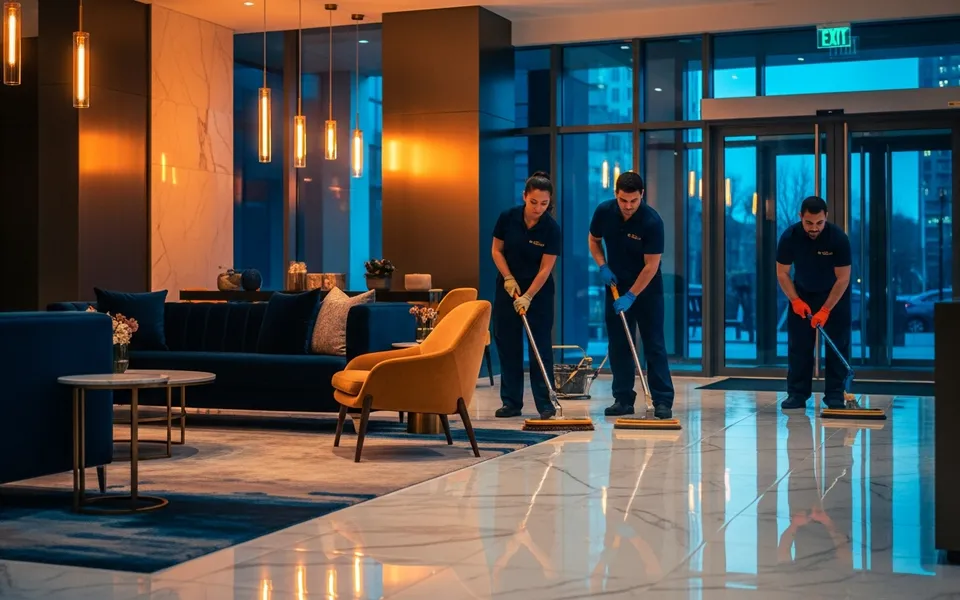
Post-construction cleaning in Toronto: rough, final, and occupancy-grade explained.
Property managers, GCs, and developers routinely treat post-construction cleaning as a single line item. It's actually three distinct phases — and the gap between them is where turnover delays live.
Quick answer
Post-construction cleaning in the GTA is three phases: rough clean during construction, final clean after trades leave, and occupancy-grade clean before tenant handover. Scoping each explicitly — with photo-verified documentation in the trade contract — closes punch lists faster and avoids the gap between GC demobilization and occupancy expectations.
Rough, final, occupancy-grade: the three phases most contracts collapse into one line
On paper, most trade contracts and property management scopes reference 'post-construction cleaning' as a single deliverable. In practice, cleaning a newly built or renovated commercial space is three sequential phases, each with distinct scope, labor loading, equipment requirements, and quality bars. When those phases collapse into one line item, the risk is straightforward: something falls into a gap, and it usually surfaces on the walk-through — the moment when everyone is trying to hand over the space to the tenant.
The three phases are rough clean (during construction, focused on debris and gross soil removal), final clean (after trades leave the space, focused on deep dust and detail cleaning), and occupancy-grade or white-glove clean (immediately before tenant handover, focused on the walk-through-ready finish). Each phase is triggered by a different milestone, priced differently, and requires different documentation. Treating them as one line item is where the scope gaps start.
For GTA property managers coordinating with a general contractor and a landlord's rep, the most useful thing to do early is separate the phases in writing. Clarify which are inside the GC's demobilization clean, which sit with the property management side, and where the handoff happens. That single act of scope clarification eliminates a category of turnover disputes before they start. For a broader look at how janitorial scope decisions cascade into building operations, this is the same principle at a smaller scale.
Phase 1: Rough clean during construction
The rough clean happens while trades are still active on site. Its purpose is not to make the space look finished — it's to remove the debris, packaging, and gross soil that accumulate during framing, drywall, mechanical rough-in, and other construction phases. Without a rough clean cycle, that debris gets walked into new finishes, embedded in freshly poured concrete, and packed into the corners where subsequent finish work has to happen.
Scope for a rough clean typically includes bulk debris removal, sweeping and shop-vacuuming of hard surfaces, removal of packaging waste, wipe-down of surfaces that are receiving next-phase work, and disposal coordination with the GC's waste management setup. Rough cleans are usually cycled — weekly, or after specific trade milestones — rather than performed once at the end of a construction phase.
In most trade contracts, the rough clean is either the GC's responsibility (via their subcontractor) or bid out separately as construction-phase cleaning. For property managers, the useful clarification is that rough cleaning is not the same as janitorial service — it does not produce a tenant-ready space. It produces a workable space for subsequent trades. If your contract references 'daily cleaning' during construction, confirm whether that means rough cleaning or a more detailed scope.
Phase 2: Final clean after trades leave
The final clean is the deep detail cleaning that happens after the last trade has demobilized and before the space is presented for pre-occupancy inspection. This is where the fine construction dust — the drywall dust, sanding dust, and airborne particulate that has settled on every horizontal surface and in every crevice — gets removed. It's also where glass, stone, and metal restoration happens: removing overspray, adhesive residue from protective films, paint splatter, and manufacturer's markings.
Scope for a final clean is substantially more involved than a rough clean. It includes HEPA-vacuuming of all surfaces including tops of door frames, light fixtures, HVAC diffusers, and window mullions; damp-wiping of all vertical and horizontal surfaces; glass cleaning inside and out including tracks and frames; hard floor cleaning with appropriate finish protection; restroom detail cleaning and fixture polishing; kitchen and millwork detail; and stainless steel and metal polishing. On a properly scoped final clean, the labor loading is high — this is the phase where the hours are.
Final cleans also require equipment that a routine janitorial crew may not carry: HEPA-filtered vacuums appropriate for construction dust, water-fed pole systems for high glass, floor equipment sized for the finish type (whether polished concrete, engineered hardwood, LVT, or stone), and PPE appropriate for the residual air quality. Scoping a final clean using a janitorial rate card without addressing the equipment requirement is a common source of underscoping.
Phase 3: Occupancy-grade / white-glove clean
The occupancy-grade clean — sometimes called a white-glove clean — is the final pass performed after the pre-occupancy walk-through and punch list, immediately before tenant handover. It is a punch-list-driven scope: the walk-through identifies fingerprints, smudges, missed spots, protective film that wasn't fully removed, and last-mile issues, and the occupancy-grade clean addresses each one. On a well-run project, this is a short, precise pass — not a full re-clean.
The occupancy-grade phase is where the standard is highest and the tolerance for issues is lowest. Tenants and their reps do the walk-through with fresh eyes and no forgiveness for construction residue. A smudge on the elevator lobby glass, adhesive haze on a storefront, dust in an HVAC diffuser directly above a workstation — any of these can hold up sign-off. The value of the occupancy-grade phase is that it exists specifically to catch and correct these before the tenant sees them.
In practice, the occupancy-grade clean is where photo-verified documentation matters most. Every punch-list item that gets addressed should be documented with a before/after photo. That documentation goes into the handover package and is what closes the item on the GC's or property manager's punch list. Without it, closeout is a memory contest between the walk-through team and the cleaner.
The scope gaps that cause turnover delays
The most common cause of a delayed turnover is not the visible scope — it's the scope that lives in the gap between phases. A handful of items surface repeatedly on walk-throughs across GTA commercial fit-outs, and each of them is scope that isn't obviously anyone's responsibility unless it's called out in writing.
HVAC vents and diffusers are the classic example. Construction dust migrates into supply and return ductwork and settles on the interior faces of diffusers and grilles. If the final clean only addresses the visible face, the first time the system runs the dust redistributes across the freshly cleaned space. Scoping should include diffuser removal and interior wipe-down, and — depending on the build — coordination with a mechanical contractor for duct cleaning before commissioning.
Ceiling plenums and above-grid areas are another gap. Drywall dust settles on ceiling tiles, T-bar grid, and the tops of light fixtures. If the scope only addresses what's visible from below, the plenum stays contaminated. Protective film residue on glass, stainless, and elevator interiors is a third: films left on too long, or removed carelessly, leave adhesive haze that requires solvent restoration, not just glass cleaning. Floor protection removal — Ram Board, kraft paper, plastic sheeting — often leaves adhesive residue on the finished floor that needs specific solvent treatment.
The pattern is consistent: these items are all technically 'cleaning' but sit outside a standard janitorial or floor care rate card. Naming them explicitly in the scope — and confirming whether they're inside the final clean or the occupancy-grade clean — is what prevents the walk-through from becoming a scope negotiation.
Documentation: the turnover clean handoff package
The single most useful deliverable a post-construction cleaning scope can produce is a photo-verified handoff package. For each phase completed — rough, final, and occupancy-grade — the package documents what was cleaned, what condition it was left in, and what punch-list items were addressed. It is what feeds directly into the GC's substantial completion documentation and the property manager's occupancy sign-off.
A properly formatted package includes a room-by-room log with completion timestamps, before/after photos of any surfaces requiring restoration (glass film removal, adhesive residue, stone or metal polishing), a punch-list closure log with corresponding photos, and the operator's checklist for the phase. On a well-run turnover, the same package format is used for all three phases, so the reader can trace what happened at each stage without cross-referencing multiple document sets. Master Building Services provides Photo-verified completion documentation formatted for direct inclusion in a property management or GC closeout package.
The documentation also matters for warranty and comeback disputes. If a tenant reports an issue in the first week of occupancy — a dusty diffuser, adhesive haze on a glass panel — the handoff package establishes what the space looked like at turnover. Without it, the question becomes a memory contest. With it, the answer is on the file. This is the same accountability logic behind vendor consolidation: documented handoffs replace verbal ones, and the whole turnover process moves faster.
For GTA property managers scoping their next fit-out or full-building turnover, the practical takeaway is to write the three phases into the trade contract separately, name the specific scope gaps (HVAC, plenum, film residue, floor protection) in the final and occupancy-grade phases, and require a photo-verified handoff package as a deliverable. That scoping discipline costs nothing to specify and saves days on the walk-through. For a scoping conversation, contact us or review our repairs and maintenance scope for adjacent turnover work.
Frequently asked questions
What's the difference between rough clean and final clean on a commercial construction project?
A rough clean happens during construction — it removes debris, packaging, and gross soil so subsequent trades can work efficiently, and is often cycled weekly. A final clean happens after all trades demobilize and is a deep detail scope: HEPA-vacuuming, glass and stone restoration, film residue removal, HVAC diffuser wipe-down, and full floor care. The two are not interchangeable, and the labor loading on a final clean is substantially higher than on a rough clean.
Is post-construction cleaning included in the GC's demobilization scope?
It depends on the contract. Most GC demobilization scopes cover the rough clean and, in some cases, a broom-clean level of final clean — but occupancy-grade cleaning and the fine detail scope (film residue, HVAC diffusers, plenum dust) is often scoped separately. The safest approach is to confirm in writing which phases sit with the GC and which sit with the property management side, so nothing falls into the gap between them.
How long before tenant occupancy should the occupancy-grade clean happen?
The occupancy-grade clean is scheduled after the pre-occupancy walk-through and punch list are complete, and immediately before tenant handover. On a well-run project the final clean produces a near-turnover-ready space, and the occupancy-grade pass is short and precise — addressing punch-list items and last-mile issues. Building in a same-day or next-day window between punch-list closeout and tenant handover is typical.
What documentation should a post-construction cleaning contractor provide at handoff?
A room-by-room completion log with timestamps, before/after photos of any restoration work (glass film removal, adhesive residue, stone or metal polishing), a punch-list closure log with corresponding photos, and the operator's checklist for each phase. The package should be formatted to drop directly into the GC's substantial completion documentation or the property manager's occupancy sign-off file — no reformatting required.
Do you carry insurance and WSIB coverage for post-construction cleaning work?
Yes. Master Building Services is WSIB Covered and Fully Insured ($5M Liability), with Working at Heights Trained crews for work at elevation. Certificates of insurance and WSIB clearance are provided as part of onboarding and are updated automatically before expiry. Additional-insured endorsements for the property owner, GC, or landlord are included on request as standard practice.
Ready to scope a turnover clean that survives the walk-through?
Tell us about your project. Full quote in 48 hours, guaranteed.
Serving Toronto, Mississauga, Brampton, Vaughan, Markham, Richmond Hill and the entire GTA.