
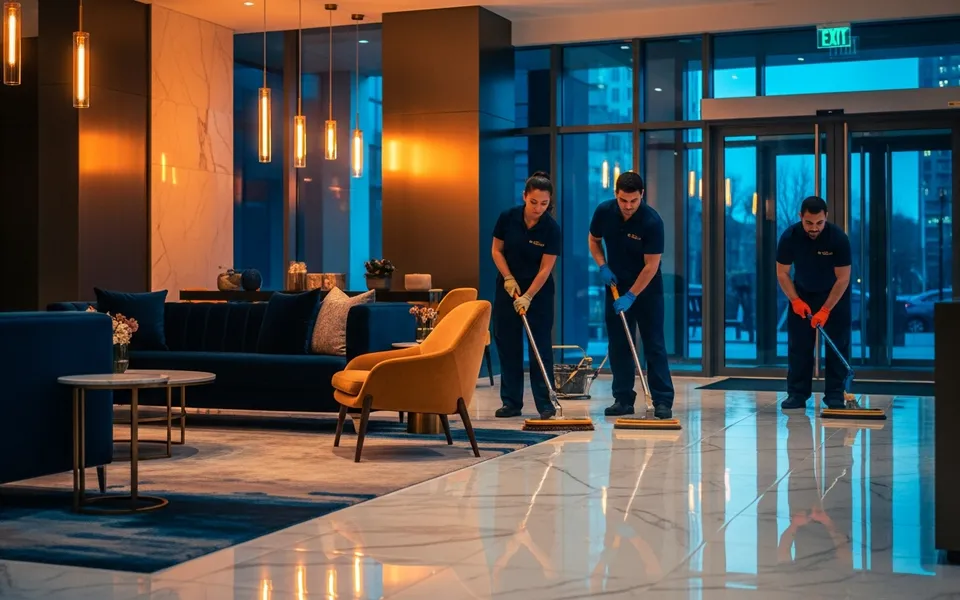
Janitorial services in Toronto: what property manager-grade scope looks like
Janitorial in Toronto for property managers — condo common areas, commercial offices, retail, retirement residences — runs on documented checklists, photo-verified completion, and SLAs that don't drift, and the difference between consumer-grade and PM-grade vendors is whether they ship those by default.
Quick answer
Property-manager-grade janitorial in Toronto means supervised crews, documented checklists, photo-verified completion, and a 48-hour quote SLA. Scope typically covers lobbies, hallways, elevators, amenity rooms, parking garages, and waste/compactor rooms. Frequency runs from three visits per week up to daily, depending on building type. Multi-year flat-rate contracts with no annual escalators beat the alternative on every capital-plan metric, and one master service agreement consolidates the COI.
What commercial cleaning and janitorial actually mean
Commercial cleaning is the broader category covering recurring janitorial work (lobbies, hallways, common areas), floor care (strip-and-wax, carpet extraction, stone polishing), specialty cleaning (window cleaning, post-construction cleanup, deep cleans), and emergency cleanup (water damage, biohazard, post-fire). Janitorial services — the term that distinguishes recurring scheduled visits from the deeper or more specialized categories — form the daily or weekly subset that keeps the building presentable and compliant between deep cleans.
For property managers, the practical distinction between commercial cleaning and janitorial matters because a vendor who calls themselves a 'commercial cleaning service' might cover only the janitorial piece, or they might cover the full scope including floor care, post-construction cleanup, and emergency response. When you issue an RFP, the scope definition is your responsibility — a well-drafted scope prevents the 'we don't do that' conversation after the contract is signed.
PM-grade commercial cleaning in Toronto distinguishes itself from residential or consumer-grade cleaning by three things that professional building service contracts treat as standard: a documented checklist for every visit (not just a verbal confirmation), photo verification of completion, and crew supervision. In a well-run janitorial program, you should never have to wonder whether the waste room was cleaned or the elevator sills were wiped — the checklist and photo log tell you, for every visit.
Property manager-grade scope: lobbies, elevators, amenities, and beyond
A standard PM-grade janitorial scope for a Toronto condominium or commercial building covers the areas that residents and tenants interact with daily. Lobbies: floor mopping or vacuuming (substrate-dependent), surface wiping, glass at entry, elevator call buttons, and waste receptacles. Hallways: floor care, baseboards, light switches, suite door handles. Elevators: floor, walls, ceiling, handrail, and full interior wipe-down. Amenity rooms: gym equipment surfaces, common room furniture, kitchen counters and appliances. Garbage and compactor rooms: floor wash, exterior bin wipe, and deodorizing.
Parking garages are part of the scope that many janitorial vendors underspec. Stairwells, elevator lobbies, and the first three rows of parking near building entry should be on the regular cleaning schedule — these are high-traffic zones that accumulate salt, tracked-in debris, and oil drips. Skipping garage cleaning is one of the most common ways a janitorial scope looks adequate on paper but falls short in practice.
Retail-mix buildings add tenant-side common area requirements that vary by lease. Office buildings often include washroom servicing on the tenant floor — restocking supplies, sanitizing fixtures, and floor mopping — as part of the building-standard cleaning obligation. For property managers with mixed-use buildings, the cleaning scope should be segmented by area type and frequency, not written as a single catch-all line item. Our janitorial service page covers the standard common-area checklist in detail, and our services overview explains how janitorial integrates with the full building service program.
Frequency: 3x/week vs daily, by building type
Cleaning frequency is one of the first scoping decisions in a janitorial RFP, and it's also one of the most commonly set incorrectly. Frequency should be driven by occupancy, traffic volume, and the building's resident profile — not by what the previous vendor was doing or what the budget line suggests.
For occupied residential condominiums in Toronto, the minimum effective frequency for lobby, elevator, and hallway cleaning is typically three times per week. Buildings with heavy move-in/move-out traffic (towers near university campuses, or those with a short-term rental mix) may need daily service to maintain an acceptable standard. High-end or luxury condos with concierge service typically specify daily cleaning of the main lobby and elevators, with three-times-weekly for upper-floor hallways.
Commercial office buildings run on a different logic: cleaning happens after hours, so frequency is less about visual appearance during the day and more about the reset that happens overnight. Standard downtown Toronto office buildings typically run Monday-to-Friday nightly cleaning, with a full-scope deep clean on weekends. Retail buildings vary dramatically by tenant mix — restaurants and food-court adjacent retail run daily deep cleans; clothing retail or professional services can often work with three-times-weekly. Retirement residences have the highest frequency requirements of any category, typically daily common-area cleaning with enhanced protocols around dining and healthcare spaces.
Photo-verified completion: what makes it different
The gap between 'cleaning was done' and 'cleaning was done to the specified standard' is where most janitorial vendor relationships eventually break down. A property manager gets a complaint from a resident about a dirty elevator sill. The vendor says the elevator was cleaned on schedule. There's no documentation either way. The dispute goes unresolved, or the PM takes the vendor's word for it. Repeat that cycle six times and you have a vendor relationship built on eroding trust.
Photo-verified completion closes that gap. After every cleaning visit, the crew generates a photo-documented checklist — the lobby floor photographed after mopping, the elevator interior photographed after wipe-down, the waste room floor photographed after washing. The checklist is delivered to the property manager within a defined window after the visit. If a task on the checklist was missed due to a blocked access point or a short-staffed visit, that's noted — not hidden. The photo record is timestamped and archived. See how the Building Health Report uses the same documentation standard for condition tracking.
For property managers who submit monthly reports to ownership or boards, photo-verified completion simplifies the reporting step significantly. Instead of describing whether cleaning happened, you're showing it. The documentation trail also provides clear evidence in the event of a dispute with a resident or board member — every visit has a record, and the record is specific, not generic. This is the difference between a PM-grade cleaning program and a consumer-grade one.
Flat-rate multi-year contracts vs annual escalators
Janitorial contracts in Toronto typically renew annually, and many single-service vendors apply CPI or cost-of-living escalators at renewal. On its face, a 3–4% annual escalator sounds reasonable. Over a three-year term, it means the cleaning line item that started at a given annual value is meaningfully higher by year three — and the board sees a different number in the capital plan than what was presented at signing.
Flat-rate multi-year contracts eliminate that drift. The price you negotiate is the price for the life of the contract — no annual escalators, no line-item additions mid-term, no renewal-time renegotiation. For property managers who present maintenance budgets to boards or ownership, the cleaning line item is a number you can defend at the five-year capital plan review. For boards reviewing the contract, flat-rate multi-year pricing is the kind of certainty that most building service vendors don't offer — because most vendors prefer the annual escalator path.
Flat-rate pricing also changes the incentive structure for the vendor. When there's no escalator mechanism, the only path to contract extension is performance. The vendor's interest aligns with yours: show up, do the work to the documented standard, and generate the photo-verified reports that make the relationship easy to defend at renewal time. Under an integrated master service agreement, the janitorial contract sits alongside the other eight services on the same flat-rate, multi-year terms — and the same accountability structure applies to all of them.
Office, retail, and retirement residence: scope differences that matter
While the core janitorial scope is similar across building types, the execution differences between a downtown commercial office tower, a retail strip mall, and a Toronto retirement residence are significant enough to change how you evaluate vendor bids.
Office cleaning runs after hours, is invisible to occupants during the day, and the quality measure is the morning-after condition — what does the office look, smell, and feel like when the first employee arrives? The scope is heavy on desk-surface wiping, washroom servicing, and kitchen/break room reset. In the hybrid-work era, office cleaning frequency often shifts mid-week based on occupancy patterns — a vendor with a flexible scheduling model handles this better than one with a fixed daily program.
Retirement residences have the most demanding janitorial requirements of any building type we work with in Toronto. Common-area cleaning at daily minimum, enhanced protocols for dining rooms and healthcare-adjacent spaces, and scent sensitivity that rules out many standard cleaning products. Floor care programs in retirement residences are also more intensive — high-traffic common areas require strip-and-wax or stone polishing programs that go beyond what standard janitorial visits cover. Property managers overseeing retirement residence portfolios should spec cleaning and floor care together rather than treating them as separate line items. Retail buildings, by contrast, typically have the most straightforward scope — entry and common-area cleaning, washrooms, and landlord-side exterior entrance management — but the tenant-by-tenant variation means the scope document needs to be specific about which zones are landlord-side obligations and which are tenant-side. For property managers who are also deciding whether to outsource cleaning or keep it in-house, why hire a commercial cleaning service for your GTA building covers the insurance, WSIB, and compliance math that drives that decision. For buildings with commercial office tenants whose needs differ from residential common areas, office cleaning in Toronto details the scheduling, scope, and SLA expectations specific to that building type.
Frequently asked questions
What is commercial cleaning?
Commercial cleaning is the broader category covering recurring janitorial (common areas, lobbies, washrooms), floor care (strip-and-wax, carpet extraction, stone polishing), specialty cleaning (window cleaning, post-construction), and emergency cleanup. Janitorial is the daily or weekly scheduled subset. For a property manager, understanding the distinction matters when writing an RFP — a vendor who advertises 'commercial cleaning' may or may not cover floor care, deep cleans, or emergency response.
What scope should a Toronto condo janitorial RFP cover?
Lobbies, hallways, elevators, amenity rooms, parking garage stairwells and elevator lobbies, and waste/compactor rooms. Each area should have a defined checklist specifying what gets cleaned, how, and how often. Minimum frequency for occupied residential condos: 3x/week for all common areas. Daily for main lobby and elevators in higher-end buildings. The RFP should also specify completion documentation requirements — documented checklists and photo-verification should be mandatory, not optional.
How is photo-verified completion delivered?
After every visit, the crew submits a photo-documented checklist to the property manager — one photo per area completed, timestamped. Reports are delivered within a defined window after the visit and archived for reference. They're formatted to drop directly into a board package or compliance file without reformatting. The Building Health Report from Master Building Services follows the same documentation format for condition assessments.
Why choose flat-rate multi-year over annual escalator contracts?
Annual escalators in janitorial contracts compound quietly — a 3% escalator across a three-year term means a meaningfully different number by year three than what was presented at signing. Flat-rate multi-year contracts lock the line item for the contract term, giving you a budget number you can defend at board reviews for years in advance. Under a master service agreement, the janitorial flat-rate sits alongside the other building services on the same terms.
Get a property manager-grade janitorial quote for your Toronto building
Tell us about your building. Full quote in 48 hours, guaranteed.
Serving Toronto, Mississauga, Brampton, Vaughan, Markham, Richmond Hill and the entire GTA.