
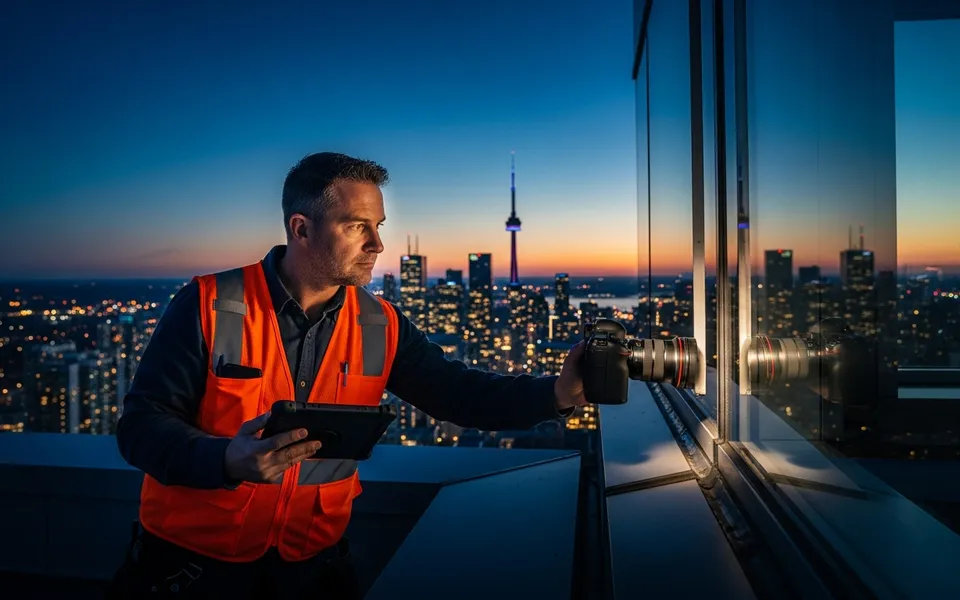
Commercial exterior inspections for Oakville property managers.
A Working at Heights trained technician on your Oakville building's facade, sealants, drainage and accessible roof areas — delivering a photo report with every finding ranked urgent, this year, or monitor, so your board can make prioritized budget decisions from documented evidence.
Oakville's building stock spans four distinct exterior inspection profiles, and the priorities on each differ materially. Uptown Core high-rise condos around Trafalgar Road and Dundas Street are hitting the five-to-ten-year first envelope inspection window when original sealant stock reaches end of service life and curtain-wall terminations, EIFS transitions and window perimeter joints need systematic elevation-by-elevation review. Old Oakville and Bronte waterfront buildings face accelerated corrosion and drainage stress from salt-air exposure on lakeshore elevations. Kerr Village, Cornwall Road and Winston Park low-rise offices need canopy, parapet and sign-anchor attention that a ground-level walkthrough will not surface. Glen Abbey, West Oak Trails and Iroquois Ridge mid-rise mixed-use buildings typically present brick and mortar joint conditions that should be documented against the reserve fund cycle rather than addressed reactively.
For Ontario condominium corporations, the Condominium Act, 1998 requires class 1 corporations to update the reserve fund study every three years, and the Condominium Authority of Ontario provides the regulatory framework property managers work within. The exterior inspection is the physical condition evidence that informs those reserve fund updates and gives boards the documented basis for prioritizing capital expenditure. Running inspections on the two natural anchor windows — post-winter, when freeze-thaw damage is fully visible, and pre-winter, before the next cycle begins — keeps the documentation cadence aligned with the reserve fund planning calendar. The free Building Health Report MBS offers qualifying Oakville properties delivers the same photo-documented, priority-ranked output as a paid inspection — request it alongside your first exterior service quote.
What's included in an Oakville exterior inspection
The inspection scope covers every accessible exterior component: facade surfaces (brick, stucco, EIFS, concrete, metal panels, curtain-wall cladding), window and door perimeter sealants, control joints and expansion joint sealants, drainage elements (scuppers, downspout connections, catch basins visible from grade or accessible roof areas), balcony railings and balcony slab edges, canopy and sign anchor points, parapet caps, and accessible flat roof areas and roof-to-wall transitions. Every finding is photographed with the defect clearly in frame — not an overview photograph, but a close-up that documents exactly what was observed. Findings are categorized as urgent (immediate risk of water ingress or structural compromise), this year (address within the current maintenance cycle) or monitor (document and reassess next inspection cycle).
The inspection report is written for a property manager or condo board audience: plain language descriptions of each finding, its location on the building, the category assigned, and the recommended follow-up scope. Where findings fall within existing MBS service capabilities — caulking and sealants, exterior painting, pressure washing, repairs — the report flags the relevant service for a quote. Where findings require structural assessment or trades outside MBS scope, the report says so clearly. You receive the full report before any follow-up work is proposed, and there is no obligation to proceed with remediation through MBS. Guidance on how to read the resulting document sits in Reading a facade inspection report as a property manager.
Inspection priorities across Oakville's building types
Uptown Core high-rise condos around Trafalgar Road and Dundas Street built in the past decade are approaching or entering the first significant envelope inspection window. Original curtain-wall sealants, EIFS terminations at slab edges and parapets, and window perimeter joints installed at construction are reaching the end of their service life on a predictable curve. Systematic elevation-by-elevation inspection at this stage catches sealant adhesion loss, EIFS termination separation and drainage detail failures before they produce interior damage. Old Oakville and Bronte waterfront buildings warrant annual inspection because salt-air exposure on lakeshore elevations accelerates corrosion at metal terminations, anchor points and drainage components, and freeze-thaw cycling on wetted lake-facing walls degrades mortar joints faster than inland properties. The typical spring inspection on a waterfront building surfaces a different finding set than the same visit on a Glen Abbey property a few kilometres inland.
Kerr Village, Cornwall Road and Winston Park low-rise office buildings often have inspection priorities that are invisible from a routine ground walkthrough: canopy connection points, parapet cap fasteners, sign anchor conditions and rooftop unit penetration flashings. These are the components that produce sudden liability exposure — a loose canopy fastener, a failed sign anchor — but are easy to miss without elevation access. Glen Abbey, West Oak Trails and Iroquois Ridge mid-rise mixed-use buildings, many of them brick and mortar construction, benefit from a systematic mortar joint audit that documents current condition against the reserve fund update cycle. The findings feed directly into capital planning rather than sitting as reactive repair line items. The pattern of unbudgeted findings this process typically surfaces is documented in The spring facade walk: five findings that were not in the budget.
From inspection findings to an actionable Oakville repair plan
The inspection report is the starting point, not the end point. For property managers responsible to a condo board or REIT ownership, the photo-documented finding with a priority ranking is the evidence required to approve repair spending through the standard capital expenditure process. Board presentations and reserve fund updates that include actual photographic documentation of defects — rather than verbal contractor reports — consistently move through approval faster, because the board can see the evidence rather than assess a verbal claim. For 16 Mile Creek and Bronte Creek watershed properties, drainage findings carry particular weight: any observation that ties into stormwater conveyance connects to conservation authority sensitivities that boards need to understand.
For Oakville buildings running a master service agreement with MBS, findings from an inspection flow directly into a remediation quote under the same agreement, without requiring a new tender. Urgent findings — active sealant failures, drainage blockage, visible spalling at vulnerable locations — are quoted within 48 hours of the inspection report delivery. This year and monitor findings are incorporated into the annual service plan so nothing falls off the list between inspection cycles. The One Building. One Partner. model means the account manager who received the inspection report is the same person coordinating the remediation scope — no communication gap between the inspection team and the repair team.
Oakville-specific factors
- Uptown Core high-rise condos around Trafalgar Road and Dundas Street built in the past five to ten years are entering the first significant envelope inspection window where original sealants, EIFS terminations and curtain-wall joints need systematic review.
- Old Oakville and Bronte waterfront buildings face salt-air corrosion at metal terminations and accelerated mortar degradation on lakeshore elevations, making annual inspection a maintenance necessity rather than a recommendation.
- Kerr Village, Cornwall Road and Winston Park low-rise offices frequently present canopy connections, parapet cap fasteners and sign anchor conditions that only elevation access can properly document before they become liability issues.
- Glen Abbey, West Oak Trails and Iroquois Ridge mid-rise mixed-use brick and mortar buildings benefit from systematic joint audits timed to the three-year reserve fund update cycle required of Ontario class 1 condo corporations.
- Properties draining into the 16 Mile Creek or Bronte Creek watersheds warrant careful drainage inspection because any stormwater conveyance issue carries conservation authority sensitivities the board needs on the record.
Exterior Inspections in Oakville — questions property managers ask
What is the difference between the free Building Health Report and a paid exterior inspection?
The free Building Health Report covers a qualifying building's exterior and interior condition in a single photo-documented review, with a prioritized fix list covering both envelope and common-area interior observations. A paid exterior inspection is the same exterior-focused methodology applied to a building that may be outside the qualifying scope for the complimentary report, or where the property manager needs the inspection tied to a specific scope — a pre-purchase condition review, a pre-painting substrate assessment, or a post-winter sealant audit. Both deliver the same photo-documented, ranked-findings format. Ask about the Building Health Report when you request your first quote — many Oakville buildings qualify.
When should an Oakville building schedule exterior inspections through the year?
The two anchor inspection windows on an Oakville building are post-winter — typically April or May, once the freeze-thaw damage is fully visible on the facade — and pre-winter, typically September or early October, before the next cycle begins. The post-winter inspection surfaces any sealant failures, mortar joint damage, drainage blockage and coating degradation that developed over the winter. The pre-winter inspection catches outstanding conditions before they compound through another freeze-thaw season. For Old Oakville and Bronte waterfront buildings, running both cycles is the appropriate cadence. For inland Uptown Core, Glen Abbey and Iroquois Ridge properties, one thorough annual inspection is often sufficient, timed to whichever window aligns with the reserve fund update calendar.
Can an exterior inspection satisfy our condo corporation's reserve fund study requirements?
The MBS exterior inspection report — photo-documented, categorized by priority and covering all accessible exterior components — provides the condition evidence that informs reserve fund planning and capital expenditure budgeting. It is not a licensed engineering reserve fund study under the Condominium Act, 1998, but it complements one: it provides the current physical condition documentation that a reserve fund planner or engineer needs as their starting point, and it updates condition records between the formal three-year engineering study cycles Ontario class 1 corporations are required to run.
What happens after the inspection report if we want to proceed with repairs through MBS?
Findings from the inspection that fall within MBS service capabilities are quoted within 48 hours of the report delivery. Urgent findings are prioritized and can typically be scheduled within the same maintenance season as the inspection. This year findings are incorporated into the annual service plan. All remediation work runs under the same master service agreement, the same COI and the same account manager who coordinated the inspection — no re-tendering, no new insurance paperwork, no separate mobilization coordination. Every remediation is delivered with photo-verified completion documentation so the board sees the closing evidence, not just the opening report.
How do inspections coordinate with other Oakville exterior maintenance services?
The spring inspection is the ideal mobilization to pair with other exterior scopes. Findings drawn from the inspection can feed directly into the same season's caulking and sealants and exterior painting scheduling, and the pre-inspection walkthrough can be combined with a pressure washing or window cleaning mobilization so a single site visit covers multiple deliverables. For buildings on the master service agreement, this consolidation is the operational core of the One Building. One Partner. model — one crew mobilization producing an inspection report and executing planned work on the same visit.
Document your Oakville building's condition before the next repair season.
Tell us about your building. Full quote in 48 hours, guaranteed.
Serving Toronto, Mississauga, Brampton, Vaughan, Markham, Richmond Hill and the entire GTA.