
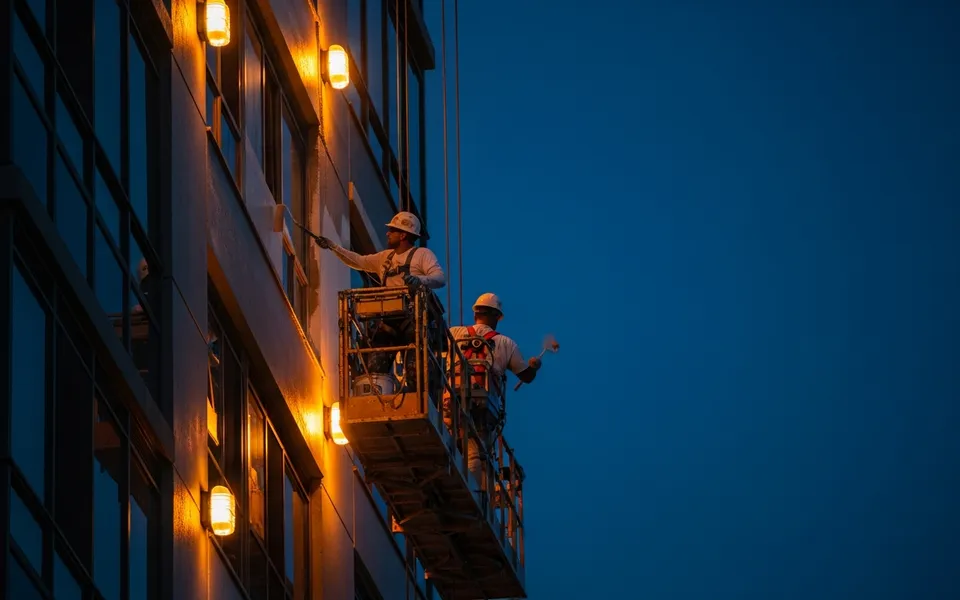
Commercial exterior painting for Oakville property managers.
Uptown Core high-rise condos, Old Oakville and Bronte waterfront trim, Kerr Village storefronts, and Winston Park industrial steel siding all share one reality: exterior coatings exposed to lake-effect UV, salt air and freeze-thaw eventually need real prep, real product and a photo-verified result.
Oakville's commercial building stock breaks into four or five distinct substrate profiles across its neighbourhoods, and each one responds differently to the town's exterior paint environment. The first-generation Uptown Core towers around Trafalgar and Dundas are predominantly EIFS panel and precast concrete construction that is now hitting the 8 to 12 year mark on original coatings — the point at which EIFS mesh joints, sealant interfaces and precast panel edges start to telegraph through the finish coat and require proper substrate remediation before any repaint scope. The Kerr Village and Cornwall Rd professional office corridors carry a mix of mid-rise storefront trim, aluminum curtain-wall components and painted brick that ages very differently from panel-clad new construction. Glen Abbey and West Oak Trails include coordinated mid-rise mixed-use and retail plaza work where HOA-style colour standards and elevation-by-elevation consistency drive the scope more than the substrate alone.
The Lake Ontario shoreline through Old Oakville and Bronte is the single biggest driver of coating service life on south- and west-facing elevations. UV load combined with salt-laden air degrades paint film faster than inland exposure — coastal-style trim wear, chalking at raised-panel edges and adhesion failure at substrate transitions all show up years earlier on waterfront and near-shore buildings than on comparable buildings north of the QEW. The 16 Mile Creek and Bronte Creek watersheds add a second constraint: product scoping has to account for VOC content and runoff, particularly on scopes that involve pressure-wash prep in proximity to the creeks. Surface preparation — cleaning, sealant replacement before coating, and the right primer matched to EIFS, brick, precast or steel — accounts for roughly 80% of a coating's service life, and on waterfront-adjacent buildings it is where the entire scope has to start.
What's included for Oakville buildings
Every exterior painting project starts with a scope assessment: the substrate type and condition, existing coating layers, sealant condition at every transition point, and any spall, delamination, EIFS impact damage or panel-edge degradation that needs remediation before coating. Failed sealant beads are replaced before the first coat of paint goes on — applying elastomeric coating over compromised sealant produces premature failure at exactly the locations that need the most protection. Surface preparation on EIFS and precast panel buildings includes cleaning, mesh and basecoat patching where required, and a primer coat appropriate to the substrate. Aluminum curtain-wall trim and steel siding on Winston Park and QEW industrial-flex buildings are cleaned, primed with a rust-inhibiting primer, and top-coated with a product specified for the exposure and finish requirement.
Colour matching to the building's existing standard is part of every scope. Oakville condo corporations, HOA-managed plazas and professional office buildings typically have a documented colour standard for exterior surfaces, and we work from that specification — whether it is a paint manufacturer's formula number or a physical colour sample. If the colour standard has not been documented, we produce a match sample from the existing coating before committing to production quantities. All work is photo-verified: pre-paint substrate condition, sealant replacement locations, primer application, and finished coat — the full sequence is documented and included in the completion report for your building records.
EIFS, precast and brick coatings on Oakville's Uptown Core and Old Oakville buildings
The first-generation EIFS and precast panel towers built through the Uptown Core in the early-to-mid 2000s are now at the point in the maintenance cycle where the original coating system is losing its ability to bridge mesh joints and panel-edge movement. A proper scope on these buildings includes inspection of the EIFS basecoat and mesh at panel edges, patch repair of impact damage, sealant renewal at panel-to-panel and panel-to-window transitions, and a primer selection matched to the specific finish coat being applied. Precast concrete panels on the same corridor need spall patching and consolidation before coating, and elastomeric product selection matched to the panel movement being observed on the elevation.
Painted brick and mortar on Old Oakville, Kerr Village and Cornwall Rd buildings present a different challenge: breathable coating systems that allow water vapour to escape while resisting rain penetration, applied over substrates that may have absorbed decades of previous coatings. Under-applied elastomeric or the wrong product class on breathable masonry produces blistering within one or two freeze-thaw seasons. The completion documentation for every Oakville repaint includes a record of primer application and finish coat thickness verification so you have documented evidence that the coating was applied to specification. If the painting scope reveals sealant failures or masonry issues that extend beyond the coating scope, those are flagged for caulking and sealants or exterior inspections under the same agreement.
Managing exterior painting projects around Oakville building operations
Exterior painting on occupied Oakville commercial and residential buildings requires scheduling that minimizes disruption to tenants and building operations. Swing-stage and rope-access work on Uptown Core high-rises is coordinated with the building's concierge and property management before any crew arrives on site. Kerr Village and Cornwall Rd professional offices have specific protocols around client-facing storefront hours and signage that we plan against on every visit — paint fumes, VOC content and scaffold proximity to entrances are all managed to the building's requirements. Coordinated repaint programs across Glen Abbey and West Oak Trails plazas are sequenced elevation by elevation to keep tenant visibility and access intact through the project.
Buildings running exterior painting under a master service agreement with MBS have the advantage of a shared access history: the account manager already knows the building's access constraints, the key contact at the property management office, and the documentation requirements for board approval. For buildings where the painting scope is being planned alongside other exterior work — caulking replacement, wash-down prep to clean the substrate, or a façade inspection to identify all defects before the painting budget is finalized — all of those scopes are coordinated under one agreement and one timeline, with product scoping tuned to health and environmental constraints around the 16 Mile and Bronte Creek watersheds.
Oakville-specific factors
- Lake Ontario shoreline exposure through Old Oakville and Bronte accelerates UV degradation, chalking and coating adhesion failure on south- and west-facing elevations well ahead of inland buildings.
- First-generation Uptown Core EIFS and precast panel towers around Trafalgar and Dundas are hitting the 8 to 12 year repaint cycle where mesh joints, panel edges and sealant interfaces require substrate remediation before coating.
- Painted brick and mortar on Old Oakville, Kerr Village and Cornwall Rd buildings need breathable coating systems and primer selection matched to decades of accumulated paint history to avoid blistering.
- Winston Park and QEW industrial-flex buildings require rust-inhibiting primers and coating systems specified for steel siding, dock doors and canopy metal exposed to salt spray and heavy service traffic.
- The 16 Mile Creek and Bronte Creek watersheds constrain product scoping and pressure-wash prep on nearby buildings, driving VOC selection and runoff-management decisions that have to be planned before mobilization.
Exterior Painting in Oakville — questions property managers ask
How long should exterior paint last on an Oakville waterfront or near-shore building?
A properly prepared and applied elastomeric coating on a lake-facing Oakville building typically delivers 6 to 8 years of serviceable life on directly exposed elevations — somewhat shorter than the 8 to 10 years achievable on sheltered north-facing walls or buildings north of the QEW. Surface preparation is the primary variable: buildings where failing sealant is replaced before coating, EIFS mesh joints and panel edges are properly remediated, and the substrate is primed with the correct product consistently outperform buildings where new paint is applied over inadequate prep. We document the full prep and application sequence so you have evidence of what was done if adhesion questions arise later.
Do you colour-match to our building's existing exterior paint standard?
Yes. We work from a documented formula number, chip sample or physical colour match before any production paint is ordered. Oakville condo corporations, HOA-managed plazas and professional office buildings often have a colour standard on file with the property manager or in the building's maintenance records — if yours does not, we pull a sample from the existing coating and produce a match for board approval before proceeding. Colour verification is part of the completion documentation.
Does exterior painting scope include sealant replacement at window, panel and door perimeters?
Yes. Failed sealant is replaced before the first coat of paint goes on — this is a non-negotiable part of the prep sequence, not an optional add-on. Applying elastomeric or any other coating over compromised sealant produces early failure at the joint, allowing water ingress directly under the new coating. On EIFS and precast panel buildings this is especially critical at panel-to-panel and panel-to-window transitions. If the scope reveals sealant conditions beyond what the painting prep budget covers, we flag those for a separate caulking and sealants scope and quote before the painting work begins.
Can you scope exterior painting near the 16 Mile Creek or Bronte Creek watersheds without runoff and VOC issues?
Yes. Buildings in proximity to the 16 Mile Creek and Bronte Creek watersheds are scoped with VOC content and runoff management planned before mobilization. Low-VOC coating systems are used where product performance allows, pressure-wash prep is contained and directed away from storm inlets and watercourses, and the product data sheets and application methodology are documented for the property manager's records. We review the specific site conditions before scope is finalized and confirm the approach in writing before any crew mobilization.
Restore Oakville's lake-weathered facades before the next season.
Tell us about your building. Full quote in 48 hours, guaranteed.
Serving Toronto, Mississauga, Brampton, Vaughan, Markham, Richmond Hill and the entire GTA.