
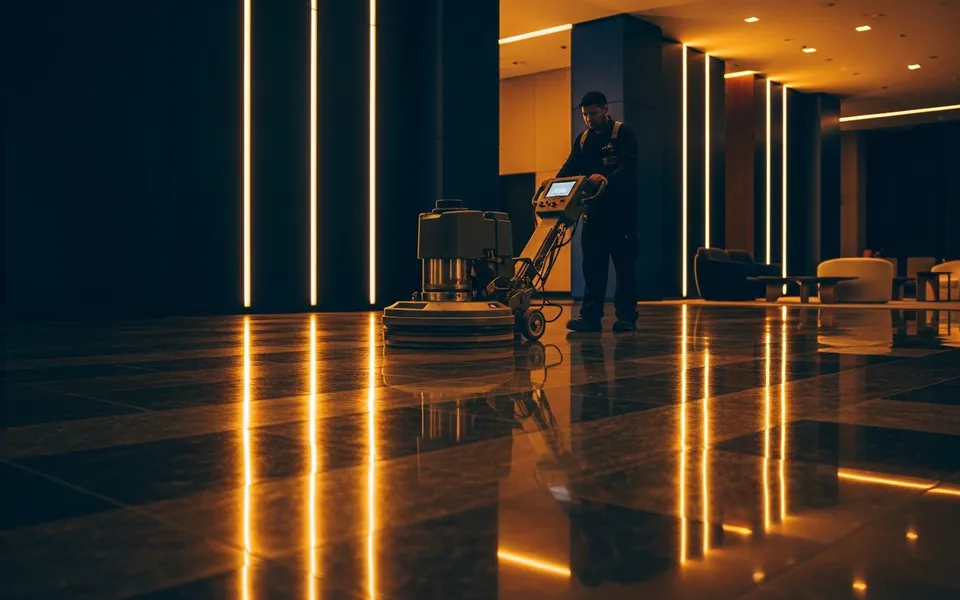
Toronto Lobby Floor Care: Salt Season, Strip-and-Wax, and Winter Matting on One Scheduled Program
Toronto's road salt destroys lobby floors from November to April — Master Building Services runs strip-and-wax, carpet extraction, stone polishing, and winter matting programs for Toronto buildings that extend replacement cycles by years and coordinate with your janitorial schedule.
No GTA city takes more punishment on lobby floors than Toronto. From November to late March, road salt, liquid deicer, and freeze-thaw slush cross every building threshold on boots, delivery carts, and stroller wheels. Toronto applies salt aggressively on its sidewalks and roadways — more so than many neighbouring municipalities — and that salt rides directly into lobbies, elevator vestibules, and main-floor corridors. Salt residue is corrosive: it eats floor finish, bleaches grout lines, dulls stone, and embeds into carpet fibres at entrance mats and carpeted corridors. A lobby that runs a standard cleaning program without a coordinated floor restoration program is losing years off its replacement cycle with every winter that passes.
Master Building Services runs scheduled floor care programs for Toronto buildings — strip-and-wax cycles calibrated to the salt season, winter matting programs installed before the first storm and removed after the last melt, carpet extraction timed for the spring recovery window, and stone and concrete polishing that restores what the freeze-thaw cycle took off. Every program runs under one master service agreement with one COI, one WSIB clearance, and one monthly invoice. Paired with a janitorial program, it gives Toronto lobbies the combination they actually need: daily cleaning that holds the standard, and scheduled restoration that reverses the damage.
What's included for Toronto buildings
Toronto floor care programs cover four core services, each scheduled around the building's calendar and Toronto's seasonal cycle. Strip-and-wax programs for resilient flooring — vinyl composite tile, luxury vinyl plank, sheet goods — are timed in cycles matched to traffic volume and the salt load each winter leaves behind. A light-traffic lobby strip-and-wax cycle runs annually; a Financial District office building lobby or a Yorkville high-rise that sees hundreds of boot crossings per day may need two cycles annually, with burnishing passes between. Carpet extraction covers carpeted corridors, entrance mats, and common-area rugs, pulling the embedded salt and grit out of the fibre that vacuuming never reaches. Stone and concrete polishing restores the surface luster on granite, terrazzo, marble, and polished concrete lobbies that freeze-thaw and salt have taken the shine off. Winter matting is the prevention layer: high-absorbency commercial matting installed at every entry point before the first salt of the season captures the salt load at the door instead of letting it travel across the floor.
All floor care work is scheduled in advance, worked in sections, and completed with a photo-verified report. Lobbies stay open throughout. No booking is confirmed without your sign-off on timing. Between visits, questions go to one account manager who responds within two business hours. Where the floor inspection surfaces adjacent damage — scuffed walls, failing base transitions, damaged base cove — it feeds into a repairs and maintenance visit or an interior painting touch-up under the same agreement.
The Toronto salt season program — November through April
The Toronto salt season sets the floor care schedule more than any other factor. The program has two halves. The fall half runs before the first salt of the season: matting is installed, strip-and-wax is completed on resilient floors while the surface is clean, and the extraction visit pulls the summer's embedded dust and traffic from carpeted areas so they head into winter at full capacity. Getting ahead of the season is what separates a floor care program that preserves the surface from one that reacts to damage already done.
The spring half runs after the last significant melt — typically late March to early April in Toronto. Matting comes out, extraction removes the winter's salt-load from carpet fibres, and resilient floors get assessed for whether a fresh strip-and-wax cycle or a burnishing pass is needed. Stone and polished concrete lobbies get a polishing pass to restore the finish the freeze-thaw cycle degraded. Coordinating this with the janitorial schedule means the cleaning crew is not mopping over a floor that needs restoration, and the floor care crew is not arriving to find a surface that has not been maintained since the last visit. The account manager holds both schedules, so the programs do not work against each other.
Winter matting programs and capital plan impact
Winter matting is the most cost-effective line in a Toronto floor care program. Commercial-grade matting installed before salt season captures a substantial fraction of the salt load at the entrance rather than allowing it to distribute across the lobby floor. The matting takes the damage that the floor finish would otherwise absorb, and it is replaced on a cycle rather than triggering an early floor replacement. For Toronto high-rises with polished stone or high-end resilient flooring in the lobby, the math is straightforward: a matting program that costs a fraction of a floor replacement per year defers that replacement by years on the capital plan.
The capital plan impact of a scheduled floor care program extends beyond matting. Strip-and-wax cycles on resilient flooring prevent the substrate from being reached, and stone polishing prevents the micro-scratches that accumulate into permanent surface degradation. Toronto buildings that defer floor care typically discover the cost at a capital plan renewal: a lobby floor that should have had five more years needs replacement now because the finish was never restored after the seasons that eroded it. The free Building Health Report includes a photo-documented walk-through of your interior common areas that puts your floor condition in the same prioritized format — urgent, this year, monitor — as the rest of your building's needs. Pair floor care with our other Toronto building services under one master agreement.
Toronto-specific factors
- Toronto's salt season (November–April) is the primary driver of lobby floor degradation — road salt eats finish, dulls stone, and embeds into carpet fibres faster than regular cleaning can counteract
- Winter matting installed before the first salt storm captures the corrosive load at the entrance threshold rather than letting it distribute across the lobby floor
- Spring recovery — carpet extraction, strip-and-wax, and stone polishing — restores what five months of freeze-thaw and salt traffic removed, with spring as the right booking window
- Toronto high-rise lobbies in Yorkville, the Financial District, and the Yonge corridor see daily boot and cart traffic volumes that shorten strip-and-wax cycles compared with lower-density suburban building stock
Floor Care in Toronto — questions property managers ask
When should we book winter matting for a Toronto building?
In the fall, before the first significant salt application reaches your entrances — typically before mid-November in Toronto. Matting installed after the first salt event is already reacting to damage rather than preventing it. The fall window also pairs naturally with a pre-winter strip-and-wax on resilient floors and a carpet extraction pass, so every surface heads into the salt season at full capacity.
How does strip-and-wax work in a Toronto lobby that cannot be closed?
Strip-and-wax is scheduled in sections so entrances and pedestrian routes stay open throughout. We book the timing with you in advance — nothing is confirmed until you have signed off — and we work in sections that keep residents moving through the lobby without encountering a wet floor or a blocked entrance. Large lobbies in Financial District towers or Yonge corridor condos are typically done across two to three sessions, each covering a section of the floor.
Which floor types does your Toronto floor care program cover?
Strip-and-wax covers resilient flooring (vinyl composite tile, luxury vinyl plank, sheet goods). Stone and concrete polishing covers granite, terrazzo, marble, and polished concrete. Carpet extraction covers carpeted corridors, entrance matting, and common-area rugs. If a floor is past restoration, the photo report will say so directly — we do not sell care that will not hold.
How does coordinating floor care with janitorial improve outcomes for Toronto buildings?
A janitorial program holds the day-to-day standard between floor care visits — cleaning that keeps salt from sitting and compounding between restoration passes. A floor care program restores the surface that daily cleaning cannot recover. The two programs running on the same agreement, coordinated by the same account manager, mean the janitorial crew is not mopping over a floor that needs strip-and-wax, and the floor care crew is not arriving to find a surface in worse condition than expected because maintenance lapsed.
How do I get a floor care quote for a Toronto building?
Tell us about your building — floor types, square footage of lobby and common areas, and any specific concerns about current condition — and a quote comes back in 48 hours, guaranteed. If you want a photo-documented baseline before committing to a program, the free Building Health Report walks your interior common areas and delivers a prioritized fix list that includes your floor condition. You keep the report regardless of whether you hire us.
Protect Toronto's lobby floors before salt season starts
Tell us about your building. Full quote in 48 hours, guaranteed.
Serving Toronto, Mississauga, Brampton, Vaughan, Markham, Richmond Hill and the entire GTA.