
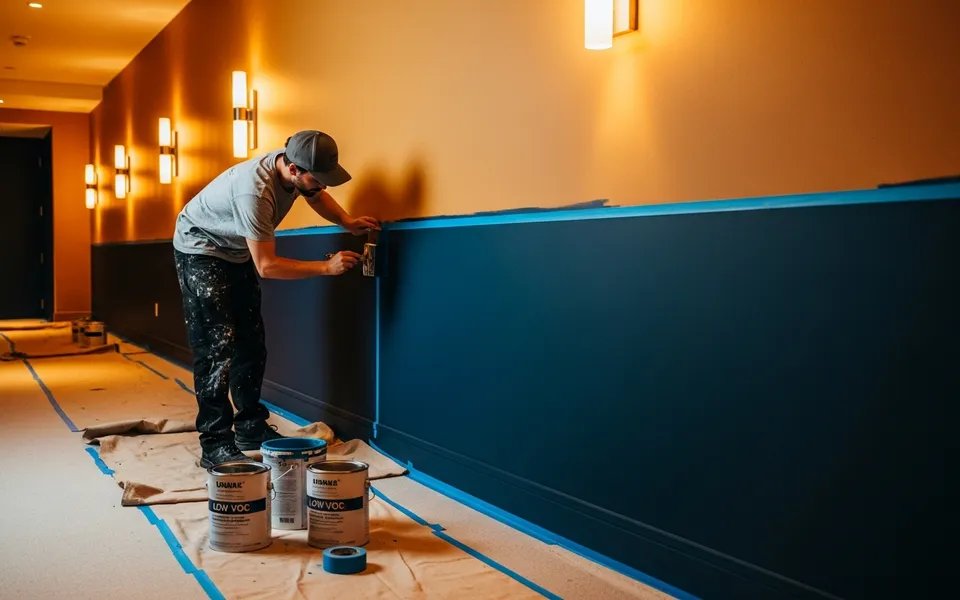
Interior Painting for Toronto Buildings: Hallways, Unit Turns, and Garage Lines on Your Schedule
Toronto condos and commercial buildings need interior painting that works around residents and tenants — low-VOC products, evening and weekend crews, and photo-verified completion delivered under one flat-rate contract alongside the rest of your building services.
Toronto's residential building stock runs on a tenant turnover calendar that concentrates painting work into predictable, compressed windows. September 1 and January 1 are the heaviest lease-end dates across the city — a single building can see dozens of suite turns in the same week, each requiring fresh paint before a new resident takes possession. At the same time, hallway refresh cycles, lobby accent updates, and garage line repainting follow their own schedules driven by condo board approvals, capital plans, and the wear patterns that Toronto winters accelerate. Managing that painting workload through multiple vendors, on staggered timelines and invoices, creates more coordination overhead than the work itself warrants.
The Interior Painting & Refresh program from Master Building Services is built for Toronto's high-density residential and commercial building environment. Low-VOC products keep suites and hallways re-occupiable quickly, which matters in a building where a resident wants to move in on the first and cannot wait five days for paint to off-gas. Evening and weekend scheduling keeps painting out of peak-traffic windows without forcing residents to navigate wet paint on a Wednesday morning. Every project closes with a photo-verified completion report, and all painting work runs under the same master service agreement as janitorial, repairs and maintenance, and floor care.
What's included for Toronto buildings
The interior painting scope for Toronto buildings spans four recurring categories. Hallway and corridor repaints are typically driven by a two-to-five-year refresh cycle on the capital plan, coordinated around the building's schedule so residents always have access. Unit turnover painting runs on demand — a suite turns over, the painting crew follows the departing tenant out and finishes before the new resident's key date. Lobby and amenity accent updates are often tied to board-approved refresh projects, where colour and finish changes happen floor by floor across a larger program. Parking garage line repainting is a spring-window project, scheduled after the winter salt load has been removed, repainting traffic lanes, numbered stalls, fire lanes, and directional markings so they are clearly visible and compliant.
All interior painting uses low-VOC products by default for Toronto residential work. High-density residential buildings typically have ventilation constraints — suites share return-air systems, hallways connect to common exhaust — and low-VOC paint eliminates the odour complaints that follow a traditional paint project. For commercial office repaints in buildings like those on Bay Street or in the Financial District, product selection is matched to the occupancy type and ventilation, and work is scheduled in phases so the occupied floors stay operational throughout.
Unit turnover painting in Toronto's rental and condo market
Toronto's September 1 and January 1 lease turnover dates create a predictable surge in unit painting demand that catches unprepared property managers short. A building that manages 20 or 30 suite turns in the same two-week window — each requiring walls, ceilings, trim, and closets — needs a painting partner who can mobilize crews at scale and hold a consistent standard across units without individual supervision from the property manager. The program is built for that cadence: painters work through a documented scope for each suite, photo-verify completion, and hand off to the incoming resident's key date.
Suite turnover painting in Toronto also requires navigating building access rules: elevator booking windows, freight elevator hours, no-move-in restrictions on weekends in some buildings, and parking provisions for trades. Master Building Services operates across the GTA and is familiar with the access protocols that vary building by building. For buildings that see turn work alongside hallway scuffing and door hardware issues from move traffic, repairs and maintenance visits handle the punch list that painting alone does not cover.
Hallway refresh programs and garage line repainting
Hallway repaints in Toronto high-rise buildings are capital projects that require board approval, colour sign-off, and scheduling across multiple floors without closing the building. Programs are typically phased by floor, working from the top down or in blocks to minimize disruption at any one time. Crews work evenings and weekends to keep painting out of the windows when residents are moving in and out of suites. Where hallway walls have scuffs, dings, and damage beyond normal paint wear, the repair work that feeds into a hallway refresh — drywall patching, base coat touch-ups, door frame repairs — runs under the same visit as repairs and maintenance rather than requiring a separate scheduling and invoice cycle.
Parking garage line repainting is one of the most commonly deferred maintenance items in Toronto building portfolios. Faded stall numbers, worn fire lanes, and illegible directional markings create liability exposure and resident friction. Spring is the right window: once the salt load from November through March has been removed and the garage floor has dried, crews repaint stalls, directional arrows, fire lanes, and visitor areas. The work pairs naturally with a post-winter floor care pass on the lobby and with any touch-up caulking at garage-level entrances. All of this runs under one agreement, one invoice, one COI.
Toronto-specific factors
- Toronto's September 1 and January 1 lease turnover dates drive concentrated unit painting demand — a building can see dozens of suite turns in the same two-week window
- Low-VOC products are standard for all Toronto residential interior painting, reducing off-gas time and keeping suites re-occupiable quickly for incoming residents
- Evening and weekend scheduling keeps painting crews out of peak lobby and hallway traffic windows without forcing residents to navigate wet paint during their daily routines
- Spring garage line repainting follows salt-season removal — faded stall numbers and fire lanes create liability exposure that compounds through winter if deferred
Interior Painting & Refresh in Toronto — questions property managers ask
Can you handle multiple suite turns at the same time during Toronto's September 1 turnover rush?
Yes. The program is built for the September 1 and January 1 surge. Crews are scaled to the volume of units turning over in your building in a given window, each suite is worked to a documented scope, and completion is photo-verified before the new resident's key date. Access protocols — elevator booking, freight hours, parking for trades — are handled by our team, not yours.
Do you use low-VOC paint for Toronto condo and residential work?
Yes, low-VOC products are the default for all Toronto residential interior painting. High-density buildings share ventilation systems and have residents in adjacent suites during painting, so eliminating the odour problem is a practical requirement, not a premium upgrade. For commercial office repaints, product selection is matched to the occupancy type and ventilation.
Can you repaint parking garage lines in the spring after Toronto's salt season?
Yes. Spring garage line repainting is one of the most commonly deferred items in Toronto building portfolios. Once the salt load has cleared and the garage floor has dried, crews repaint stalls, fire lanes, directional arrows, and visitor areas. It pairs naturally with a post-winter floor care pass and any caulking touch-ups at garage entrances — all under the same agreement.
How do you schedule hallway repaints in a building where residents are always present?
Hallway repaints are phased by floor and scheduled for evenings and weekends, so residents always have access to at least one clear route through the building. Colour and finish are signed off before any work begins, and each phase is photo-verified on completion. Where hallway walls have damage beyond normal wear, repairs and maintenance runs alongside the painting visit so drywall, door frames, and trim are addressed in the same mobilization.
Can interior painting be added to an existing master service agreement?
Yes. If you already hold a master service agreement with Master Building Services, interior painting folds into the existing COI, WSIB clearance, and monthly invoice — no new paperwork and no new vendor to onboard. If you are starting fresh, the free Building Health Report gives you a photo-documented baseline of your interior common areas before any contract is signed.
Get Toronto's hallways, units, and garage lines painted on your schedule
Tell us about your building. Full quote in 48 hours, guaranteed.
Serving Toronto, Mississauga, Brampton, Vaughan, Markham, Richmond Hill and the entire GTA.