
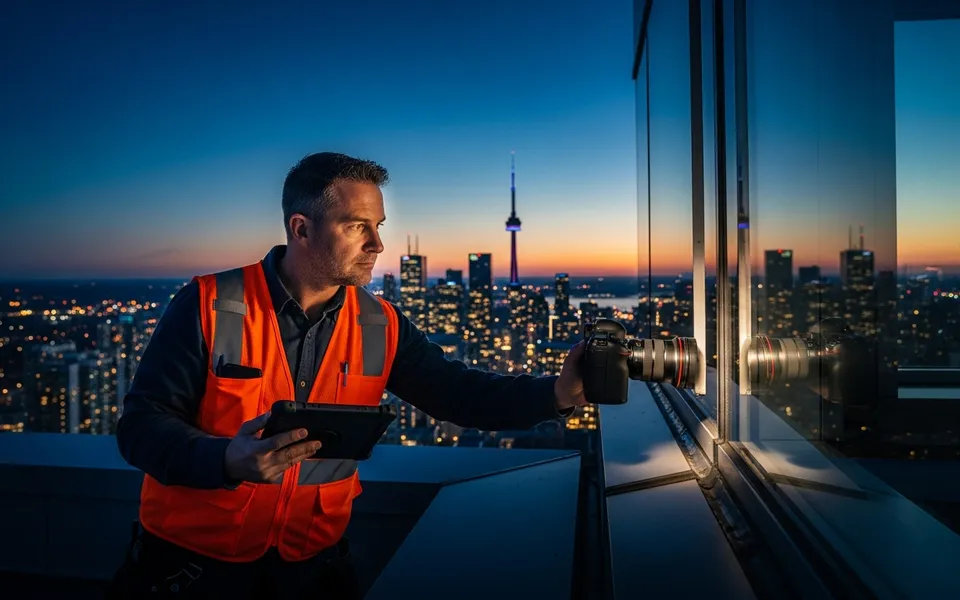
Exterior building inspections for Vaughan property managers — photo-documented, prioritized, and budget-ready.
Vaughan's inland freeze-thaw cycle makes every undetected façade defect a capital risk — a Working at Heights trained technician on your building's envelope, delivering a photo report with a ranked fix list, is the most cost-effective inspection investment you can make before the next salt season opens.
A Vaughan exterior inspection is not a formality — it is the first line of defence against a capital event. Vaughan sits inland from Lake Ontario in a way that concentrates freeze-thaw stress on every building envelope element: sealant joints, brick veneer ties, parapet caps, drainage systems, and exposed concrete. The VMC high-rise corridor at Jane and Highway 7 includes buildings entering their first major re-inspection window after the initial warranty period expires. The Woodbridge and Concord mid-rise stock carries aging envelopes where deferred maintenance has been compounding for a decade or more. The 400-corridor industrial properties have large roof areas and façades where undetected failures can result in inventory damage and tenant disruption before the problem surfaces inside. For all of these building types, a scheduled, photo-documented exterior inspection is the difference between a planned capital repair and an emergency phone call mid-winter.
Ontario property managers overseeing condominium corporations have a specific obligation: reserve fund studies require current condition assessments, and an exterior inspection report that documents sealant condition, drainage function, and façade integrity is the evidence reserve fund planners need to assign cost and timing to capital repair line items. For Vaughan condo boards that align approval cycles to late-summer meetings, having a photo-verified inspection report in hand before September means the board can approve a capital repair scope with documented evidence — not estimated condition. An exterior inspection is also the ideal starting point for any building owner considering a purchase, an insurance renewal, or a refinancing event where lenders require current building condition documentation.
What's included for Vaughan buildings
A Vaughan exterior inspection covers the full building envelope: façade cladding condition, sealant and caulking integrity at windows, doors, control joints, and penetrations, drainage system function at parapet level and podium level, accessible roof areas including parapet caps and scuppers, and any visible structural concerns at the envelope level. Every finding is photographed in place and included in the photo report. Findings are ranked in three tiers: urgent (active water admission or immediate safety concern), this year (schedule and budget before next winter), and monitor (track at next inspection cycle). The report is delivered in a format that boards, reserve fund planners, and building owners can act on without interpretation.
Working at Heights trained technicians perform all elevation access required for the inspection, ensuring compliance with Ontario's Occupational Health and Safety Act on any building where working at height is involved. WSIB Covered and Fully Insured ($5M Liability) means the inspection itself adds no liability exposure to your property management record. When the inspection report recommends follow-up work — caulking and sealants for sealant failures, exterior painting for coating failures, pressure washing for drainage obstruction — those can be quoted and executed under the same master agreement by the same account manager who conducted the inspection.
Inspection timing for Vaughan's building and board cycles
The most useful inspection timing for a Vaughan condo building is spring — April or May, after the freeze-thaw season has run its course and before summer obscures the evidence of winter stress. Winter's work on a building envelope is most visible in spring: sealant joints that separated under freeze-thaw pressure, drainage that backed up under snow and ice load, coating sections that delaminated during the cold-snap cycle, and efflorescence on masonry that indicates where water migrated through the winter. A spring inspection captures that evidence while it is fresh, which is what makes it the right input for a late-summer board meeting capital approval.
For VMC buildings approaching or past their first post-warranty inspection window — typically five to ten years after substantial completion — a baseline envelope inspection establishes the current condition from which all future capital planning runs. Buildings that have not had a documented inspection in three or more years should treat the first inspection as a baseline assessment rather than a maintenance check. The Free Building Health Report is the right entry point for buildings where the full interior and exterior condition is unknown — it delivers a photo-documented exterior condition overview alongside the interior picture, and it is the starting point for a master service agreement that coordinates every service that flows from the findings.
Industrial and commercial inspection scope on the 400 corridor
Industrial-flex and warehouse properties along the Highway 400 and 407 corridor have distinct exterior inspection priorities that differ from residential high-rise or mid-rise commercial. Large, low-slope or flat roof areas are the primary risk: undetected membrane failure in a warehouse roof results in inventory damage before any interior water stain is visible, and the repair cost is a fraction of the inventory loss or tenant disruption that follows discovery. Our industrial inspection scope includes accessible roof membrane condition, perimeter flashing and parapet cap integrity, roof drain and scupper function, loading dock weather seals, overhead door frame and header condition, and façade panel condition at wall-to-roof transitions.
For multi-tenant industrial properties, a landlord-commissioned inspection of the base building exterior — envelope, roof, and structural — is a standard tool for managing tenant relations and lease renewal conversations. When a tenant raises a concern about water intrusion or thermal comfort, a photo-documented inspection report with prioritized findings and a clear repair timeline is the professional response — and the basis for a capital repair quote that the landlord controls. Pair the exterior inspection with a window cleaning visit on the office-front glazing and a pressure washing pass on the truck court in the same crew mobilization to maximize the visit.
Vaughan-specific factors
- Vaughan's inland freeze-thaw cycle concentrates envelope stress on sealant joints, parapet caps, and drainage systems more aggressively than lakeside GTA cities — a spring inspection after the freeze-thaw season captures damage at its most visible.
- VMC high-rise condos are entering their first post-warranty inspection windows, making a baseline envelope assessment a current capital planning priority for many VMC condo boards.
- Woodbridge and Concord mid-rises carry aging envelopes where deferred maintenance compounds with each winter cycle — a prioritized photo inspection report is the first step to a planned repair program rather than emergency response.
- Large-footprint industrial and warehouse roofs on the 400 corridor are primary undetected failure risk: membrane failure in a flat or low-slope warehouse roof causes inventory damage before any interior water stain becomes visible.
Exterior Inspections in Vaughan — questions property managers ask
What does a Vaughan exterior inspection report include, and how is it structured for our condo board?
The report covers every envelope surface accessible during the inspection: façade cladding, sealant and caulking at windows and joints, parapet caps and drainage, accessible roof areas, and visible structural concerns. Every finding is photographed in place and ranked as urgent, this year, or monitor. The report is structured so a board member, reserve fund planner, or property management company can read it without requiring a site visit to interpret the findings. Follow-up quotes on any flagged work arrive within 48 hours under the 48-Hr Quote Guarantee — so the board has documented evidence and a cost estimate together.
How often should a Vaughan condo building schedule an exterior inspection?
For most Vaughan condominium buildings, an annual inspection is the right interval — specifically in spring, after the freeze-thaw season has run its course. Buildings approaching or past ten years of age, buildings in the VMC with open-wind exposure, and Woodbridge or Concord mid-rises with aging sealant systems benefit most from annual documentation. Buildings with active reserve fund studies on file should schedule an inspection to coincide with the reserve fund planner's site visit cycle. The first inspection on any building without a recent envelope assessment functions as a baseline rather than a check — and the Free Building Health Report is the right entry point if the overall building condition is unknown.
Can a Vaughan exterior inspection be paired with window cleaning or pressure washing on the same mobilization?
Yes. Pairing an exterior inspection with window cleaning and pressure washing on the same crew mobilization is a common and cost-effective approach for Vaughan buildings. The window cleaning crew accesses elevations that the inspector can review simultaneously; the pressure washing crew clears drainage channels and entrance concrete that the inspection documents. One visit, one access coordination, one photo-verified report covering all three services. The same account manager quotes and schedules all three under one master agreement.
Do you inspect flat or low-slope warehouse roofs in Vaughan's 400-corridor industrial parks?
Yes. Industrial roof inspection — accessible membrane condition, perimeter flashing, parapet caps, roof drains and scuppers — is within scope for 400 and 407 corridor properties. Warehouse and industrial-flex roofs are frequently the highest-impact undetected failure risk: a membrane failure in a flat roof causes inventory damage long before any interior water stain becomes visible from inside. An inspection that catches a failed flashing or a blocked drain before the next heavy rain event is measurably less expensive than the alternative. Findings are photo-documented and prioritized; repair quotes under the same agreement arrive within 48 hours.
Document Vaughan's envelope before next winter finds the gaps.
Tell us about your building. Full quote in 48 hours, guaranteed.
Serving Toronto, Mississauga, Brampton, Vaughan, Markham, Richmond Hill and the entire GTA.