
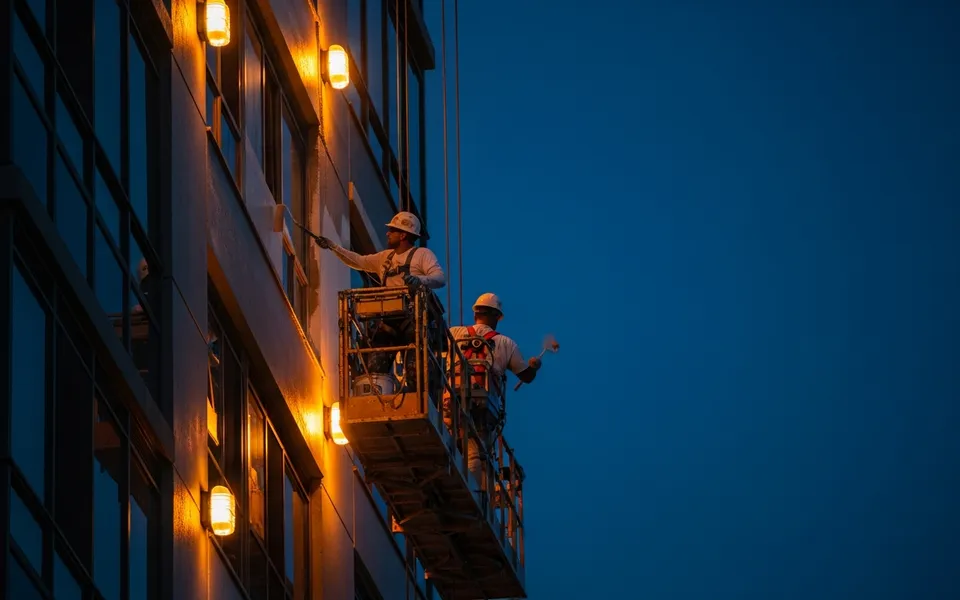
Commercial exterior painting for Vaughan buildings — stucco, concrete, metal and cladding done right.
Vaughan's inland winters degrade exterior coatings faster than the GTA average — proper surface prep and a commercial-grade paint system are what separate a six-year result from a two-year peeler on a Woodbridge stucco or VMC concrete façade.
Exterior coatings on Vaughan buildings face a performance test that starts in November and doesn't relent until April. Further inland than Toronto or Mississauga, Vaughan's winters produce deeper temperature swings, more freeze-thaw cycles, and a harsher wind chill that drives moisture into every surface micro-crack that inadequate prep leaves behind. A paint system applied over a surface that wasn't properly cleaned, patched, and primed in Vaughan's climate doesn't fail gradually — it blisters, peels, and detaches in sections by the second winter. The difference between a coating that lasts five to seven years and one that lasts two comes almost entirely from the surface preparation phase that too many vendors rush or skip.
Vaughan's building mix creates a wide range of exterior painting substrates. The Woodbridge commercial and mixed-use corridor — 1970s through 1990s construction — is heavy in exterior insulation and finish system stucco, painted concrete block, and painted metal panels, all of which require substrate-appropriate primer and commercial-grade topcoat systems. The VMC high-rise corridor's newer concrete and glass construction is more paint-minimal on the envelope itself but has significant podium-level and amenity-level concrete that weathers hard. The 400-corridor industrial stock runs corrugated metal and tilt-up concrete panel construction where coating failure on loading dock doors and wall panels creates both a presentation problem and a surface protection problem. Each substrate type needs a different system, and we specify accordingly.
What's included for Vaughan buildings
Commercial exterior painting in Vaughan follows a surface-first protocol. The scope begins with a documented assessment of the substrate condition: adhesion testing on existing coatings, identification of peeling, chalking, or blistering areas, documentation of moisture intrusion points, and notation of any caulking failures that must be resolved before paint is applied — because painting over a failed sealant joint seals in the water pathway, it doesn't fix it. Surface prep for a Vaughan exterior painting project includes pressure washing, scraping and feathering loose coating, spot-patching cracks and voids, and applying the specified primer system before any topcoat goes on. The prep is documented in the completion report.
Topcoat selection is matched to the substrate and exposure. Stucco and EIFS facades on Woodbridge mid-rises get an elastomeric or acrylic masonry coating that bridges minor cracks and allows moisture vapour to escape. Metal cladding and panels get a direct-to-metal system or an alkyd-primer-plus-topcoat sequence depending on existing coating condition. Parking garage and podium concrete gets a traffic-rated system on horizontal surfaces and a concrete-grade coating on vertical faces. Colour matching to the building's existing standard is included; full colour changes are quoted separately. Before-and-after photos document every surface on completion.
Surface prep as the determining factor for Vaughan's climate
The single most important determinant of exterior paint life in Vaughan is not the paint — it is the surface preparation. In a climate with Vaughan's freeze-thaw cycle count, any moisture trapped under a coating by inadequate prep will freeze, expand, and push the coating off the substrate within one to two winters. Vendors who skip the adhesion test, skip the crack repair, or apply topcoat directly over chalking primer are delivering a result that fails on the property manager's watch — not the painter's. Our protocol does not allow topcoat application on inadequately prepared substrates, and the documented pre-coating assessment means you have a record of what condition the surface was in before the paint went on.
For Woodbridge buildings with aging stucco — particularly EIFS systems installed in the 1980s and 1990s — substrate preparation includes a careful check for existing moisture intrusion that painting would seal in. If the assessment finds active moisture behind the coating, the finding is flagged and caulking and sealants repair is scoped before the paint system is applied. Painting over a water-damaged substrate guarantees early failure; resolving the water pathway first is the only sequence that produces a lasting result. The same single account manager coordinates both the sealant repair and the paint application, so there is no sequencing gap between trades.
Industrial and commercial properties in the 400 corridor
The Highway 400 and 407 corridor's industrial stock presents painting scope that differs from residential and office mid-rise: corrugated steel walls, tilt-up concrete panel exteriors, overhead door frames and panels, and loading dock aprons with painted curbs and safety markings. Salt aerosol from highway traffic accelerates corrosion on unprotected steel panels and around fasteners; the result is visible rust-through and paint failure that affects both the building's presentation to tenants and the structural protection of the steel. A commercial-grade direct-to-metal system with a rust-inhibiting primer, applied over properly cleaned and de-rusted steel, restores the surface and extends the protection cycle significantly.
Interior loading dock areas — technically interior spaces but exposed to outdoor conditions through open dock doors — get a durable, washable coating system that handles forklift contact, hose-down cleaning, and sustained vehicle exhaust exposure. Parking lot and loading zone line repainting is coordinated with the broader floor care program or scoped separately as part of an exterior painting visit. For multi-tenant industrial properties, coordinating a painting visit across multiple tenants at once — shared exterior walls, common areas, truck court curbs — reduces mobilization cost per tenant and ensures consistent presentation across the property.
Vaughan-specific factors
- Vaughan's inland freeze-thaw cycle is more aggressive than lakeside GTA cities, making thorough surface preparation — adhesion testing, crack repair, primer — the single most important factor in exterior coating lifespan.
- Woodbridge's 1980s–1990s EIFS stucco stock is at or past the point where elastomeric re-coating and sealant repair is more cost-effective than continued patchwork — and moisture-behind-coating assessment before painting is essential to avoid sealing in an active water pathway.
- 400-corridor industrial buildings face accelerated corrosion on steel panels and fasteners from highway salt aerosol, requiring a rust-inhibiting primer and commercial-grade direct-to-metal topcoat system rather than a standard exterior latex.
- VMC podium and amenity concrete weathers hard in Vaughan's wind-exposed, open-site context, and requires traffic-rated horizontal coatings and concrete-specific vertical coatings — not general-purpose exterior systems.
Exterior Painting in Vaughan — questions property managers ask
Why does exterior paint on Vaughan buildings fail faster than on Toronto properties?
Vaughan's inland location means more freeze-thaw cycles per winter with deeper temperature swings — and no Lake Ontario to moderate the wind chill on exposed north- and west-facing elevations. Any moisture that gets under a coating by adhesion failure, inadequate crack repair, or painting over a failed sealant joint will freeze and expand, pushing the coating off the substrate. A single harsh Vaughan winter can turn a poor preparation job into a peeling façade by spring. Our surface-prep protocol — adhesion testing, crack patching, primer before topcoat — is specifically sequenced to prevent that. If there is active moisture behind an existing coating, we identify it before painting and scope caulking and sealants repair first.
Can you match our building's existing colour on stucco or concrete without repainting the entire façade?
Yes. Colour matching to an existing building standard is included in our exterior painting scope for Woodbridge and Vaughan properties. We can address failed sections, peeling areas, or accent surfaces without requiring a full-façade repaint — provided the existing coating system is in sufficiently sound condition to accept a partial recoat without visible sheen or texture variation. The documented assessment before work begins confirms whether spot painting is appropriate or whether full-surface prep is required for a consistent result.
Do you paint corrugated metal and tilt-up concrete panel buildings in the 400-corridor industrial parks?
Yes. Corrugated steel wall panels, tilt-up concrete exterior panels, overhead door frames, and loading dock areas in the 400 and 407 corridor industrial parks are standard scope. Steel panels near the highway corridor often show corrosion at fasteners and panel edges from salt aerosol — we specify a rust-inhibiting primer and commercial-grade direct-to-metal topcoat system for these surfaces. Safety line repainting in parking lots and loading zones can be coordinated in the same visit. Surface prep and system specs are documented in the completion report.
How long does exterior painting typically take on a Woodbridge mid-rise, and how much disruption should residents expect?
Duration depends on the scope — number of elevations, substrate condition, required prep work, and whether interior access points are needed. Surface prep typically runs one to three days per elevation; coating application adds one to two days depending on topcoat system and dry-time requirements. Residents on the affected elevation may have swing-stage or rope-access crews visible outside windows during work hours; we provide pre-visit notice through your property management office and schedule around any building blackout dates. The exterior inspection or caulking and sealants phase that precedes painting is quoted by the same account manager, so the total project timeline is coordinated from assessment through final coat. Crews are WSIB Covered and Fully Insured ($5M Liability); one COI covers the full scope under your master service agreement.
Give Vaughan's weathered façades a finish that holds.
Tell us about your building. Full quote in 48 hours, guaranteed.
Serving Toronto, Mississauga, Brampton, Vaughan, Markham, Richmond Hill and the entire GTA.