
How to hire a commercial cleaning company in Toronto: the property manager's evaluation guide.
Hiring a commercial cleaning company in Toronto means more than comparing hourly rates — it means verifying WSIB coverage, defining scope precisely, and understanding what accountability looks like after the crew leaves.
Quick answer
Hiring a commercial cleaning company for a GTA building requires evaluating WSIB clearance, certificate of insurance ($5M liability minimum recommended), defined scope per visit, and a completion verification system. Property managers who skip these steps discover gaps at the worst time — an insurance claim, a board complaint, or a lapsed certificate during a vendor audit. This guide covers the full evaluation framework: what to verify, what to define in writing, and what separates a cleaning vendor from a building maintenance partner.
Why hiring commercial cleaning in Toronto is harder than it looks
The market for commercial cleaning in Toronto is crowded. A quick search for commercial janitorial services in the GTA returns dozens of companies ranging from one-truck owner-operators to large national franchises. Every one of them will provide a quote and a list of services. The ones that create problems for property managers — compliance gaps, inconsistent delivery, disappearing crews, board complaints — are rarely obvious at the quoting stage. They become obvious six months into a contract, when the original crew that sold the job has been replaced three times and the board package shows a pattern of missed tasks.
This is a buyer's-market category where the evaluation framework matters more than the headline rate. Toronto property managers who have been through a bad janitorial contract know the checklist: verify WSIB before anyone sets foot in the building, confirm the COI names you as additional insured, define the scope in writing with a task-level checklist, and establish upfront what documentation you'll receive after every visit. Property managers who haven't been through a bad contract often skip these steps — until the first compliance event makes it retroactively urgent.
This guide walks through the practical evaluation framework: what to verify before signing, what to define in the contract, what to require as ongoing documentation, and how to evaluate whether a standalone cleaning vendor or an integrated building services partner is the right structure for your property. For buildings that are already managing four or more separate vendors, the answer is often the latter — the Why One Partner page covers the consolidation rationale in full. For a deeper look at what PM-grade janitorial scope actually looks like in practice, see property manager-grade janitorial in Toronto, which covers documented checklists and photo-verified SLAs in detail. If you are still weighing the outsourced-versus-in-house question, why hire a commercial cleaning service walks through the insurance and compliance math.
Compliance first: WSIB and COI verification
Before any commercial cleaning company sends a crew to your building, you need two documents in your compliance file: a current WSIB clearance certificate and a certificate of insurance (COI) that meets your property's minimum coverage requirements. These are not optional requests — they are the baseline standard for any contractor working in an occupied Ontario building, and the obligation to verify them sits with the property manager, not with the contractor.
WSIB clearance certificates are issued online and confirm that the employer is registered with and currently in good standing with the Workplace Safety and Insurance Board. A clearance certificate can be verified at the WSIB's online clearance portal. The key word is 'current' — clearance status changes when a company falls behind on premiums or has an account discrepancy, and a certificate that was valid at contract signing may not be valid at the time of an on-site incident. The practical mitigation is to request clearance certificates at signing, at each annual renewal, and at any point where a new crew is deployed. Track expiry dates in your compliance calendar.
The COI requirement varies by property, but a $5M commercial general liability policy is the industry standard for GTA commercial building work. Request that the COI name your property management company and the building corporation as additional insured — this ensures coverage extends to your organization in the event of a claim. Any cleaning company that pushes back on an additional-insured endorsement request is signalling either that their broker won't accommodate it (which is a red flag about the policy structure) or that they're unfamiliar with standard commercial contracting — which is a different red flag about their commercial experience. Do not move forward without this endorsement.
Defining scope: what should be on the written checklist
The single most common source of janitorial disputes in commercial buildings is scope ambiguity. A contract that specifies 'lobby cleaning three times per week' means something different to the property manager and something different to the cleaning company, and the gap between those interpretations becomes a board complaint. Every janitorial contract for a GTA commercial or residential building should include a task-level written checklist — specific enough that any crew member, on any visit, could perform the defined scope without additional instruction.
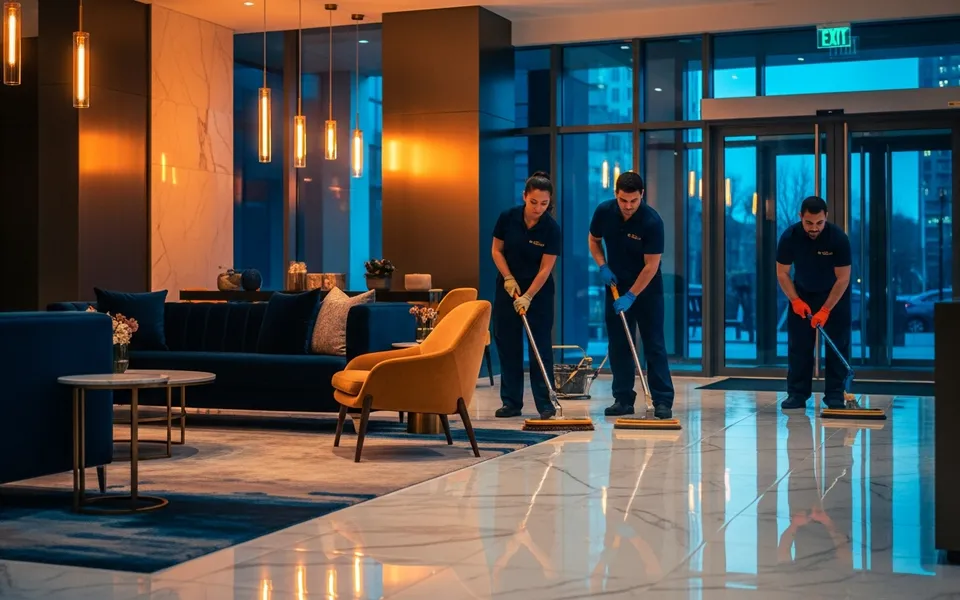
For a typical mid-rise building, the lobby checklist includes: floor sweeping and mopping, entrance mat vacuuming, glass cleaning at entrance doors and interior glass surfaces, elevator interior wiping (walls, floor, door tracks), lobby furniture wipe-down, and trash removal. Each corridor floor has its own checklist: hallway vacuuming or sweeping (depending on flooring type), baseboards, elevator lobbies per floor, and any floor-specific common areas. Washrooms and garbage rooms have their own task lists. Stairwells, mechanical room entries, and loading dock areas should all be explicitly assigned or explicitly excluded.
The written checklist has two functions beyond operational clarity. First, it gives the cleaning crew accountability — they know what 'done' looks like. Second, it gives you a verification tool. If the scope is defined at the task level, photo-verified completion (a checklist photo for each defined area, taken at the end of each visit) becomes feasible and meaningful. Without a task-level checklist, photo documentation is symbolic. With it, the documentation confirms that specific defined tasks were completed, which is a fundamentally different level of accountability. See the Janitorial and Common Areas service page for how Master Building Services structures scope definition and completion documentation.
Evaluating proposals: what to compare and what to ignore
When evaluating competing proposals for commercial cleaning services, the most common mistake is leading with price comparison. Hourly rates and monthly contract totals are visible and comparable, which makes them the natural focus — but they often correlate poorly with delivered service quality. A lower-priced proposal built on high crew turnover and loose scope definition will cost more in management time, board escalations, and service-level recovery than a moderately higher-priced proposal with stable crews and documented completion.
The evaluation dimensions that actually predict service quality are: crew stability (what is the typical crew retention rate for this company? how many crew changes should you expect in the first year?), scope definition quality (is their proposed scope at task level, or does it read as a general description?), documentation system (what do they provide after each visit, and in what format?), compliance track record (can they provide current WSIB clearance and COI on request without delay?), and reference accounts (can they provide contact information for two or three current accounts in comparable buildings?). Ask these questions in writing and score the responses. A company that answers all five clearly and specifically is demonstrating operational maturity. One that answers vaguely or defers is flagging the questions that will become problems.
For buildings already managing multiple vendors, it's also worth evaluating whether adding a standalone janitorial contract is the right structure, or whether bundling janitorial under a master service agreement that covers the building's other services makes more operational sense. The MSA model eliminates the separate compliance tracking for janitorial, folds the scope into one invoice, and assigns one account manager to the full bundle. If your building already has a caulking contractor, a window cleaning company, and an exterior maintenance vendor, the question worth asking is why janitorial should be the fifth separate compliance relationship. See vendor consolidation in practice for that analysis.
Completion documentation: what you should receive after every visit
The documentation standard for commercial cleaning has changed significantly in the past several years. Historically, a signed attendance log was considered adequate — it confirmed that crew members were present. Contemporary property management expectations, particularly for buildings where boards receive monthly operational reports, require completion documentation that confirms what was done, not just who showed up.
At minimum, every janitorial visit should generate a completed task checklist with the crew member's initials or signature on each line. For large multi-floor buildings, this is a multi-page document covering each area in scope. For board-reportable buildings — anywhere a board expects to see service verification in the monthly package — photo documentation is increasingly standard: a series of photos taken at the end of each visit showing defined areas in completed condition. The photo record is timestamped and tied to the visit date, making it useful for dispute resolution as well as routine reporting.
Property managers who receive this level of documentation discover several things quickly: they spend less time responding to 'was the lobby cleaned on Tuesday?' inquiries; board complaints about cleaning quality become resolvable with evidence rather than escalating to vendor disputes; and the documentation itself creates an accountability feedback loop — crews who know their work will be photographed maintain higher consistency than crews who know they'll only be checked on complaint. This is the documentation structure Master Building Services uses for janitorial and common-area work under its building services agreements. Contact us for a scoping conversation about your property.
Red flags: what a weak commercial cleaning vendor looks like
Experienced GTA property managers recognize a short list of warning patterns that predict cleaning vendor failure before the contract is signed. Understanding them helps at the evaluation stage, before a bad contract creates a board issue.
The first red flag is difficulty producing compliance documents on request. A company that takes more than 48 hours to produce a current WSIB clearance certificate, or that doesn't have COI language ready to forward on request, is revealing something about their operational infrastructure. Companies that handle commercial building accounts at any meaningful scale maintain current compliance documents and can produce them immediately. Delays or 'I'll have to check with my insurance broker' responses indicate either that the company is small enough that they don't have this infrastructure, or that there's a compliance issue they're managing around.
The second red flag is scope written as a general description rather than a task list. Any proposal that reads 'janitorial services for common areas, three times weekly' without a defined task list is a proposal that can't be measured. You cannot verify that undefined work was done. You cannot enforce scope on a dispute. You cannot document completion meaningfully. Push every prospective vendor to provide a task-level checklist before signing — their willingness to do so, and the quality of that checklist, is itself an evaluation data point.
The third red flag is no reference accounts in comparable properties. Cleaning a 300-unit residential tower is operationally different from cleaning a 12-unit boutique building or a retail plaza. If a company can't provide references from at least two accounts of comparable size and type, you're the test case for their capacity in your building category. For Toronto property managers managing buildings in the Toronto locations we serve, the reference check should specifically ask about experience in high-rise residential or commercial buildings — not general commercial cleaning.
Integrating cleaning into a building maintenance program
Janitorial and common-area cleaning doesn't operate in isolation from the rest of a building's maintenance program. Floor care programs — strip-and-wax for vinyl composition tile, extraction for carpet, polishing for stone — are distinct from routine janitorial but share scope with it: the janitorial crew maintains the surface daily, but the floor care program extends the surface's life over years. Running them under separate vendors creates coordination gaps: the floor care contractor strips the lobby floor and the janitorial company doesn't know when the surface is ready for resumed traffic, or uses the wrong products for the refreshed coating.
Similarly, janitorial and interior painting interact. Lobby walls that are freshly painted last longer and look better under a regular cleaning program; they degrade faster under heavy cleaning chemistry or abrasive techniques that weren't considered in the paint specification. When janitorial and interior painting are handled by separate vendors, neither vendor's crew has visibility into the other's specifications. When they're under one building services agreement, the account manager can coordinate specifications and scheduling to extend service life on both.
This is the practical case for integration — not just administrative simplification, but reduced total cost over the building's life. Buildings that coordinate janitorial, floor care, interior painting, and common-area repairs under a single agreement consistently outperform buildings where those services are managed separately, because the integration effect reduces work that gets undone by the next trade. Start with a free building condition walk-through to see where your building stands, or get a quote for a coordinated janitorial and maintenance program.
Frequently asked questions
What insurance minimums should a Toronto commercial cleaning company carry?
The industry standard for commercial cleaning contractors serving GTA buildings is a minimum the lower industry-minimum commercial general liability policy, though many property management companies and building corporations require $5M for mid- and high-rise accounts. The COI should name your property management company and the building corporation as additional insured — not just as certificate holders. Master Building Services carries $5M liability coverage as part of its standard commercial terms, with additional-insured endorsements included on request at signing. Contact us for compliance documentation.
How often should commercial common areas be cleaned in a GTA building?
Frequency depends on building occupancy and type. A 200-unit residential tower with active lobby traffic typically requires lobby cleaning five to seven days per week, elevator cleaning daily, and corridor cleaning two to three times per week. A smaller office building with predictable occupancy patterns may be adequately served by three-days-per-week service on business days. The right frequency is determined by traffic volume, building standards, and board expectations — a Building Health Report assessment will include an observation of current common-area condition as part of the walk-through.
Can I switch commercial cleaning vendors mid-contract if the service is poor?
Whether you can exit a cleaning contract early depends on the contract language — specifically, whether there is a performance-standard clause with defined remedy steps and a cure period. Contracts that lack a performance standard clause make early exit difficult without a financial penalty. This is one reason why well-drafted janitorial contracts include explicit scope definitions (task-level checklists), completion documentation requirements, and a performance remedy clause — so that documented, repeated scope failures give you a contract-supported exit path rather than a dispute. Review your existing contract with this framework before signing any new commercial cleaning agreement.
Looking for commercial cleaning with documented completion?
Tell us about your building. Full quote in 48 hours, guaranteed.
Serving Toronto, Mississauga, Brampton, Vaughan, Markham, Richmond Hill and the entire GTA.