
Commercial caulking and sealants for Toronto's freeze-thaw climate.
Toronto's freeze-thaw cycles attack every window joint, control joint and penetration in your building's envelope — and a failed sealant bead never stays the same size twice, which is why before-and-after photo documentation on every section is the only proof that counts.
Caulking and sealant failure is the envelope defect that Toronto property managers see most often and address least systematically. The GTA's freeze-thaw cycle is the primary driver: when water enters a hairline crack in a sealant bead, freezes overnight, and expands, it pries that crack open further. By spring, what started as a hairline has become a visible gap — and that gap has been admitting wind-driven rain, heated air and lake-effect moisture into the envelope all winter. The problem concentrates in buildings that are 10 years or older, which describes a significant portion of Toronto's commercial building stock in neighbourhoods like North York, Scarborough, Etobicoke, the Annex and along the Yonge corridor. By the time a property manager hears about drafty units or notices staining around window joints, the envelope has typically been taking water for at least a season.
High-rise buildings in Toronto's Financial District and along the lakeshore face an additional stressor: wind-driven rain at elevation. A sealed joint that performs adequately at ground level may fail faster on the 20th or 30th floor of a lakeshore tower where wind pressure and rainfall intensity are significantly higher. Buildings on exposed Waterfront or harbourfront sites — particularly those facing south or west across Lake Ontario — experience some of the most aggressive envelope loading in the GTA. An annual sealant assessment, or a full re-sealing project timed ahead of the freeze-thaw season, is the cost-effective intervention that prevents the much larger cost of water damage remediation inside the envelope.
What's included for Toronto buildings
Commercial re-caulking is envelope work, not cosmetic touch-up. We begin with an assessment — walking the building's elevations and identifying which sealant runs have failed and which remain serviceable — then deliver a written scope and quote within 48 hours, guaranteed. Buildings that want a comprehensive picture before committing to a scope often start with an exterior inspection first: a photo-documented review of the full façade, drainage and accessible roof areas that ranks every defect, including sealant failures, by priority.
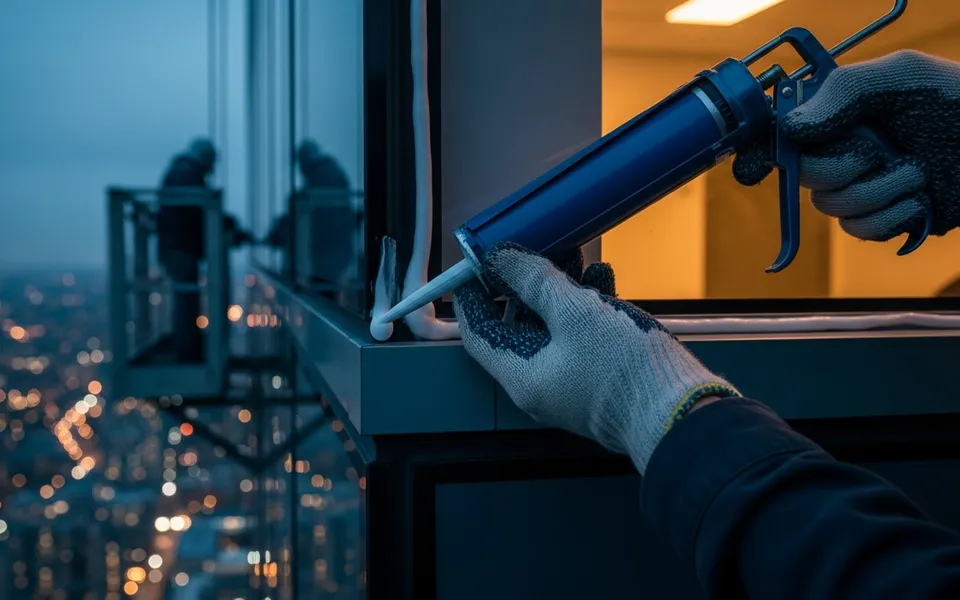
On the job, crews cut out the failed sealant material completely — running a new bead over old, cracked material is not a repair — and re-seal windows, doors, control joints and penetrations with commercial-grade product rated for the GTA's temperature range and freeze-thaw exposure. Every section is photographed before and after. The project closes with a photo-verified completion report you can file or present to the board as evidence, not just a description, of what was replaced. Crews are Working at Heights trained and WSIB covered, with $5M in liability coverage and a documented hazard assessment before any elevation work begins.
Why timing matters in Toronto's climate
The practical rule in Toronto is: re-seal before winter, not after. Sealant applied in late summer or early fall has time to cure fully before the first freeze, so the new joint faces the GTA's freeze-thaw season intact. Sealant applied over damaged substrate in spring is repairing last winter's damage rather than preventing next winter's. For buildings where a full re-sealing project is needed, the optimal window is August through October — late enough that summer heat won't cause adhesion issues in direct sun, early enough to cure before November's first frost.
Where the assessment also uncovers failing paint or bare substrate around sealed areas, exterior painting can run in the same campaign, so the envelope is weatherproofed and refinished in a single contractor mobilization. If water has already entered the building through a failed joint and caused interior damage, emergency and disaster recovery handles the interior response while envelope re-sealing is scoped and scheduled. For buildings across Toronto's older residential stock — the 1970s and 1980s high-rise towers that make up so much of North York and Scarborough's condo supply — a scheduled sealant re-assessment every three to five years is a defensible and cost-effective preventive maintenance posture.
Documentation that satisfies Toronto condo boards
Sealant work creates a specific documentation challenge for property managers: the completed work is largely invisible from grade. A fresh sealant bead around a 30th-floor window joint looks, from the street, exactly like the original failed bead looked — which is to say, it is not visible at all. Without before-and-after photographs at the section level, a condo board has no evidence that the work was actually done as scoped. This matters financially: sealant re-sealing projects are capital expenditure items in most Toronto condo corporation reserve fund plans, and boards need documentation to support that spending.
Every MBS caulking project closes with a photo-verified completion report covering each re-sealed section — the same standard we apply to exterior inspections. The report includes before photos showing the failed sealant and after photos showing the completed joint, organized by elevation and section. It is designed to be filed with the building's maintenance records and presented at AGMs or board reviews without requiring a physical walk of the elevations. Flat-rate multi-year contracts with no annual escalators mean the caulking budget line holds steady once the program is in place.
Toronto-specific factors
- Toronto averages dozens of freeze-thaw cycles per winter, making annual or biannual sealant assessment the practical preventive standard for any building 10 years or older in the GTA.
- Lakeshore and harbourfront towers in Toronto face wind-driven rain loading at elevation that accelerates sealant failure faster than the same building type at grade-level exposure inland.
- The GTA's 1970s and 1980s high-rise residential stock — concentrated in North York, Scarborough and Etobicoke — represents a significant cohort of buildings where original sealants are well past expected service life.
- Toronto condo boards require capital expenditure documentation for sealant re-sealing projects; before-and-after photo reports organized by elevation satisfy that requirement and support reserve fund filings.
Caulking & Sealants in Toronto — questions property managers ask
How do we know if our Toronto building's sealants need replacement versus spot repair?
The distinction between spot repair and a full re-sealing program is determined during assessment, not before it. Visible cracking along window or door joints, drafty suites, unexplained moisture staining around joints, or a building age over 10–15 years are all indicators that a full assessment is warranted. We walk the building, identify which runs have failed versus which remain serviceable, and deliver a written scope within 48 hours. If you want a broader picture first, the free Building Health Report covers the full exterior envelope including sealants, with a prioritized fix list you keep regardless of what you decide to act on.
Can caulking and sealant work be done on Toronto high-rises without disrupting residents?
Yes. Exterior sealant work is done from swing stage, rope access or boom lift on high-rise elevations, with crews Working at Heights trained and the access method specified in the scope before work begins. Residents and tenants are typically not aware that exterior envelope work is underway unless the building requires a notice to suites for swing-stage presence adjacent to windows. We handle access coordination with your building management team before every elevation visit.
When is the best time of year to re-seal a Toronto building's exterior joints?
The optimal window is late summer through early fall — August through October — so the new sealant has time to cure fully before the first freeze. This is especially important for Toronto buildings, where the freeze-thaw season can begin as early as November. Re-sealing in spring repairs last winter's damage; re-sealing before winter prevents next winter's damage. If your sealant assessment reveals failures that need immediate attention outside the optimal window, we can advise on product selection appropriate for the temperature at time of application.
Does caulking and sealant work require any permits in the City of Toronto?
Caulking and sealant replacement on existing building envelopes does not typically require a building permit in the City of Toronto, as it is classified as maintenance and repair work rather than structural alteration. However, swing-stage and rope-access operations on high-rise buildings require compliance with Ontario's Occupational Health and Safety Act and applicable Working at Heights regulations — requirements that all MBS crews meet on every elevation visit.
Stop the freeze-thaw damage before next winter.
Tell us about your building. Full quote in 48 hours, guaranteed.
Serving Toronto, Mississauga, Brampton, Vaughan, Markham, Richmond Hill and the entire GTA.