
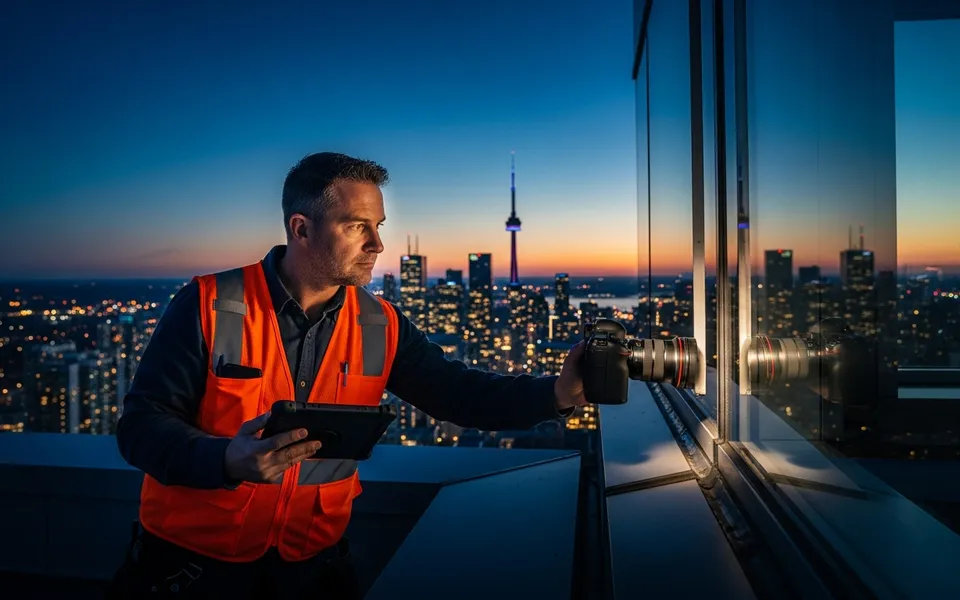
Exterior building inspections for Toronto property managers — photo report, prioritized fix list, no guessing.
Toronto's aging building stock and aggressive freeze-thaw climate produce envelope defects that compound year over year — a photo-documented inspection with a ranked fix list is how you stop reactive repairs from becoming capital emergencies.
Toronto's commercial and residential building stock spans a wide and challenging age range. The Financial District's glass towers from the 1970s and 1980s are approaching or past 40 years of age. The mid-rise stucco condos that define North York, Scarborough and Etobicoke's residential landscape were built predominantly in the 1990s and early 2000s and are now entering the period when original envelope components — sealants, coatings, drainage details — are at or near the end of their designed service life. The heritage commercial buildings in Leslieville, Corktown, the Distillery District and along Bloor Street carry masonry and limestone detailing that requires a different assessment lens than a curtain-wall tower. For Toronto property managers and condo boards, the question is rarely whether the exterior needs attention — it is which defects to address first and what the capital planning implication is.
Toronto's freeze-thaw climate is the accelerant. Unlike cities with colder but more consistent winters, Toronto oscillates above and below freezing dozens of times per season. Each freeze-thaw cycle takes any existing micro-defect in the envelope — a hairline sealant crack, a minor drainage detail failure, a spalled concrete edge — and works it a little further open. The progression from nuisance to water damage to structural repair is not a matter of if in an untested building; it is a matter of when. An annual or biannual exterior inspection conducted by a trained technician with a camera, an access plan and a prioritized output report is the intervention that converts reactive emergency spending into planned capital management.
What a Toronto exterior inspection actually covers
An MBS exterior inspection is a systematic, photo-documented review of the building envelope by a trained technician. The scope covers the façade — all elevations accessible from grade, podium level, accessible roof areas and any intermediate setbacks — with specific attention to sealant condition at windows, doors, control joints and penetrations; drainage detail performance at balconies, parapet copings and roof-to-wall intersections; concrete and masonry condition including spalling, cracking and exposed reinforcement; coating condition on painted surfaces; and evidence of water infiltration through staining or efflorescence. For accessible roof areas, the inspection covers visible drainage, membrane condition and penetrations.
The output is a photo report with every finding ranked in one of three categories: urgent (address this season), this year (include in the current budget cycle) and monitor (document for trend review at next inspection). That ranking structure is what makes the report useful for budget planning and reserve fund updates, not just compliance. Pair the exterior inspection with our free Building Health Report — which adds an interior common-area review — and your board has a complete picture of the building's condition in a single document, without commissioning a full professional engineering study.
How Toronto property managers use inspection reports
Condo boards and property managers in Toronto use exterior inspection reports in several distinct ways. The most immediate is capital prioritization: when a board needs to decide between addressing sealant failures and repainting a stucco elevation in a budget year where there is only room for one project, a ranked photo report makes that conversation evidence-based rather than opinion-based. The second use is reserve fund planning: Ontario's Condominium Act requires condo corporations to maintain a reserve fund based on a reserve fund study, and a current condition report — especially one documenting the progression of a defect across annual inspections — supports the reserve fund study provider's input.
The third use is due diligence. Toronto's condo and commercial real estate transaction market is active enough that building condition reports are standard supporting materials in purchase transactions, refinancing processes and insurance renewals. A photo-verified inspection report from the current season, covering all accessible exterior surfaces with a ranked deficiency list, is exactly the format that purchasers' lawyers, lenders and insurers ask for. When the inspection report identifies defects that need immediate action — sealant failure on the south elevation of a lakeshore tower, for instance — caulking and sealants or exterior painting can be scoped and quoted under the same master service agreement within 48 hours of the inspection report delivery.
Annual inspection cadence for Toronto building stock
The recommended inspection cadence for most Toronto commercial and residential buildings is annual, with the inspection timed to follow the spring thaw — May or June — so that the full impact of the winter's freeze-thaw cycling is visible and can be captured in the report. A post-thaw inspection catches sealant openings that widened during freeze-thaw cycles, concrete spalling that the freeze activated, and drainage issues that the snow melt revealed. That timing also leaves the summer and early fall window open to act on urgent findings before the next freeze-thaw season begins.
Buildings undergoing active renovation or remediation programs may benefit from a second inspection in the fall — September or October — to document the condition of completed work and identify any envelope details that need attention before winter. For Toronto buildings operating under a master service agreement with MBS, the inspection integrates naturally into the envelope service program: window cleaning crews who are already on the elevations can flag visible sealant failures for formal inspection follow-up, and the inspection report drives the scoping conversation for caulking, painting or repairs within the same account relationship.
Toronto-specific factors
- Toronto's freeze-thaw cycling — dozens of above/below-zero oscillations per winter season — converts minor envelope defects into active water entry points faster than in cities with colder but more consistent winters.
- Ontario's Condominium Act reserve fund requirements create a direct administrative use case for annual exterior inspection reports in Toronto condo corporations, supporting reserve fund study updates with current condition documentation.
- Toronto's aging mid-rise stucco building stock from the 1990s and early 2000s is entering the period when original sealants, coatings and drainage details are at or past designed service life and require systematic condition assessment.
- Toronto's active real estate and refinancing market makes current, photo-verified exterior condition reports standard supporting material for transactions, lender reviews and insurance renewals.
Exterior Inspections in Toronto — questions property managers ask
What's covered in a Toronto exterior building inspection from MBS?
The inspection covers all accessible exterior elevations with specific attention to sealant condition at windows, doors, control joints and penetrations; drainage performance at balconies, parapets and roof-to-wall intersections; concrete and masonry condition; coating condition on painted surfaces; and evidence of water infiltration. Accessible roof areas are included. Every finding is photographed and ranked — urgent, this year or monitor — in the written report. Pair it with the free Building Health Report for an interior common-area review in the same visit.
Do the technicians who perform Toronto high-rise inspections hold Working at Heights certification?
Yes. MBS inspection technicians are Working at Heights trained under Ontario's Occupational Health and Safety Act requirements, WSIB covered and backed by $5M in liability insurance. A documented hazard assessment is completed before any elevation access. For high-rise buildings in Toronto where roof or upper-elevation access is required, the access method — boom lift, scaffold, rooftop walkout — is confirmed in the scope before the inspection visit.
Can an MBS exterior inspection report support our Toronto condo corporation's reserve fund study?
Yes. The MBS exterior inspection report is a photo-documented condition assessment with defects ranked by urgency and scope — the format that reserve fund study providers use as input for condition-based cost projections. The report does not replace a formal reserve fund study under Ontario's Condominium Act, but it provides current, dated photographic evidence of the building's envelope condition that supplements and updates the reserve fund study data. We recommend timing the annual inspection to occur before your reserve fund study provider's site visit so their assessment can reflect current conditions.
What happens after the inspection identifies defects that need repair?
Every defect in the report is ranked by urgency. For findings that require repair action, MBS can scope and quote the remediation work — caulking and sealants, exterior painting, or concrete patching — under the same master service agreement within 48 hours of delivering the inspection report. Because the inspector's photos and findings are already on file, the remediation scope does not require a second site assessment visit. Buildings already under a master service agreement have the repair work added to the existing account with the same account manager.
How does an exterior inspection differ from the free Building Health Report?
The free Building Health Report is a combined exterior and interior common-area condition overview — a photo-documented walk-through of your building's exterior envelope and interior common areas with a prioritized fix list, designed as an entry point for property managers who want a full picture before committing to any specific scope. A formal exterior inspection goes deeper on the exterior only: systematic elevation coverage with specific defect classification, drainage and roof access where permitted, and a ranked output report formatted for reserve fund and board documentation purposes. Both are available; many Toronto property managers start with the free Building Health Report and follow it with a formal annual inspection once a maintenance program is in place.
Know what your Toronto building's exterior is hiding.
Tell us about your building. Full quote in 48 hours, guaranteed.
Serving Toronto, Mississauga, Brampton, Vaughan, Markham, Richmond Hill and the entire GTA.