
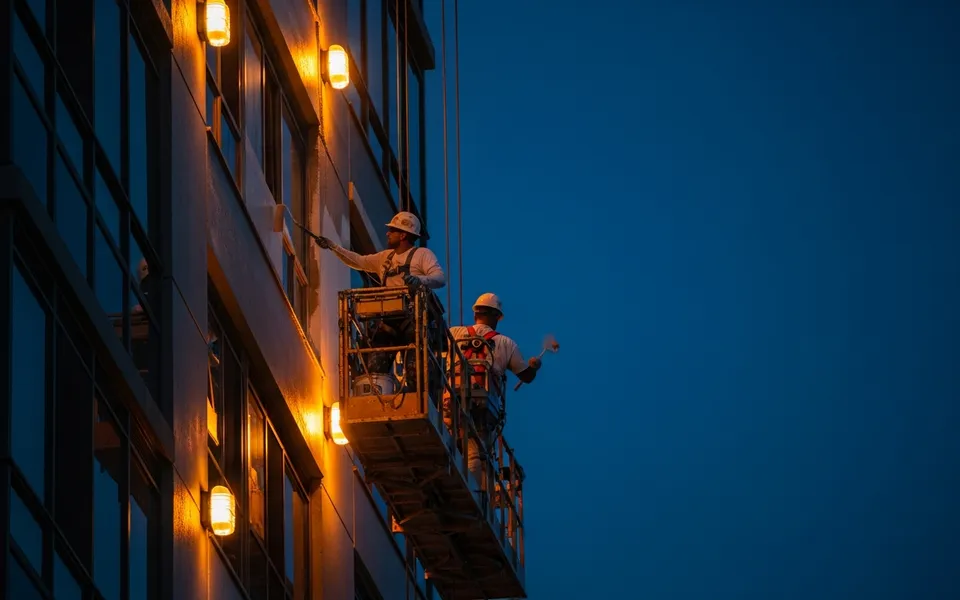
Commercial exterior painting for Toronto buildings — prepped right, weather-rated, photo-verified.
Toronto's freeze-thaw cycles and humidity extremes demand exterior coatings applied over properly prepared substrate — an 80% prep / 20% paint ratio that makes the difference between a coating that lasts a season and one that lasts a decade.
Toronto's exterior building stock is as diverse as the city itself: the Heritage Conservation District buildings in Corktown and Leslieville with their heritage-painted brick facades, the stucco-clad mid-rise condos along Yonge and Eglinton, the glass-and-metal commercial buildings of the Financial District, the poured concrete podiums of North York's residential towers, and the wood-trim detailing on the Victorian-era semi-detacheds converted to retail and office use throughout the Annex and Roncesvalles. Each material type has different painting requirements, and Toronto's climate makes those requirements non-negotiable. A coating system applied to unprepared or inadequately cleaned substrate in a freeze-thaw climate will fail — peeling in the first winter, cracking at the second freeze, and creating the water entry path that the coating was supposed to prevent.
Toronto's exterior painting calendar is constrained by temperature in a way that the GTA's milder neighbours are not. Exterior paint and coating application requires ambient temperatures above a product-dependent minimum — typically 5°C to 10°C for commercial-grade elastomeric and masonry coatings — which limits the application window to roughly May through October in Toronto. Within that window, summer humidity on the lake side of the city can affect cure times and adhesion for certain coating systems. The practical consequence is that Toronto exterior painting projects need to be scoped and scheduled earlier in the season than most property managers expect, particularly for projects involving scaffold or swing-stage access to upper elevations.
What's included for Toronto commercial buildings
Commercial exterior painting at MBS begins with surface prep — and surface prep is the job. Depending on the substrate, prep work includes pressure washing to remove salt, grime and any loose coating; scraping and sanding to remove peeling paint; masonry crack filling and patching on stucco and concrete; and priming bare substrate before any finish coat is applied. On Toronto's stucco-clad mid-rise buildings — a common construction type from the 1980s through 2000s across North York and Scarborough — stucco surface assessment is part of the pre-paint scope to identify any sections that require patching before coating. Skipping that step means painting over a failing substrate, which shortens the coating's service life regardless of product quality.
Finish coats are weather-resistant systems selected for the specific substrate and GTA climate exposure: elastomeric coatings for stucco and concrete, direct-to-metal formulations for metal facades and trim, and exterior-grade products for wood surfaces. Colour matching to your building's existing standard is included on request — important for spot-repair and touch-up projects on Toronto heritage and character buildings where colour continuity matters. The project closes with a photo-verified completion report, and every elevation visit is covered by Working at Heights trained crews, WSIB clearance and $5M in liability coverage under one COI.
Surface types and Toronto-specific coating challenges
Stucco is the most common exterior cladding on Toronto's mid-rise residential towers built between the 1970s and early 2000s, and it presents a specific painting challenge: stucco that has developed surface cracks — often from freeze-thaw cycling — admits water behind the coating if those cracks are not filled before painting. The correct approach is to assess, patch and prime before the finish coat rather than painting over the cracks. Buildings along the Yonge-Eglinton corridor, in Scarborough and across Etobicoke have significant stucco-clad residential towers where this is the defining exterior maintenance issue.
Painted metal surfaces — balcony railings, metal canopies, mechanical enclosures and painted spandrel panels — require a different system: rust inhibitor primer, direct-to-metal finish, and proper mechanical preparation of the surface before coating. Toronto's humidity and salt exposure, particularly on buildings within a few blocks of Lake Ontario, accelerate corrosion on metal surfaces that are not adequately maintained. For buildings where sealant re-sealing and exterior painting need to happen on the same elevation, running both in the same mobilization reduces scaffold and swing-stage setup costs and minimizes the time the building's exterior is under active contractor access.
Scheduling, documentation and condo board approval
Exterior painting projects on Toronto condos often require board approval before work begins — especially projects involving significant capital spend, scaffold or swing-stage presence, or colour changes from the building's approved standard. MBS provides the written scope, product specifications and before/after photo documentation that boards need to approve and file the project. The photo-verified completion report after the project is the evidence record that supports the capital expenditure in the reserve fund and gives the board something tangible to review at the AGM.
For multi-phase exterior refreshes — common in larger Toronto properties where the full exterior is painted over several budget years — the same master service agreement and account manager carry the project across phases, with flat-rate pricing that does not escalate between Phase 1 and Phase 2. Where the exterior painting scope surfaces additional defects — failed caulking around windows, cracking in the substrate — the One Building. One Partner. model means the same agreement already covers those repairs, and they are added to the project scope rather than parcelled out to a separate contractor.
Toronto-specific factors
- Toronto's application window for exterior coatings is roughly May through October; projects requiring swing-stage or scaffold access at elevation should be scoped and booked early in the season to secure the optimal cure window before fall.
- Stucco-clad mid-rise buildings from the 1970s through early 2000s — a dominant building type across North York, Scarborough and Etobicoke — require crack assessment and patching before painting to prevent freeze-thaw water entry behind the new coat.
- Metal surfaces on Toronto lakeshore and harbourfront buildings face accelerated corrosion from salt-laden air and require rust-inhibitor primer and direct-to-metal coating systems rather than standard exterior paint.
- Toronto condo boards routinely require written scope, product specifications and before/after photo documentation for exterior painting capital projects — MBS provides all three as part of every project.
Exterior Painting in Toronto — questions property managers ask
When is the right time of year to paint commercial building exteriors in Toronto?
The practical window for exterior coating application in Toronto is May through October, when ambient temperatures are consistently above the minimum required for commercial-grade coatings to cure properly. For projects requiring swing-stage or scaffold access — which includes most high-rise and mid-rise work — scoping and booking in late winter or early spring gives you the best chance of securing May or June start dates before the season fills. A quote arrives within 48 hours, guaranteed, whenever you reach out.
Our stucco-clad North York condo tower has visible cracking. Does the stucco need to be repaired before painting?
Yes. Stucco cracking is a prep item, not something that can be coated over. Cracks that are not filled and primed before painting admit freeze-thaw moisture behind the new coat and cause the coating to fail — often within one or two winters. Our pre-paint scope for stucco buildings includes surface assessment, crack patching and priming before any finish coat is applied, and the before/after photo report documents each stage of the prep work. If the cracking is extensive and may involve the substrate beneath the stucco, an exterior inspection first gives you a prioritized assessment of whether the stucco needs patching only or more significant intervention.
Can you match our existing building colour for a partial repaint or touch-up project?
Yes. Colour matching to your building's existing standard is included on request and is standard practice for spot-repair and touch-up projects on Toronto heritage buildings and character-designated properties where colour continuity is required. We work from your existing paint specifications if you have them, or from spectrophotometer matching of the existing coat. The product type and colour match are confirmed in the scope before any work begins.
How do we get board approval documentation for an exterior painting capital project?
MBS provides written scope, product specifications and before/after photo documentation as part of every exterior painting project. The written quote serves as the pre-approval scope document for board or owner review, and the photo-verified completion report after the project is the evidence record for the reserve fund file and AGM presentation. If the project is being phased across budget years, the same master service agreement carries the scope across phases with flat-rate pricing.
Get a scoped exterior painting quote for your Toronto building.
Tell us about your building. Full quote in 48 hours, guaranteed.
Serving Toronto, Mississauga, Brampton, Vaughan, Markham, Richmond Hill and the entire GTA.