
Toronto Building Repairs & Maintenance: Clear the Punch List in One Visit
Toronto property managers deal with a standing punch list that grows faster than it gets cleared — Master Building Services consolidates drywall, door hardware, fixture swaps, and caulking touch-ups into scheduled maintenance visits that photo-verify every item, under one flat-rate contract.
Toronto's high-density residential and commercial building stock generates a maintenance punch list that never fully closes. Elevator cab scuffs from move traffic, corridor drywall dings from delivery carts, sticking suite-entry door closers, worn bulletin board hardware, leaking faucet fixtures in amenity rooms, and loose handrail anchors in stairwells — these items accumulate across every floor, every season. In a large building, a property manager fielding resident complaints tracks dozens of open items at once, each requiring a separate trade call, a separate work order, and a separate invoice. The administrative load of managing that roster of vendors rivals the time it takes to actually fix the items.
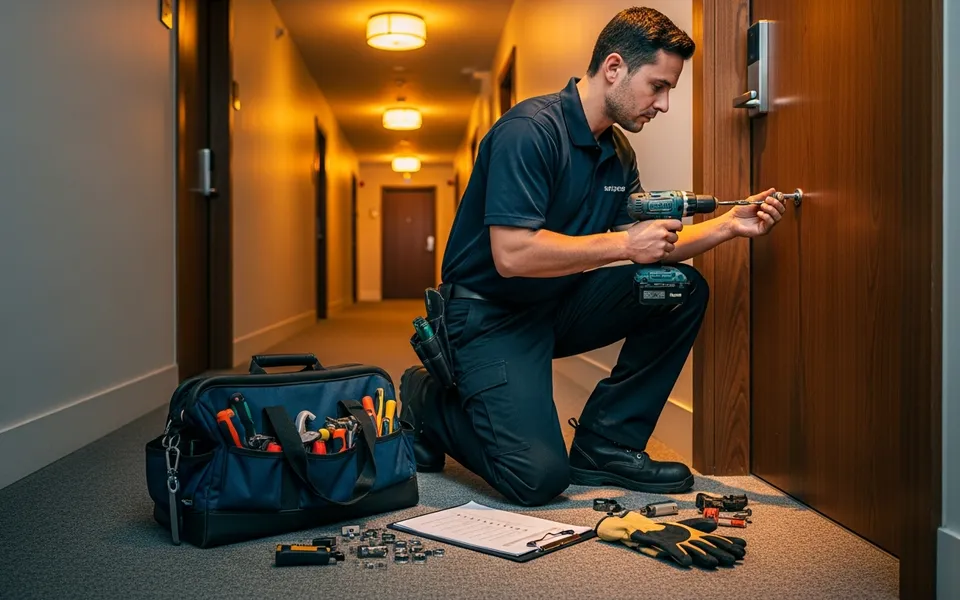
Master Building Services consolidates the standing punch list into scheduled maintenance visits that clear multiple trade categories — drywall, door hardware, fixtures, caulking touch-ups, signage, and minor millwork — under one crew, one visit, and one photo-verified completion report. For Toronto buildings, that means a predictable monthly or quarterly visit that works through whatever has accumulated since the last one, with the same account manager and the same flat-rate pricing for the full contract term. Items that surface between scheduled visits — a resident complaint, a board walk-through finding — get logged and addressed in the next visit without creating a new work order for a new vendor.
What's included for Toronto buildings
Maintenance visits cover the recurring interior punch list categories that property managers handle across Toronto's residential and commercial building stock. Drywall patches and texture matching address the dings, holes, and scuffs that accumulate in corridors from move carts, delivery traffic, and daily building use. Door hardware services cover closer adjustment and replacement, lock cylinder re-keying on suite entries after a tenancy change, push-plate and kick-plate replacement, and hinge tightening on doors that are dragging or catching. Fixture swaps cover light fixtures, switch plates, exhaust fans, and minor plumbing fixtures in common areas that are failing or beyond their useful life.
Caulking touch-ups — at window frames, base of tub surrounds in amenity washrooms, HVAC grille penetrations, and common-area countertops — are a recurring maintenance category that most property managers defer until the damage shows. At that point, failed caulking has admitted moisture behind the substrate and the repair has expanded from a caulk bead to a drywall replacement. Building signage maintenance covers suite number plates, directional wayfinding, floor identifier plates, fire exit signage, and bulletin boards. Every item across all categories is documented in the visit report with a before and after photo, so the board and the insurer both have a record.
How Toronto building maintenance visits actually work
The punch list for a typical Toronto residential tower or mixed-use building does not arrive in an organized form. Items surface through resident complaint emails, board walk-through notes, superintendent observations, and building inspector reports. A maintenance program that relies on the property manager to triage and dispatch each item individually adds hours of administrative work per week. The Master Building Services approach is to run a scheduled maintenance visit — monthly, bi-monthly, or quarterly, depending on the building's volume — that works through an accumulated list rather than individual dispatch events.
Before each visit, the account manager reviews whatever has been logged — resident complaints, board notes, superintendent walkthroughs — and builds the visit scope. Crews arrive with the materials and hardware for the items on the list, work through the building floor by floor, and close each item with a photo. The completion report organizes everything by item and location, so the property manager has a document that maps directly back to the open complaint log. If the visit surfaces something that falls outside the maintenance scope — a hallway wall that needs more than a patch, a floor surface that needs restoration work — the appropriate sibling program picks it up: interior painting for wall and trim refreshes, floor care for surface restoration.
Toronto seasonal factors and the recurring maintenance calendar
Toronto's building maintenance calendar has two peaks. The first is the spring post-winter assessment, when the salt season ends and buildings surface what five months of freeze-thaw has done to entrance vestibules, stairwell handrails, lobby fixtures, and common-area millwork. Spring is the right window for a comprehensive walk-through that builds the year's maintenance agenda — pairing a maintenance visit with a Building Health Report walk-through gives the property manager a photo-documented baseline before any work is scoped.
The second peak is the fall pre-winter preparation, when entrance doors need their closer tension checked for cold-weather operation, entrance vestibule hardware gets inspected for the wear patterns that freeze temperatures accelerate, and caulking touch-ups at exterior-facing windows and door frames are completed before temperatures drop. Buildings that run a scheduled maintenance program through both seasons avoid the condition where deferred items compound over winter and arrive on the spring board agenda as larger capital items. See the full consolidation case at Why property managers switch to Master, or explore what maintenance coordinates with at Toronto janitorial and Toronto interior painting.
Toronto-specific factors
- Toronto's September 1 and January 1 move-in surges concentrate corridor drywall, elevator cab, and door hardware damage into short windows — a scheduled maintenance visit after each turnover peak clears the backlog efficiently
- Spring post-winter assessments surface fixture, handrail, and entrance vestibule damage that accumulates through the salt season — the right window to set the maintenance agenda for the year
- Fall pre-winter preparation — door closer tension, caulking touch-ups at exterior-facing frames, vestibule hardware — prevents cold-weather failures from compounding through the season
- High-density Toronto residential towers generate a punch list volume that makes individual trade dispatch inefficient — a scheduled visit program replaces multiple vendor calls with one crew, one report, and one invoice
Repairs & Maintenance in Toronto — questions property managers ask
What maintenance items can you clear in a single visit for a Toronto building?
A single maintenance visit covers drywall patches and texture matching, door hardware (closers, lock cylinders, push plates, hinges), fixture swaps in common areas, caulking touch-ups at windows and amenity washrooms, and signage and bulletin board maintenance. Each item is documented with a before-and-after photo, and the completion report organizes everything by location so it maps back to your open complaint log.
How do you handle items that surface between scheduled visits in a Toronto building?
Items that come in between visits — resident complaints, superintendent observations, board walk-through notes — get logged against the next scheduled visit and addressed when the crew is on site. Nothing creates a new individual work order or a new vendor dispatch. If something is genuinely urgent and cannot wait for the next scheduled visit, your account manager is the single point of contact to assess it and arrange a response.
Can you handle Toronto's September turnover damage — corridor drywall, elevator cabs — after move-in season?
Yes. The September 1 and January 1 turnover windows concentrate move-cart drywall damage, elevator cab scuffs, and door hardware wear into short periods. A maintenance visit scheduled after the peak clears the backlog in one mobilization. If the hallway walls have accumulated wear beyond patch-and-paint, interior painting folds into the same visit under the same agreement.
Do maintenance visits produce documentation I can forward to the condo board?
Yes. Every maintenance visit closes with a photo-verified completion report organized by item and location. Before-and-after photos document drywall repairs, hardware replacements, and caulking work. The format maps back to a board walk-through finding or a resident complaint log without reformatting — it is ready to include in a board package as-is.
Can repairs and maintenance be added to an existing service agreement in Toronto?
Yes. If you already hold a master service agreement for janitorial or floor care, repairs and maintenance folds into the existing COI, WSIB clearance, and monthly invoice — no new onboarding and no new vendor to manage. Starting fresh? A quote comes back in 48 hours, guaranteed.
Clear Toronto's standing punch list in one visit
Tell us about your building. Full quote in 48 hours, guaranteed.
Serving Toronto, Mississauga, Brampton, Vaughan, Markham, Richmond Hill and the entire GTA.