
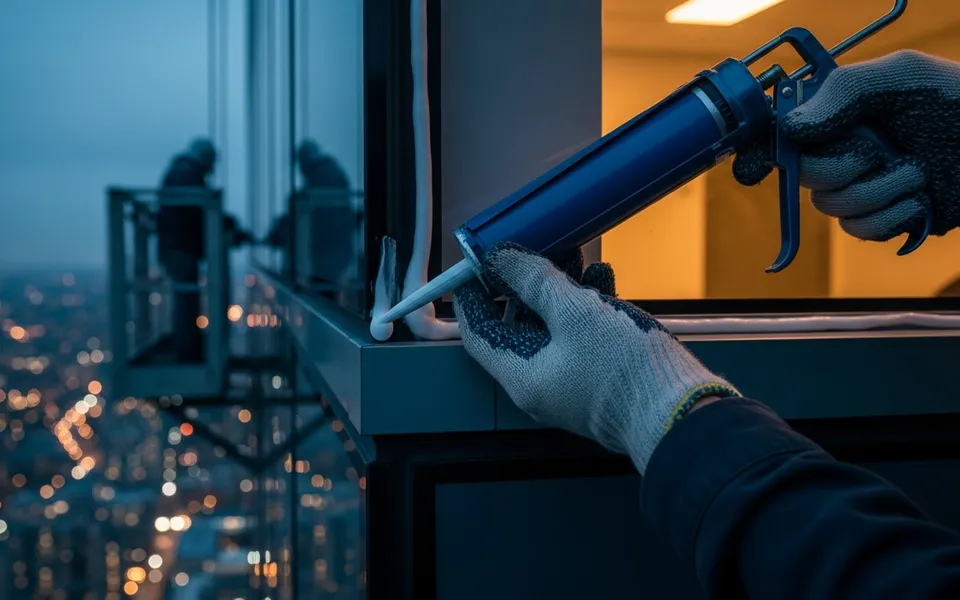
Commercial caulking and sealant replacement for Vaughan buildings — VMC condos to Woodbridge mid-rises.
Vaughan's inland freeze-thaw cycle is one of the harshest in the GTA, and it finds every failing sealant joint first — let failed caulking go another season and you're funding water damage remediation instead of a re-seal.
Vaughan's climate works on building envelopes differently than Toronto or Mississauga. Sitting further from Lake Ontario's moderating influence, Vaughan experiences deeper winter temperature swings and more freeze-thaw cycles per season — meaning building envelope sealants cycle through expansion and contraction more times per year than they would on a lakeside property. A sealant joint that might last twelve years in Toronto could show failure in eight to ten in Vaughan's harsher inland exposure, particularly on buildings fronting the open agricultural land north of the VMC or on towers standing above the surrounding low-rise stock. The VMC's new high-rise condos at Jane and Highway 7, the older Woodbridge commercial stock, and the industrial-flex buildings along the 400 and 407 corridor all face this reality — just in different building typologies with different original sealant specifications.
Failed caulking is the most common, most preventable source of water damage in York Region commercial buildings. A sealant that has pulled away from a control joint on the fifth floor of a Concord mid-rise admits moisture that travels inside the wall assembly before it becomes visible inside a unit — often not until water staining appears on the ceiling two floors below the breach. In Vaughan's winters, that moisture freezes inside wall cavities, expands, and widens the failure with each cycle. By the time a property manager sees the water damage, the remediation bill is multiples of what a timely re-seal would have cost. Our approach is to find and address sealant failure before water finds it first, using Working at Heights trained technicians and before-and-after photo documentation on every project.
What's included for Vaughan buildings
A Vaughan caulking and sealants program begins with a documented sealant assessment across all relevant surfaces: window perimeters, door frames, control joints, expansion joints, penetrations through the façade (HVAC, pipe sleeves, electrical conduit), and podium-to-tower transitions. The assessment documents every joint's condition, photos each failure, and produces a prioritized list — urgent failures that are actively admitting water, joints approaching end of life, and joints to monitor in the next inspection cycle. Every finding in the assessment maps to a scope of work with a flat-rate quote delivered within 48 hours.
Work proceeds joint-by-joint: old sealant is fully removed rather than capped over, the substrate is cleaned and prepared, and commercial-grade sealant is applied and tooled to a proper bond face on both sides of the joint. Before-and-after photos document every joint addressed. If the assessment or removal process uncovers water damage inside a wall cavity or at a window frame, the finding is flagged for exterior inspections or repairs and maintenance follow-up under the same agreement — a single account manager coordinates the full scope, not a separate contractor discovery process.
Vaughan building types and their sealant failure patterns
VMC high-rise condos are relatively new construction, but 'new' in the VMC means buildings that were designed and sealed during a compressed development cycle and are now approaching their first full re-seal window. Glazing system sealants on high-rise curtain wall in Ontario have a design life that begins to be tested at eight to twelve years, and many VMC towers are approaching or inside that range. North- and west-facing elevations — the ones taking direct Vaughan winter wind — typically show earlier sealant fatigue than south or sheltered elevations. A high-rise sealant assessment distinguishes which faces are priority and which are monitor, giving the board a phased capital plan instead of a single large-scope quote.
Woodbridge's 1970s through 1990s commercial and mid-rise buildings present a different challenge: original sealants are well past their design life, and many have been capped over rather than replaced at prior service intervals. Cap-over sealant fails faster than a proper removal-and-reseal because the bond is to the old sealant rather than to the substrate — and in Vaughan's freeze-thaw climate, cap-over joints often fail within two or three seasons. Industrial-flex buildings along the 400 corridor add their own scope: overhead door frames, dock seals, and the penetrations where HVAC and electrical enter warehouse walls are high-failure points that standard residential sealant programs often miss. We include all of these in the assessment.
Integrating caulking into Vaughan's building maintenance cycle
Sealant replacement is most cost-effective when it runs as part of a planned maintenance cycle rather than as an emergency response to visible water damage. For Vaughan condo buildings with active reserve fund studies, a documented sealant assessment with photos and a prioritized fix list gives the reserve fund planner exactly the evidence they need to budget sealant replacement at the right interval. For Woodbridge and Concord mid-rises without recent envelope assessments, the assessment itself is the starting point — and the combination of a sealant assessment with a window cleaning or exterior inspection visit on the same crew mobilization minimizes total cost.
Caulking and sealants run under the same flat-rate multi-year contract as all other MBS services — no escalators between years, one COI, one WSIB clearance, one account manager. For Vaughan property managers who also need exterior painting on stucco or concrete surfaces, sequencing sealant replacement before the paint system is applied is the correct order of operations: sealant joints must be sound before a paint system is laid over them, and the same crew mobilization handles both. The Free Building Health Report is a useful starting point for buildings where the full envelope condition is unknown — it includes a sealant condition overview alongside the broader interior and exterior picture.
Vaughan-specific factors
- Vaughan's inland location produces more freeze-thaw cycles per winter than lakeside GTA cities, shortening sealant design life on all elevations and accelerating failure at north- and west-facing joints exposed to unobstructed wind.
- VMC high-rise condos at Jane/Highway 7 are approaching or inside the first full re-seal window for their glazing system sealants, making a phased high-rise sealant assessment a current capital planning priority for many VMC condo boards.
- Woodbridge's 1970s–1990s commercial and mid-rise stock frequently carries cap-over sealant from prior service intervals — a faster-failing method in freeze-thaw climates that requires proper removal-and-reseal to restore the joint's design life.
- 400-corridor industrial buildings present additional sealant scope at overhead door frames, dock seals, and façade penetrations that standard residential-focused programs often omit from assessment scope.
Caulking & Sealants in Vaughan — questions property managers ask
How do Vaughan's freeze-thaw cycles affect caulking lifespan compared to Toronto buildings?
Vaughan averages more freeze-thaw cycles per winter than lakeside Toronto because it sits further from Lake Ontario's moderating influence. Each freeze-thaw cycle stresses sealant joints as the substrate expands and contracts — a joint that lasts twelve years in a sheltered Toronto location may show failure at eight to ten years on a Vaughan north- or west-facing elevation. The VMC's open site context and the older Woodbridge building stock are the most common places we find this accelerated wear. A sealant assessment — which we can pair with a window cleaning or exterior inspection visit — identifies which joints are priority, which are approaching end of life, and which can be monitored for another cycle.
What is the difference between re-caulking over old sealant and a proper removal-and-reseal?
Capping over old sealant bonds the new sealant to the existing failed material rather than to the substrate — which means the new joint inherits the adhesion failure of the old one, typically failing within two to three seasons in Vaughan's freeze-thaw climate. A proper removal-and-reseal cuts out and removes all old sealant, cleans and prepares the substrate to manufacturer specifications, and applies commercial-grade sealant with a correct bond face on both sides of the joint. Before-and-after photos document every joint. It takes longer, but the resulting joint has its full design life — typically ten to twenty years depending on sealant type, substrate, and exposure.
Can you provide a sealant assessment for our Vaughan condo board's reserve fund study?
Yes. A documented sealant assessment with photos and a prioritized fix list — urgent, this-year, and monitor — is exactly the format reserve fund planners need to assign a cost and a timeline to sealant replacement in a building's capital schedule. The assessment report can be included in your reserve fund study documentation. If the board approves a re-seal scope from the assessment, the flat-rate quote is guaranteed within 48 hours of submission and the work runs under one master agreement alongside any other exterior maintenance services already in place.
Do you handle caulking on 400-corridor industrial buildings as well as VMC condos?
Yes. Industrial-flex and warehouse buildings along the Highway 400 and 407 corridor have specific high-failure sealant points: overhead door frames, dock seals, HVAC penetrations, and the joints where office-front glazing meets the warehouse cladding. These are included in our industrial sealant assessment scope. Pairing a caulking visit with window cleaning on the office-front glass in the same mobilization addresses the full exterior envelope efficiently. The same flat-rate, no-escalator contract structure applies to industrial properties as to residential and commercial.
Find Vaughan's failing sealants before water does.
Tell us about your building. Full quote in 48 hours, guaranteed.
Serving Toronto, Mississauga, Brampton, Vaughan, Markham, Richmond Hill and the entire GTA.