
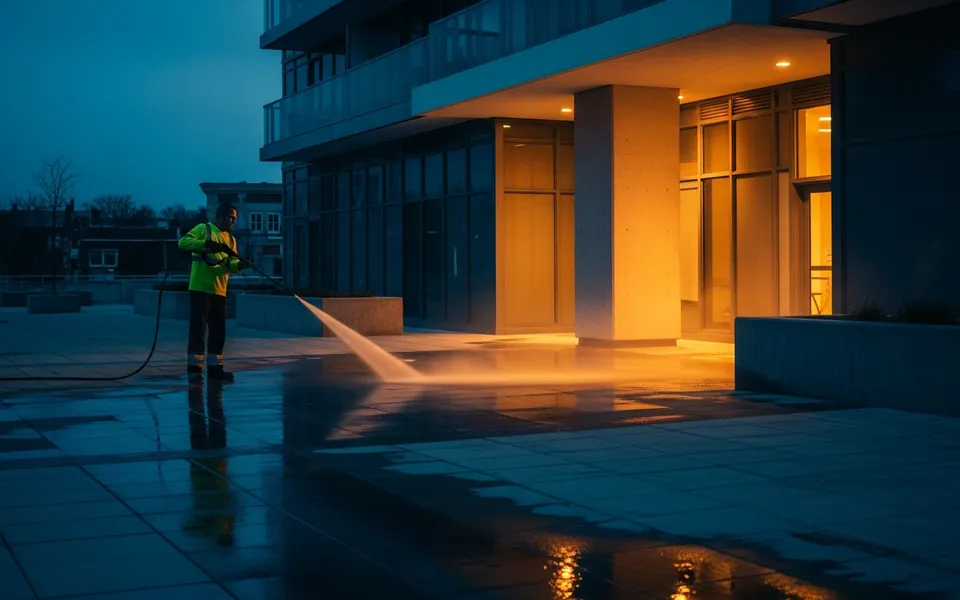
Commercial pressure washing in Toronto: schedule, scope, and ROI
Commercial pressure washing in Toronto is a salt-corridor operation — sidewalks, parking garages, podiums, and façades all need the same spring deep-clean cycle to roll back winter's load.
Quick answer
Commercial pressure washing in Toronto runs on a spring plus summer cadence: post-winter salt and grime removal, mid-summer entry-area refresh, fall pre-winter prep. Scope typically covers sidewalks, entrance plazas, parking garages, dumpster areas, and façades. Eco-conscious detergents are available for properties with sensitive landscaping or drainage requirements. A full written quote arrives within 48 hours of a scoping conversation.
Why Toronto commercial properties need pressure washing every spring
Toronto's winters are a salt-corridor problem. From the first significant snowfall through to the last frost, road salt and sand applied to sidewalks, parking entrances, and pedestrian plazas is tracked through building entries, ground into concrete and interlocking pavers, and embedded into the exposed aggregate on ramps and platforms. By the time the freeze-thaw cycle ends, most commercial properties are carrying several months of accumulated salt, sand, and organic debris — and none of that lifts with a standard mop or a dry sweep.
The surface-chemistry problem is straightforward: road salt (calcium chloride, magnesium chloride, or sodium chloride depending on the application) dissolves in meltwater and penetrates porous surfaces like concrete and brick. When the water evaporates, the salt recrystallizes inside the surface matrix. The expansion force of recrystallization accelerates spalling — the flaking and crumbling of surface concrete — and produces the white efflorescence staining visible on building bases, parking garage floors, and entrance plazas in late winter. Left unaddressed, the damage compounds with each successive winter cycle.
Spring pressure washing, done properly, removes the salt residue before it causes further damage. For a property manager, this is not a cosmetic exercise — it's maintenance that protects the capital value of the concrete, interlocking, and masonry surfaces under management. A parking garage floor that is pressure-washed annually will last significantly longer before requiring resurfacing than one that is allowed to accumulate salt loading year over year. The ROI on the spring cleaning visit is calculated against the cost of the deferred remediation, not against the cost of the next wash.
Scope: sidewalks, podiums, parking garages, façades, and dumpster areas
The full scope of a commercial pressure washing program in a Toronto building typically covers five distinct zones, each with different pressure settings, detergent requirements, and drainage considerations. Sidewalks and entrance plazas are the highest-visibility areas and usually the priority in a spring clean — they carry the most salt loading, the most organic staining from wet leaves and standing water, and the most gum and food debris from pedestrian traffic. Standard commercial pressure washing at 2,000–3,000 PSI with a rotating surface cleaner attachment handles this zone efficiently.
Parking garages are the highest-volume zone by square footage and often the most neglected. Multi-level garages accumulate oil drips, tire rubber, salt deposits, exhaust residue, and standing water staining across every level. The approach differs from surface work — garage pressure washing requires careful attention to drainage direction to avoid flushing contaminated water into storm drains, and detergents used in garages must be approved for the building's drainage system. Dumpster enclosures and waste staging areas are typically added to the garage scope given their proximity and similar contamination profile.
Façade pressure washing — the building's exterior cladding at podium and mid-rise levels — is a specialized scope that requires lower pressure settings than pavement work. Stucco, brick, glass, and aluminum panels each respond differently to pressure and temperature, and the wrong combination can damage the surface or drive moisture behind the cladding. Façade pressure washing pairs naturally with a caulking and sealants assessment, because the same close-up access reveals joint condition that is difficult to assess from grade. Scheduling both for the same visit is a common efficiency for spring maintenance programs.
Scheduling: spring deep clean, mid-summer refresh, and fall prep
The commercial pressure washing calendar in Toronto has three natural visit points, and most well-maintained properties use at least two of them. The spring deep clean — typically scheduled from late March through May as weather consistently breaks above 5°C — is the highest-priority visit and the one that removes the accumulated winter load. This is the visit that matters most from a surface-protection standpoint, and it should be scoped broadly enough to cover all five zones in one or two visits rather than being trimmed for budget.
The mid-summer refresh is lighter in scope and focused on the highest-traffic areas: building entrances, lobby drop-off areas, and parking garage entrances where summer heat is baking in organic material and exhaust residue from increased vehicle activity. Many Toronto commercial properties skip this visit unless the building is high-traffic retail or food service adjacent. For a standard condo or office building, the spring and fall visits are typically sufficient.
The fall prep visit is timed to run in September or early October, before the salt season begins. The goal is to remove summer accumulation — algae, bird waste, and organic staining — so surfaces enter the winter clean and with maximum drainage capacity. A clogged drain or a standing-water area covered in organic material will freeze harder and be more susceptible to damage than a clean surface. Pairing the fall pressure washing with a caulking and sealants inspection and an exterior inspection gives the property manager a complete pre-winter envelope assessment in a single mobilization.
Eco-conscious detergents and Toronto stormwater drainage considerations
Toronto's municipal stormwater system separates sanitary and storm sewers in most of the urban core — which means water that flows into a storm drain during pressure washing goes directly to a receiving waterway, not to a treatment plant. This is a material consideration for any commercial pressure washing program: detergents and degreasers that are safe in a sanitary system are not necessarily safe in a stormwater outfall, and some common pressure washing detergents contain surfactants or phosphates that are harmful to aquatic ecosystems.
Eco-conscious detergents formulated for commercial pressure washing use biodegradable surfactants and phosphate-free cleaning agents that are safe for stormwater discharge where regulations permit. For properties with sensitive landscaping adjacent to washing areas — particularly at-grade planters, green walls, and permeable paving systems where runoff contacts root zones — these formulations also prevent chemical damage to plantings that standard degreasers would cause.
The practical implication for property managers is to confirm, in the scope conversation, that the contractor's detergents are appropriate for the building's drainage configuration. This is especially relevant for underground garages that drain to municipal catch basins, and for podium-level washing where runoff crosses landscaping before reaching a drain. A responsible commercial pressure washing contractor will ask about the drainage layout and specify compliant detergents before the visit, not after. Confirm this in writing as part of the scope document.
What a Toronto commercial pressure washing quote should include
A complete commercial pressure washing quote for a Toronto property covers zones, not just square footage. Each zone should be itemized separately — sidewalks and entrance plazas, parking garage levels, façade areas, dumpster enclosures — with a specified pressure range, detergent choice, and expected duration. A quote that aggregates everything into a single line item makes it impossible to understand what you're buying or to adjust scope in a budget conversation.
The quote should also specify whether the price includes crew for drainage management, water recovery where required, and post-wash disposal of any material collected from high-contamination zones like dumpster enclosures. Some buildings — particularly those in business improvement areas or with specific property maintenance bylaws — have requirements around runoff management that affect how the job is set up. Confirm whether the contractor is familiar with the relevant requirements for your area before awarding.
Photo documentation before and after the wash is the correct completion standard for a commercial program, not a residential-grade business. Before photos establish the baseline condition and serve as a reference if the building management or ownership questions the scope of work done. After photos provide the deliverable that goes into the board package. Combine pressure washing with exterior inspections and request one integrated photo report covering both scopes — it saves the property manager from managing two separate documentation packages for what is effectively one exterior maintenance visit. Contact us to receive a 48-hour quote for your building's spring or fall pressure washing program. The spring mobilization is also the right moment to schedule a building inspection — both scopes run in the same April-to-May window, and the close-up access from the wash crew gives the inspector a clear surface to assess. For buildings past the 7-year mark on their sealant program, pairing that visit with a high-rise caulking assessment captures all three exterior maintenance priorities in a single scheduling window.
Frequently asked questions
How often should a Toronto commercial property be pressure washed?
At minimum, twice per year: spring (post-winter salt removal, typically April–May) and fall (pre-winter prep, September–October). High-traffic properties — retail, food service adjacent, or buildings with heavy vehicle throughput — typically add a mid-summer refresh in July or August. Parking garages in buildings with year-round vehicle traffic may benefit from quarterly maintenance. Pair the spring visit with a caulking inspection and the fall visit with an exterior inspection to maximize each mobilization.
What does Toronto winter road salt actually do to surfaces?
Road salt dissolves in meltwater and penetrates porous surfaces like concrete and brick. When the water evaporates, the salt recrystallizes inside the surface matrix, and the expansion force of that recrystallization accelerates spalling — flaking and surface deterioration that weakens the structural integrity of the slab or masonry over time. Spring pressure washing removes the salt residue before it causes compounding damage with the next freeze-thaw cycle.
Can pressure washing be combined with other exterior services?
Yes — pairing pressure washing with a caulking and sealants assessment or a façade inspection makes the most of a single mobilization. The crew is already on-site with access equipment; adding a close-up inspection during the same visit eliminates a second scheduling window and gives the property manager an integrated report covering surface condition and envelope condition together.
Ready to schedule your building's spring pressure washing program?
Tell us about your building. Full quote in 48 hours, guaranteed.
Serving Toronto, Mississauga, Brampton, Vaughan, Markham, Richmond Hill and the entire GTA.