
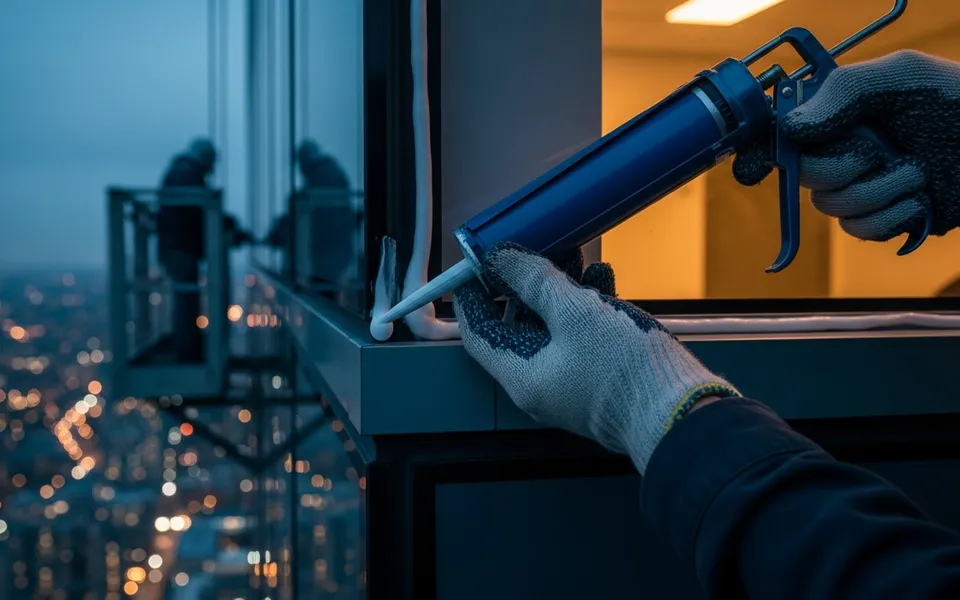
Commercial caulking in Toronto: high-rise sealant programs and lifecycle
Caulking in Toronto high-rises operates on a 7–10 year lifecycle, and the buildings that defer it usually pay twice — first in lost energy, then in capital reserve when the façade catches up.
Quick answer
Commercial caulking on Toronto high-rises follows a 7–10 year design life — often shorter on lakeshore towers exposed to wind and freeze-thaw. Programs cover window perimeters, control joints, expansion joints, and penetration sealing. Failed caulking causes water intrusion, energy loss, and drafty units. Re-sealing on a schedule beats reactive crisis re-sealing on every metric: cost, disruption, and reserve fund impact.
Why Toronto high-rise sealants fail faster than their design life
Commercial-grade polyurethane and silicone sealants used on Toronto high-rise window perimeters and curtain-wall joints are rated for a 10-to-20-year service life under standard laboratory conditions. The operative phrase is 'standard conditions' — and Toronto high-rise conditions are not standard. The combination of lake-effect humidity in summer, freeze-thaw cycling through winter (with temperatures crossing the critical 0°C threshold dozens of times per season), ultraviolet exposure on south and west elevations, and the thermal movement of large glazed facades creates a loading environment that shortens useful sealant life substantially.
Wind is the factor that receives the least attention in capital planning discussions and does the most damage over time on lakeshore and mid-rise towers. Wind-driven rain at the joint face creates a differential pressure across the sealant bead — pushing water toward any gap in the adhesive bond while simultaneously flexing the joint. Buildings on the western lakeshore experience sustained wind exposure that interior GTA buildings do not. The windward elevation of a lakeshore tower will degrade faster than the leeward side by a meaningful margin, and a sealant program that applies a uniform replacement schedule across all four elevations is either over-investing on protected sides or under-investing on exposed ones.
The practical planning figure for Toronto high-rise sealant programs is 7–10 years for the first re-seal after original installation, with subsequent cycles potentially shorter depending on product quality and application conditions. Buildings that have never been re-sealed since construction and are in or past that window are carrying a deferred maintenance liability that will become visible — and expensive — without much additional notice. A proactive assessment is the responsible response; reactive repair after water intrusion is the expensive one.
What a commercial sealant program actually covers
A complete high-rise sealant program covers four categories of joint: window perimeter seals, control joints, expansion joints, and penetration seals. Each category has different movement requirements, product specifications, and failure modes. Understanding the difference is important for a property manager or reserve-fund consultant trying to scope and price a program accurately.
Window perimeter seals are the highest-profile category — the bead of sealant running around the perimeter of each window unit at the interface with the building wall or frame. These seals carry two jobs simultaneously: excluding weather and accommodating thermal movement as the window and wall expand and contract at different rates. A window perimeter seal that is the wrong width, the wrong depth, or installed without a proper backer rod cannot do both jobs effectively and will fail early. On a 30-storey building with multiple windows per floor, window perimeter seals represent a significant lineal footage of joint to assess and maintain.
Control joints and expansion joints are designed into the building structure to accommodate movement — they are not construction defects but intentional break points in concrete, masonry, or cladding systems. The sealant in a control joint must be able to compress and extend without tearing or losing adhesion. Expansion joints on large buildings move more than control joints and typically require wider sealant beads with higher movement ratings. Penetration seals — at pipe penetrations, conduit entries, and mechanical unit perimeters — are smaller in scale but important for air and moisture exclusion. A sealant assessment that ignores penetration seals is leaving water pathways unaddressed.
Visible signs of failure that property managers see first
The most reliable early-warning signal for sealant failure is the one that comes from inside the building: resident complaints about drafty windows or cold spots on exterior walls. A sealant bead that has lost adhesion at one interface — pulling away from either the glass or the frame, but not yet showing a visible exterior crack — is already admitting air infiltration. The resident on a windy November night feels the cold air as a draft; the property manager logs it as an HVAC complaint; the actual cause is a failed sealant joint on the exterior face that no one has looked at closely enough to diagnose.
Condensation patterns on interior glass and wall surfaces are a related signal. Condensation that appears on the interior wall surface, the window sill, or the junction between the window frame and the surrounding drywall indicates that cold, moisture-laden outdoor air is reaching the interior assembly — which means the exterior seal has failed. This is a different presentation from normal window glass condensation (which happens on the cold glass surface) and should be treated as a sealant failure signal until proven otherwise. A competent inspector can distinguish the two patterns in a single visual assessment.
Visible cracking at the exterior joint is a later-stage symptom for some failure modes and an early signal for others. UV degradation presents as surface chalking — a white or grey powder on the sealant surface that appears before structural cracking develops and indicates the polymer matrix is breaking down. Cohesive failure (the sealant tearing through the middle) and adhesive failure (the sealant pulling away from the substrate) both produce visible gaps that are detectable from close-up inspection and sometimes from the ground on lower floors. For a complete picture of joint condition across all elevations and floors, a swing-stage or rope-access assessment is the correct tool — grade-level observation misses the majority of failures on upper floors.
Re-sealing on a schedule versus reactive crisis management
The capital planning case for proactive sealant programs is straightforward: a scheduled re-seal at or before end-of-life costs significantly less than the combination of emergency re-sealing and interior remediation that follows water intrusion. The math changes once water enters a building. A failed sealant joint that admits water into a wall assembly starts a secondary damage sequence that involves drywall replacement, mould remediation, insulation replacement, and sometimes structural repair depending on how long the intrusion went undetected. The sealant repair is a fraction of the total remediation cost.
For reserve-fund consultants and property managers preparing multi-year capital plans, the sealant program is one of the few line items where the deferral cost is calculable with reasonable precision. A building approaching the 8–10 year mark since original installation or last major re-seal can be modelled as carrying an end-of-life sealant liability that will crystallize as either a planned re-seal or an unplanned remediation — and the planned version is consistently less expensive. Presenting this to a board as a scheduled capital expenditure rather than an unpredicted emergency is the outcome of a working proactive maintenance program.
The scheduling advantage is practical as well as financial. Emergency re-sealing after water intrusion requires mobilizing crews on short notice, often at premium rates, with limited ability to choose the optimal weather window for sealant application. Planned re-sealing is scheduled in the spring-through-fall window when temperatures and humidity levels are within the product's application specifications, when scaffold and swing-stage access can be planned efficiently, and when the work can be coordinated with other exterior services. See the related post on summer humidity and sealant failure for a deeper look at the seasonal failure mechanisms — this program-level guide covers the lifecycle and scheduling decisions; the seasonal post covers the material science.
Working at Heights and rope-access execution on Toronto high-rises
Any sealant work above 3 metres on a Toronto building falls under Ontario's Working at Heights requirements — the Ministry of Labour regulations covering fall protection planning, equipment, and worker certification. For a property manager, this means confirming that the contractor's technicians are current on their Working at Heights training and that the company holds a current WSIB clearance, which verifies coverage for the workers on your property.
The access method for high-rise sealant work is determined by the building's anchor points, the geometry of the facade, and the scope of joints to be addressed. Rope access — where technicians descend from roof anchors on certified rope systems — is faster and less disruptive than swing-stage setup for buildings with adequate anchor infrastructure. Swing stages are required for buildings without suitable roof anchors or for scopes that require horizontal movement across the face of the building. A contractor who proposes only one access method without assessing the building's anchor layout is not giving you the right answer for your building — the correct access method depends on a site assessment.
Residents typically see rope-access or swing-stage crews on the exterior face of the building during sealant work but are not directly affected — the work is done from outside the building envelope, and units do not lose access or functionality during the program. For buildings with units in the active sealant work zone, a courtesy notice to residents is appropriate, identifying the floors being worked and the approximate duration. This is standard practice and prevents alarm when residents see technicians descending past their windows.
Pairing caulking with exterior inspections and window cleaning for single-visit efficiency
The most efficient commercial caulking programs in Toronto are not run as standalone scopes — they are run as part of an integrated exterior maintenance visit that combines sealant assessment and re-sealing with at least one other close-up exterior service. The rationale is access efficiency: mobilizing swing stage or rope access equipment is the expensive part of any at-height exterior program, and once the equipment is in position, the marginal cost of adding a second service from the same access point is much lower than a separate mobilization.
The two most natural pairings for caulking work are exterior inspections and window cleaning. An exterior inspection done during the sealant program uses the same close-up access to assess drainage condition, façade cladding, balcony railings, and other envelope elements — delivering a complete photo-documented condition report from one visit rather than requiring a second mobilization. Window cleaning, similarly, can be done from the same rope access or swing stage position, covering the window face at the same time the perimeter joint is re-sealed. The combined scope produces a cleaner exterior and a documented sealant baseline in one visit.
For property managers with caulking and sealants as part of a master service agreement, this integration happens automatically — the account manager coordinates the service schedule to stack access-intensive exterior scopes into combined visits, reducing total building disruption and mobilization costs across the year. The same photo documentation covers both scopes, and the completion report drops into the board package as a single integrated record. Contact us to discuss a sealant assessment for your building — responses arrive within 48 hours, and the assessment includes a prioritized joint inventory and recommended program schedule. On buildings where the sealant work reveals surface coating failures, the same swing-stage visit is a natural trigger for commercial exterior painting — sealing first, then coating, in the correct sequence protects both the repair and the investment. Similarly, pairing the caulking program with commercial window cleaning in the same access mobilization covers the window perimeter joint and the glass surface in a single visit rather than two.
Frequently asked questions
How long does commercial building caulking last in Toronto?
Design life for commercial-grade sealants is 10–20 years under standard conditions, but Toronto's freeze-thaw cycling, wind exposure, and high summer humidity typically shorten useful life to 7–10 years on a well-protected elevation — and 5–8 years on the windward or lakeshore-facing side. The summer humidity and sealants post covers the material science in detail; this program covers the scheduling and capital planning response.
What are the visible signs of caulking failure on a Toronto high-rise?
The signs vary by failure mode. Surface chalking (white powdering on the sealant face) is early-stage UV degradation. Visible cracking along the bead or gaps at the sealant-substrate interface are mid-stage mechanical failure. Interior symptoms — condensation at window perimeters, drafts near exterior walls, or water staining on interior walls below windows — indicate that a failure has already allowed moisture or air to enter the building assembly. Interior symptoms mean the repair scope has grown beyond re-sealing. See caulking and sealants for assessment options.
How disruptive is re-caulking for residents?
Minimal. Rope access and swing-stage work is done entirely from outside the building envelope. Residents on affected floors may see technicians descending past their windows during work hours, but units remain fully accessible and no work enters the building interior. A courtesy notice to residents on floors in the active work zone is standard practice — identifying the floors being worked and the approximate duration is all that's required.
Can caulking be scheduled in winter on a Toronto building?
Most commercial sealant products have minimum application temperature requirements — typically 5°C or higher — and require dry substrates for proper adhesion. Toronto winter conditions (sub-zero temperatures, freeze-thaw cycles, snow and ice on surfaces) fall outside those application windows for most products. Some cold-weather formulations allow work in temperatures down to -10°C, but they carry limitations on movement capability and long-term performance. The practical scheduling window for sealant programs in Toronto is May through October, with fall the preferred period for catching joints before winter loading begins.
Schedule a sealant assessment for your Toronto high-rise.
Tell us about your building. Full quote in 48 hours, guaranteed.
Serving Toronto, Mississauga, Brampton, Vaughan, Markham, Richmond Hill and the entire GTA.