
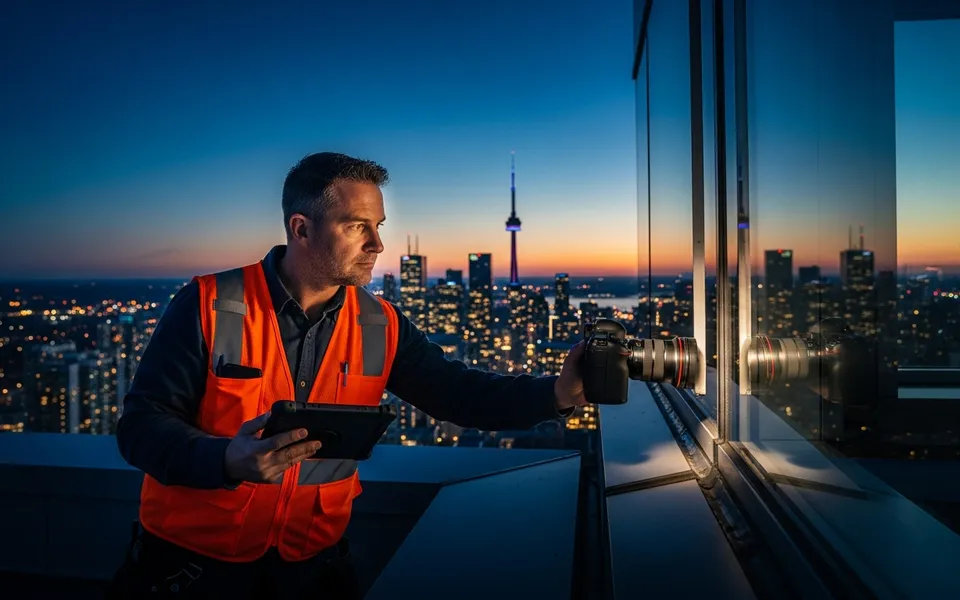
Toronto commercial building inspection guide: what property managers need to know.
A structured commercial building inspection program in Toronto is the difference between a capital plan built on documented evidence and one built on educated guesses — and in the GTA's demanding climate, guesses become expensive emergencies.
Quick answer
Commercial building inspections in Toronto should run twice annually — spring to assess winter damage, fall to identify what needs addressing before the next freeze-thaw cycle. A complete inspection covers the exterior envelope, interior common areas, life-safety elements, and accessibility features. Findings should be photo-documented, prioritized into urgent/this-cycle/monitor tiers, and formatted to feed capital planning directly. The Free Building Health Report provides this at no cost.
Why commercial building inspections differ from code-mandated checks
Ontario commercial buildings are subject to a range of mandated inspection programs — fire safety inspections under the Ontario Fire Code, elevator inspections through the TSSA, backflow preventer inspections, and emergency lighting testing, among others. These mandated programs are specific, periodic, and focused on life-safety and equipment compliance. What they don't address is the broader condition of the building's envelope, common areas, and deferred maintenance profile — the set of building condition questions that drive capital planning decisions and insurance renewal positioning.
A property manager's commercial building inspection fills that gap. It is not a code-mandated activity; it is a management best practice that generates the condition information a capital plan requires. A well-executed commercial building inspection answers questions like: Which sealants are at end-of-life and need re-sealing before the next winter cycle? Where is the exterior coating showing failure, and what is the risk if we defer it another budget year? Which corridor floors have degraded to the point where spot repairs are no longer cost-effective and a full replacement cycle should be budgeted? These are not fire-code questions — they are building-management questions that require a different kind of inspection from the ones that code requires.
The distinction matters for GTA property managers because treating mandated code inspections as a substitute for condition inspections is a common error that produces unpleasant surprises. A building whose fire safety inspection and elevator certificates are current, but whose exterior sealants have not been professionally assessed in eight years, is a building whose compliance file is clean and whose capital plan has a significant unknown exposure. The Free Building Health Report addresses this specifically — it is a condition inspection, not a code compliance check.
Spring and fall: the GTA's two-inspection rhythm
The twice-yearly inspection rhythm for Toronto commercial buildings is structured around the GTA's two primary stress events: winter and the recovery from it. The spring inspection — typically April or early May, once freeze-thaw has stabilized and the ground has drained — assesses the damage that winter inflicted on the building's exterior envelope and common areas. You're looking at what the freeze-thaw cycles cracked, what the road salt spray deposited and corroded, what ice loading on drainage systems dislodged or damaged, and what the February-March temperature swings did to sealant beads that were already at or near end-of-life.
The fall inspection — September or October, before sustained cold temperatures arrive — has a different purpose: it identifies what needs to be addressed before the next winter cycle begins. A sealant joint identified as degraded in the fall inspection, if re-sealed before November, never experiences a freeze-thaw cycle in its compromised state. The same joint identified in the spring, after the winter has exploited it, may have allowed water ingress that expanded the damage from a re-sealing job to an interior water damage remediation. The cost difference is significant. For more on the seasonal sealant cycle, see what summer humidity does to high-rise sealants.
Between spring and fall, a mid-summer check is appropriate for buildings with known envelope vulnerabilities — active water infiltration, recent storm events, or buildings in an active construction zone where adjacent site work may have deposited debris or caused vibration-related damage. For buildings in stable condition, the twice-yearly rhythm is the standard, and the fall inspection's output should be the primary input to the following year's capital planning and maintenance budget cycle. The spring inspection visit pairs naturally with commercial pressure washing of the podium and entry plaza — both happen in the same late-April to May window, and combining them under one mobilization gives the property manager a complete exterior condition picture alongside the clean surface. For a broader view of how inspection programs fit within the full ten-category maintenance scope, the commercial property maintenance guide for Toronto covers the scheduling and compliance context for each category.
Exterior envelope: the inspection sequence that catches what walks miss
The exterior envelope inspection for a Toronto commercial building requires more than a grade-level walk-around with binoculars. Grade-level inspection is useful for large-scale visible deficiencies — large facade cracks, displaced brick, significant staining patterns — but it cannot detect the adhesion failures in sealant beads that are the leading cause of water ingress in GTA high-rises. Adhesion failure — where the sealant has begun to separate from the substrate at the bond line — is invisible from grade and only detectable by probing the joint at close range. For buildings above four storeys, this means the envelope inspection requires the same above-grade access as other exterior maintenance services: boom lift, rope access, or swing stage.
The inspection sequence for a complete envelope assessment begins at the roof level and works downward. Roof drainage — drains, scuppers, and any flat-roof areas — should be checked for obstruction, debris accumulation, and membrane condition where accessible. Below the roofline, the inspection proceeds elevation by elevation: window perimeter sealants (visual condition, probing for adhesion), control joints (visual and probe), door frame sealants, penetration flashings, and the condition of any exterior coatings on concrete or masonry. Each finding is photographed with enough context to identify the exact location on the building facade — individual joint, window number, or elevation reference — so that the remediation crew can locate it precisely without conducting their own assessment.
Wall staining deserves specific attention during every GTA commercial building inspection. Brown or rust-coloured streaking on concrete or stucco facades indicates rebar corrosion — water has penetrated the cover concrete and reached the reinforcing steel, which is now oxidizing and expanding. This is a structural concern, not a cosmetic one, and it warrants a more detailed assessment than the general inspection provides. White efflorescence (chalky mineral deposits on brick or concrete) indicates water migration through the assembly and is diagnostic of an admission point above the staining. Both patterns are common on GTA buildings in the 20-to-40-year age range, and both should be flagged for follow-up assessment when found. Pair the inspection findings with our Exterior Inspections service for close-up access and detailed documentation.
Interior common areas: what to look for floor by floor
Interior common-area inspections are less technically complex than exterior envelope inspections, but they're equally important for capital planning and equally easy to underestimate. The lobby is the highest-scrutiny space in the building — it's what ownership, prospective tenants or purchasers, and board members see when they enter. Lobby floor condition (wear patterns, surface degradation, transition strips, mat condition), wall and ceiling finish condition, lighting levels and fixture condition, signage, and the condition of any feature elements (glass partitions, accent walls, reception desks) should all be assessed and photographed. For lobby floor care and maintenance scheduling, see the Floor Care service page.
Corridor inspections should be conducted floor by floor, or at minimum sampled across a representative set of floors (typically the highest, lowest, and a middle floor, plus any floor with known issues). The corridor inspection covers wall paint condition (scuffing patterns, impact marks from move-ins, fading and chalking), flooring condition and wear patterns, door hardware (closers, hinges, handles, and lock condition), suite door frame integrity, corridor lighting, and any evidence of water infiltration — staining or bubbling below window lines is a reliable indicator of a failed exterior perimeter sealant above it. Interior water staining tied to an exterior location is one of the most useful outputs of a combined interior/exterior inspection, because it lets you correlate interior symptoms with specific exterior admission points.
Stairwells and mechanical rooms are often inspected less thoroughly than lobbies and corridors, but they carry disproportionate liability if life-safety or structural issues are present. Stairwell inspections cover handrail integrity and mounting (a loose handrail is an injury waiting to happen), wall and floor conditions, lighting levels for egress adequacy, and evidence of water intrusion from roof penetrations or wall cracks. Mechanical rooms should be assessed for signs of active water infiltration — staining on walls, water marks on the floor, rust on mechanical equipment that indicates sustained moisture presence — as well as any obvious drainage issues. Document every finding with photographs referenced to floor and room.
Life-safety and accessibility: the overlooked inspection categories
Life-safety elements in commercial and multi-residential buildings are subject to mandatory inspection and testing programs, but the property manager's condition walk-through should include a visual pass on visible life-safety components regardless of whether the most recent mandated inspection is current. Exit signage should be verified as illuminated and unobstructed — an exit sign with a dead lamp, or an exit sign obscured by a storage cart left in a corridor, is a deficiency that should not wait for the next annual fire inspection. Emergency lighting units should be tested (push-button test activators are typically accessible on corridor units) to confirm battery backup function.
Fire extinguisher tags should be checked for currency — service tags that are over one year old or have no service stamp indicate that the unit has not received its required annual inspection. Stairwell doors should be tested for self-closing and positive latching — a stairwell door that props open or fails to latch is a fire separation deficiency. Note that none of this replaces code-mandated fire safety inspections; it is a supplementary check that catches deficiencies between mandated cycles, preventing them from persisting for months until the next formal inspection.
Accessibility features deserve the same systematic attention. Automatic door openers at accessible entrances should be tested for response and force calibration — a door opener that responds too slowly or requires excessive force to override is not serving its accessibility function. Accessible washroom grab bars should be tested for secure mounting. Tactile flooring elements at accessible entrances should be checked for damage or displacement. Ontario's AODA requirements apply to most commercial building types, and accessibility deficiencies found during a third-party inspection or a tenant/resident complaint carry remediation costs and potential escalation risk. Catching them during your own walk-through is substantially less expensive than having them surfaced externally.
Documenting inspection findings for capital planning
The output of a commercial building inspection is only as useful as its documentation quality. An inspection that produces a verbal debrief or a handwritten list is not a capital planning input — it's a conversation that will be reconstructed inaccurately by the time the annual budget cycle arrives. Every commercial building inspection should produce a written findings document with three elements: a photograph for each finding with a location reference (floor, elevation, and specific location within that space), a written description of the condition found and the assessor's interpretation of urgency, and a prioritization tier for each finding.
The three-tier prioritization model used by property management practitioners divides findings into: address immediately (conditions that are urgent for safety, code compliance, or ongoing damage risk — a loose handrail, an active water infiltration point, a blocked roof drain during spring melt); address this maintenance cycle (conditions that are deteriorating and should be addressed before the next inspection cycle without being immediately urgent — failed sealants at end-of-life, significant floor wear approaching replacement threshold, paint condition that has degraded past maintenance-level remediation); and monitor (conditions that are stable but should be documented and tracked for progression — hairline cracks in stable masonry, surface chalking on sealants that are not yet adhesion-compromised).
This three-tier output drops directly into capital planning conversations. Board members and ownership can review a categorized findings list and make prioritization decisions based on actual building condition data rather than the property manager's verbal assessment. Reserve fund consultants can reference current condition photographs in their component lifecycle projections. The documentation also protects the property manager: a known condition that is documented, categorized, and included in board reporting carries different liability treatment than an undiscovered condition. The Exterior Inspections service and Free Building Health Report both generate output in this format. Contact us to schedule a walk-through.
Frequently asked questions
What is included in a commercial building inspection in Toronto?
A complete commercial building inspection in Toronto covers the exterior envelope (roof drainage, sealants and caulking at window perimeters and control joints, facade condition and staining, exterior coatings), interior common areas (lobby, corridors, stairwells, mechanical rooms), life-safety elements (exit signage, emergency lighting, fire extinguisher tags, stairwell door function), and accessibility features (automatic door openers, accessible washroom hardware, tactile flooring). Each area is photographically documented with a written description and prioritization tier. The Free Building Health Report covers this full scope at no cost for qualifying GTA properties.
How does a commercial building inspection differ from a reserve fund study?
A commercial building inspection is a current-condition assessment — it documents what exists now and prioritizes near-term remediation. A reserve fund study is a long-range financial projection (typically 30 years) that estimates the remaining useful life of major building components and calculates required annual reserve contributions to fund future replacements. The two are complementary: current inspection photographs and condition data feed the reserve fund study's lifecycle assumptions, and the reserve fund study's component schedules inform which items the inspection should scrutinize most closely. The Free Building Health Report generates inspection-level output; reserve fund studies are conducted by separate licensed engineering consultants.
Does a Toronto commercial building need a structural engineer for a building inspection?
It depends on what is found. A property manager's condition inspection — or the Free Building Health Report conducted by a trained Master Building Services technician — is appropriate for assessing general building condition, identifying maintenance and capital planning priorities, and documenting the building's surface condition. If that inspection identifies findings that indicate structural concern — rebar corrosion (evidenced by rust staining and concrete spalling), significant facade cracking, or unexpected structural movement — those specific findings should be referred to a licensed structural engineer for a professional engineering assessment. The condition inspection scopes and flags; the structural engineer assesses the flagged items in depth.
How do I use inspection findings in a board presentation?
Inspection findings formatted in three tiers — address immediately, address this cycle, and monitor — are designed to present to a board without requiring the board to assess urgency themselves. Present the immediate-action items first, with the supporting photographs and a brief description of the risk of deferral. Present the current-cycle items with a proposed scheduling and cost range. Present the monitor items as a documented watch list. This structure lets the board make decisions (approve, defer, request engineering review) without requiring technical judgment they may not have. Photo documentation makes the debrief concrete rather than abstract. See how we format reports at our Free Building Health Report.
Start with a free Building Health Report.
Tell us about your building. Full quote in 48 hours, guaranteed.
Serving Toronto, Mississauga, Brampton, Vaughan, Markham, Richmond Hill and the entire GTA.