
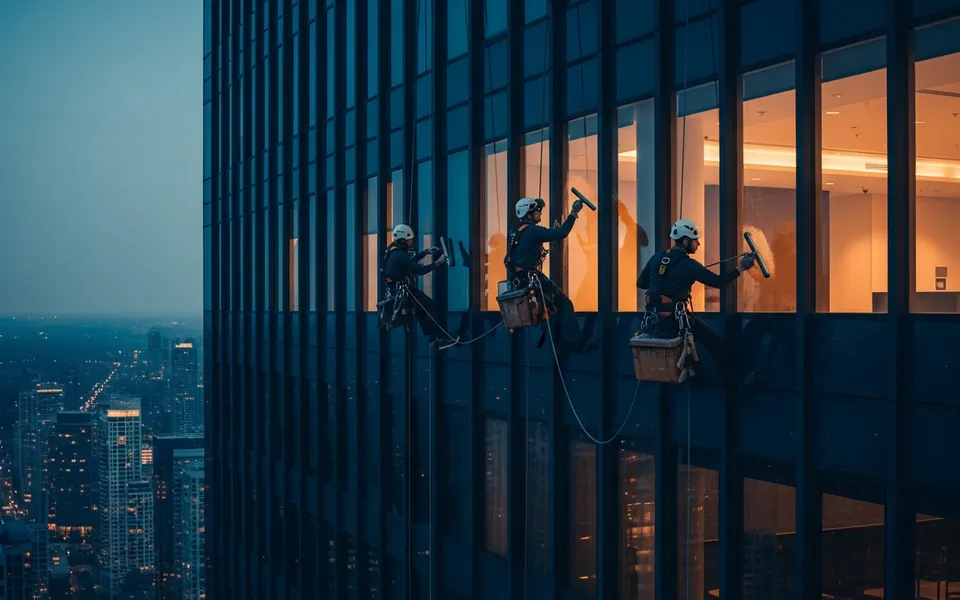
Commercial window cleaning in Toronto: frequency, access, compliance, and what to expect.
Commercial window cleaning in Toronto is more than an aesthetic service — at height, it involves Working at Heights certification, rope access or swing stage logistics, and compliance documentation that property managers need in their files before any crew goes above grade.
Quick answer
Commercial window cleaning in Toronto requires WSIB-cleared crews with current Working at Heights certification, and for buildings above four storeys, rope access or swing stage access rather than ladders. GTA buildings typically clean exterior windows two to four times per year, with frequency driven by building type, occupant expectations, and elevation exposure. Interior common-area glass (lobby, corridor windows, elevator doors) follows a separate, more frequent schedule tied to janitorial programs. Every visit should generate photo-verified completion documentation.
Window cleaning in Toronto: the GTA-specific context
Commercial window cleaning in the Greater Toronto Area operates in a specific context that differs from window cleaning in milder Canadian cities. The GTA's seasonal cycle deposits a year-round accumulation on exterior glass that is more varied and more aggressive than most markets: winter road salt spray on lower-floor windows, spring algae and mineral deposits from snowmelt and rain runoff, summer pollution haze from urban air quality and construction dust, and fall leaf residue and organic matter from deciduous tree canopy near mid-rise buildings. Each season leaves a different residue type that benefits from different cleaning chemistry and, in some cases, different timing.
The other GTA-specific factor is wind exposure. Toronto's tower district — the concentration of 50-to-80-storey residential condominiums in the downtown core and the emerging Vaughan Metropolitan Centre and North York clusters — creates street-level wind tunnels and elevated building-face wind loads that affect the accessibility windows available for rope access and swing stage operations. High-wind days cancel exterior high-rise window cleaning, and GTA spring and fall can produce weeks where wind conditions limit scheduling to indoor glass and lower-floor work. Property managers planning exterior window cleaning for mid- and high-rise buildings should factor weather-day variance into their scheduling expectations.
Finally, there's the compliance dimension. Ontario's Working at Heights Training Standard requires that any worker performing tasks at heights above three metres complete a mandatory certified training program. For window cleaning crews working on ladders or elevated equipment at any meaningful commercial building, this is a non-negotiable certification requirement — and the burden of verifying current certification is on the property manager who authorizes the work, not the contractor. See the Window Cleaning service for how Master Building Services structures compliance documentation as part of standard onboarding.
Access methods: low-rise, mid-rise, and high-rise windows
The access method for commercial window cleaning is determined by building height, facade configuration, and the availability of permanent or temporary access systems. Low-rise commercial buildings — two to four storeys — are typically serviced from ground-based equipment: extension ladders, water-fed pole systems, or boom lifts. Water-fed poles, which use purified water delivered through a brush head on a telescoping pole, have become the dominant method for low-rise commercial cleaning because they eliminate the setup time and traffic disruption of boom lifts while delivering streak-free results on glass treated with purified (deionised) water.
Mid-rise buildings — five to fifteen storeys — typically require a boom lift or a roof-mounted anchor system for rope access. Boom lift operations in dense Toronto urban environments require permits and traffic management in many cases — particularly on downtown streets where sidewalk closures affect pedestrian flow. Property managers planning a mid-rise window cleaning program should confirm whether the cleaning vendor handles permit applications as part of the scope, or whether the property manager is responsible for permit filing. Master Building Services handles permit filing as part of the engagement for any work requiring a street or sidewalk closure.
High-rise buildings — above fifteen storeys — are cleaned using rope access (rappelling technicians with certified descent gear and fall arrest systems), swing stage (temporary suspended platforms rigged from building rooftops), or Building Maintenance Units (BMUs) where permanent equipment is installed as part of the building's original design. Rope access is the most common method for GTA high-rise window cleaning and requires specific certifications (Working at Heights, and in practice the IRATA or SPRAT rope access certification levels), insurance documentation specific to elevated work, and anchor point inspections. At height, a single compliance gap creates serious liability exposure. Pair window cleaning with our exterior inspections program to use the same access mobilization for both services.
How often should a GTA commercial building clean its windows?
The standard scheduling framework for commercial window cleaning in Toronto is driven by building type, occupant expectations, and specific facade conditions. The baseline for most GTA mid-rise commercial and residential buildings is twice-yearly exterior window cleaning — once in spring, after the winter road salt and winter grime has been deposited, and once in early fall, before the building goes into winter with accumulated summer pollution. This twice-yearly rhythm is the minimum defensible standard for most mid-rise buildings with standard glazing.
Buildings with specific conditions benefit from additional cleaning cycles. Lobby glazing on a street-level retail frontage, particularly on a high-traffic corner or intersection, typically needs quarterly cleaning — the pedestrian traffic, vehicle exhaust, and direct weather exposure accumulates faster than a twice-yearly program addresses. High-rise buildings with a premium rental or ownership demographic often specify quarterly or even monthly cleaning on selected elevations (typically the building entrance and principal street-facing facade) to maintain a presentation standard consistent with the building's market positioning. Buildings near construction sites may require an additional interim cleaning cycle after a nearby project phase that deposited concrete dust, dust from excavation, or construction debris on the glass.
Interior common-area glass follows a different schedule from the exterior program. Lobby entrance glass — the interior face of entrance door glazing, lobby partitions, and interior glass walls — is typically cleaned as part of the janitorial program rather than the window cleaning program. Elevator doors and interior elevator glass, corridor sidelights, and interior lobby features are janitorial-scope items. The practical scheduling question for most property managers is which scope is the right division of responsibility — and making sure that neither interior lobby glass nor elevator glass falls into the gap between the janitorial and window cleaning contracts. Coordinating both under the same building services agreement eliminates that gap.
Compliance documentation for commercial window cleaning
The compliance file for commercial window cleaning in a GTA building is more substantive than for most building maintenance services, because the above-ground access component introduces Working at Heights regulation requirements alongside the standard WSIB and COI documents. Before authorizing any exterior window cleaning above grade, a property manager should hold three compliance documents: a current WSIB clearance certificate for the cleaning company, a COI at your required liability minimum with your organization named as additional insured, and evidence of current Working at Heights training certification for the specific crew members who will be on-site.
Working at Heights training certification must be completed through an approved training provider under the Ontario Working at Heights Training Standard, administered by the Ministry of Labour, Immigration, Training and Skills Development. The certification is valid for three years and must be renewed before expiry. Unlike WSIB clearance (which covers the employer) and COI (which covers the company), Working at Heights certification is individual — it must cover the specific workers who will be working at height on your property, not just the company as a whole. Property managers who request 'Working at Heights certification' should confirm that the certificates provided name the individual workers on the scheduled crew.
For rope access work specifically, voluntary industry certifications (IRATA or SPRAT) are considered the professional standard, though they are not legally mandated by Ontario regulation. Property managers who engage rope access crews for high-rise window cleaning should ask whether the crew holds one of these certifications, as they require progressive training, regular medical fitness assessments, and competency sign-off by a higher-level certificate holder. A crew that holds IRATA or SPRAT certification alongside Ontario Working at Heights certification is demonstrably more qualified for elevated access work than a crew that holds only the statutory minimum.
What happens during a commercial window cleaning visit
For property managers scheduling their first commercial window cleaning program, understanding the operational sequence helps set expectations and avoid scheduling conflicts. The pre-visit step is access coordination: for rope access and swing stage work, the building's roof access pathway needs to be clear on the scheduled day, and any building infrastructure that would be in the rope routing (rooftop HVAC equipment, penthouses, etc.) needs to be accessible. For boom lift operations, parking lot or driveway access needs to be free of vehicles in the planned equipment path.
The visit itself begins with the crew's safety briefing and anchor point inspection (for rope access) or stage rigging (for swing stage). Neither happens quickly on a complex facade — a building with multiple anchor configurations may require an hour of setup before cleaning begins. This setup time is part of the visit scope and should be factored into scheduling windows. The cleaning sequence typically runs top-to-bottom on each elevation, working in defined sections. Photo documentation of completed sections is taken progressively, so the completion report includes photographic coverage of the full facade on completion rather than a single end-of-day photo.
The post-visit deliverable is the completion report — the document that confirms which sections were cleaned, when, by whom, and what the condition was on completion. For property managers who include window cleaning in their monthly board reporting package, this report should arrive within 24 hours of the visit in a format that can be dropped directly into a board presentation without reformatting. Completion reports formatted for board presentation are standard for Master Building Services accounts; ask about the documentation format before signing any window cleaning agreement, as documentation quality varies significantly across the GTA market.
Bundling window cleaning with exterior maintenance
Commercial window cleaning mobilizes equipment and access that is also useful for other exterior maintenance tasks — sealant inspection, sealant touch-up, facade condition assessment, and exterior painting. When window cleaning and these complementary services are performed by the same vendor during the same access mobilization, the per-task cost of the bundled work is consistently lower than the cost of two separate mobilizations by two separate vendors. The access setup — boom lift travel to the site, traffic management setup, rope access rigging — is a significant cost component for any above-grade exterior work. Doing it once instead of twice, for two scopes instead of one, concentrates that cost across more delivered work.
For GTA property managers, the practical example is the fall window cleaning visit. A rope access team cleaning windows in October is the same team that should be doing sealant inspections before winter. If the window cleaning crew and the sealant inspection crew are different vendors, you're paying for two access mobilizations to the same building, and neither crew has visibility into what the other found. If they're the same team under a single building services agreement, the fall cleaning visit includes a sealant condition assessment at no additional mobilization cost, and findings go into one completion report that covers both scopes.
This is the bundling logic that underpins the master service agreement model for GTA buildings. The more exterior maintenance services are consolidated under one contract, the fewer times the building pays for access mobilization and the more complete the inspection coverage is on each visit. See Caulking and Sealants and Exterior Inspections for the complementary scopes that most naturally pair with a window cleaning program, or contact us to discuss a bundled exterior maintenance quote. Spring is also the right moment to pair exterior window cleaning with commercial pressure washing of entry plazas and parking podiums — both benefit from the same mobilization window, and for buildings approaching the 7-to-10-year mark, adding a high-rise caulking assessment to the same visit avoids a second access trip entirely.
Frequently asked questions
How much does commercial window cleaning cost for a Toronto high-rise?
We don't publish unit rates because building-specific variables — facade complexity, number of units, access configuration, elevation exposure, and frequency — determine the actual scope and cost. What we can tell you is that the right structure is a flat-rate per-visit agreement with no escalators, scoped in writing per elevation and per visit. Submit your property details through our contact form and receive a full written quote within 48 hours of a site assessment.
Can commercial windows be cleaned in winter in Toronto?
Exterior window cleaning in winter is constrained by two factors: temperature (most window cleaning solutions and purified water systems are ineffective or hazardous below approximately -5°C) and access safety (rope access and swing stage work in icy conditions introduces fall risk that exceeds normal elevated-access risk levels). In practice, exterior high-rise and mid-rise window cleaning in the GTA pauses from approximately December through February and resumes in March or April depending on conditions. Interior glass — lobby entrance panels, corridor windows, elevator doors — can be maintained year-round on the janitorial schedule. The Window Cleaning service page covers seasonal scheduling in detail.
What's the difference between window cleaning and facade washing for a commercial building?
Window cleaning specifically addresses glass surfaces — removing mineral deposits, pollution film, and organic matter from glazing. Facade washing (more accurately called pressure washing or soft washing, depending on the method) addresses the non-glass building exterior: concrete, brick, EIFS/stucco cladding, aluminum panels, and podium surfaces. Both services use above-grade access for multi-storey buildings and both require WSIB clearance and Working at Heights certification for elevated crews — but they address different substrates and typically use different chemistry. Pairing window cleaning with pressure washing in the same access mobilization is efficient for any building where both the glass and the facade cladding need attention.
How do I verify that a Toronto window cleaning company is properly certified for high-rise work?
Request three documents before authorizing any high-rise window cleaning work: (1) a current WSIB clearance certificate for the company; (2) a COI with your organization named as additional insured; and (3) individual Working at Heights training certificates for each crew member who will be on your property. For rope access crews, also ask whether workers hold IRATA or SPRAT rope access certification — these voluntary industry certifications are the professional standard for rappelling work. For rope access anchor points, ask for documentation of the most recent anchor inspection. Any qualified high-rise window cleaning company should provide all of these without hesitation. Difficulty producing them is a disqualifying signal. See locations we serve in Toronto for our service area coverage.
Ready to schedule commercial window cleaning?
Tell us about your building. Full quote in 48 hours, guaranteed.
Serving Toronto, Mississauga, Brampton, Vaughan, Markham, Richmond Hill and the entire GTA.