
Exterior painting for Toronto commercial buildings: substrate, schedule, and what changes the price
Exterior painting for Toronto commercial buildings — stucco, metal, concrete, wood — runs on weather windows tighter than the calendar suggests, and the substrate determines almost everything else about the program.
Quick answer
Toronto commercial exterior painting depends on three things: substrate (stucco vs metal vs concrete vs wood), surface prep, and weather window. Surface prep is 80% of the lifespan. Weather-grade coatings are mandatory for the Toronto freeze-thaw cycle. Programs typically run May through October. Quotes within 48 hours include access method, prep scope, product selection, and weather-contingency language.
Substrate determines everything else
The single biggest variable in a Toronto commercial exterior painting program isn't the colour or even the brand of coating — it's what the coating is going on. Stucco, metal, concrete, and wood each have different prep requirements, different product chemistry, and different recoat cycles. Get the substrate analysis wrong and you're repainting in half the expected time.
Stucco is the most common substrate on Toronto mid-rise condos and commercial buildings built through the 1990s and early 2000s. It's absorbent, it cracks at control joints when the building moves, and it needs an elastomeric or breathable coating that can flex with seasonal movement. Applying a rigid product to stucco creates bridging failures within a few freeze-thaw cycles.
Metal substrates — parapet caps, mechanical screens, curtain wall trim, canopies — need rust-inhibiting primers and coatings formulated for metal adhesion. Bare or rusting metal is often the result of a previous paint job where the prep was skipped. Concrete, which appears on parkade decks, podium soffits, and exposed structural elements, requires a penetrating primer and a product with CO2 and chloride-ion resistance. Wood substrates, less common on commercial buildings but present on older stock and some heritage facades, need the shortest recoat cycle of the group — typically every five to seven years in the Toronto climate.
Surface prep is 80% of the lifespan
The painting industry adage applies to commercial buildings as much as residential: surface preparation is approximately 80% of what determines how long a coat lasts. A premium elastomeric coating applied over a loose, chalky, or contaminated substrate will fail within two or three years. The same coating applied over properly cleaned, primed, and repaired substrate will hold for its rated lifespan.
Commercial surface prep for an exterior painting program typically includes pressure washing to remove dirt, chalk, and biological growth; mechanical or chemical removal of any failed sealant or previous coating that's delaminating; filling or repair of cracks and voids before priming; and application of the correct primer for the substrate. On stucco, crack repair before painting is often the single most time-consuming step — and skipping it guarantees the crack shows through the fresh topcoat within one winter.
The prep step is also where exterior inspections add value before a painting program begins. A condition walk-through before the painting quote identifies the scope of crack repair, failed caulking, and surface damage that needs to be priced into the job. Buildings that skip the inspection often discover scope surprises mid-job, which means price changes mid-contract. Scheduling an inspection first removes that variable — and the findings feed directly into the painting scope of work. See the caulking and sealants service for the waterproofing dimension that should happen alongside most exterior painting programs.
Weather windows: when Toronto exterior painting actually happens
Toronto's climate compresses the exterior painting season more than most property managers expect when they begin budget planning in January. Most architectural coatings have a minimum application temperature — typically above 10°C ambient and rising, with low relative humidity — and a requirement that the substrate itself be above the dew point during and after application. In practical terms, that means exterior painting season in Toronto opens in May and closes in October, with the most reliable window running from late May through September.
Spring is the highest-demand window for commercial exterior painting across the GTA. Property managers who want May or June start dates should have their quotes finalized and scopes confirmed by March or early April. Programs that wait until May to start the quoting process often push into July or August — which is still workable but compresses the window for any follow-up visits. The summer heat also introduces a new constraint: some coatings shouldn't be applied in direct sun above 30°C, which can shift application to early mornings on south-facing facades.
Fall offers a secondary window — typically September through October — for buildings that need a second coat or couldn't schedule in spring. After mid-October, the risk of frost during cure periods increases significantly. Any quote for a Toronto exterior painting program should include weather-contingency language: what happens if a frost event interrupts curing, what the re-application protocol is, and how schedule delays due to rain are handled. These aren't edge cases in Toronto — they're annual realities.
Colour matching to your building standard
Most commercial buildings in Toronto — especially condominium corporations and office buildings with long-term tenants — have a documented building colour standard. The stucco is a specific shade, the trim is a specific accent, and any repainting program is expected to match exactly. This sounds straightforward but is one of the more technically demanding parts of a commercial painting quote.
Colour matching on stucco requires accounting for the porosity difference between new and existing surfaces. Fresh paint on weathered stucco absorbs differently than paint on the existing coat, which means the formula that matches perfectly on a sample chip can read slightly off on the building. A paint contractor who's done this work before will spray test patches before committing to the full facade. That extra step is standard in a professional commercial program — ask for it explicitly if it's not mentioned.
For buildings where board approval is required before any colour change, the painting scope needs to include an approval step before ordering product. At Master Building Services, we include colour-confirmation sign-off as a milestone in the project schedule for any job that touches the exterior building colour. That keeps the project on schedule while protecting property managers from the liability of an unapproved colour reaching the full facade.
Access: swing stage, scaffold, and lift selection
How painters get to the surface is one of the primary cost drivers in a commercial exterior painting quote — and it's also one of the most misunderstood by property managers reviewing bids. Access method is determined by building height, roof anchor availability, surface geometry, and the presence of balconies or setbacks that change the fall zone.
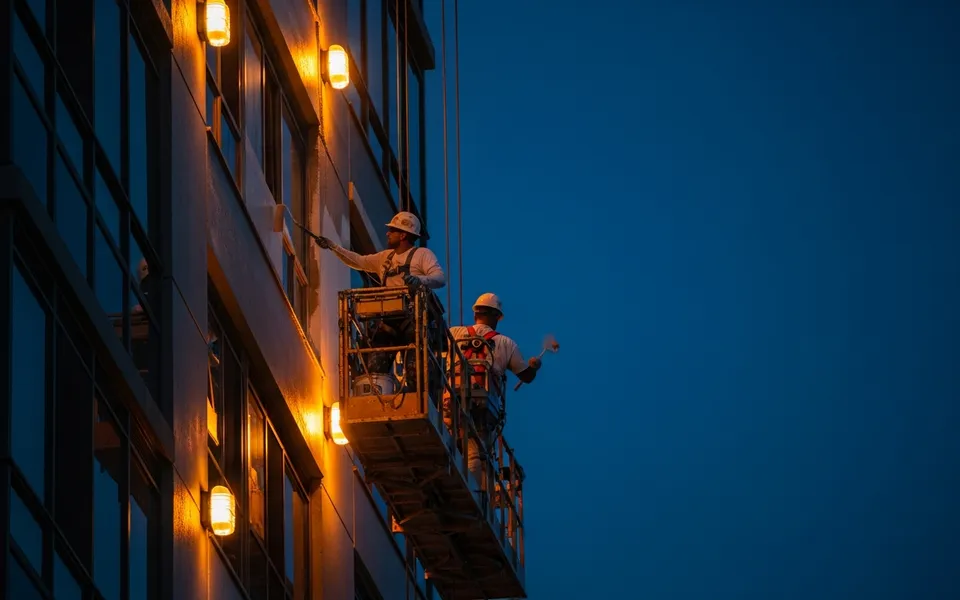
Swing stages (suspended scaffolding lowered from roof anchors) are the standard access method for high-rise and mid-rise stucco facades in Toronto. They're efficient on flat rectangular facades but add setup time on buildings with complex geometry or setbacks. Scaffold systems (tube-and-clamp or frame scaffolding erected from grade) work better for podium-level work or buildings where roof anchors aren't certified for swing-stage loads. Boom lifts or scissor lifts are appropriate for low-rise commercial buildings with clear access around the perimeter — they're faster to set up but require clear hardscape to position.
Every Master Building Services painting crew working at height is Working at Heights Trained, and every swing-stage setup is inspected before loading. The access method is specified in the quote, not left open — because vague access language in a bid is one of the most common sources of mid-project cost increases. When you receive a painting quote, verify that the access method is named, that fall protection is addressed, and that the WSIB clearance is current. Our exterior painting service page covers what to look for in detail.
What a Toronto exterior painting quote should include
A professional exterior painting quote for a Toronto commercial building should be specific enough that you could hand it to a second contractor and get a comparable scope priced. Vague quotes — 'paint exterior as per discussion' — are a red flag that the scope will expand mid-job or the prep work will be minimized to hit a low number.
A complete quote includes: substrate identification and condition notes; surface prep scope (pressure wash, crack repair, primer); product specifications (brand, product line, sheen, coat count); access method with fall-protection notes; application windows and weather-contingency language; colour confirmation process; and completion documentation (photo-verified). The 48-Hour Quote Guarantee at Master Building Services means you receive a written quote covering all of these elements within two business days of the site walk — not a ballpark figure that gets refined later.
Pairing the exterior painting program with a caulking and sealants inspection and exterior inspection on the same swing-stage mobilization is typically the most cost-efficient approach. The mobilization cost is fixed — the access equipment costs the same whether you use it for one trade or three. Bundling sealant work and a condition inspection into the same trip avoids a second mobilization and gives you a complete exterior envelope pass in a single scheduling window. For property managers managing this under a master service agreement, that coordination happens automatically — see how the master service agreement works for more. For buildings whose interior corridors are also due for a repaint cycle, interior painting for Toronto commercial buildings covers the access, scheduling, and product considerations that are specific to occupied condo and office buildings. And for the sealant work that should precede exterior painting on any building with joint failures, commercial caulking for Toronto high-rises covers the lifecycle and scheduling decisions that drive the sequencing.
Frequently asked questions
How often should a Toronto commercial building be repainted?
It depends on substrate. Stucco: typically every 7–10 years, shorter on windward or lakeshore-facing facades. Metal: 10–15 years with a proper primer. Concrete: 15+ years with the right coating system. Wood: every 5–7 years. Toronto's freeze-thaw cycle shortens all of these compared to milder climates. An exterior inspection gives you a substrate-by-substrate assessment before scheduling a repaint.
Why is exterior painting weather-dependent in Toronto?
Most architectural coatings cure within a specific temperature and humidity envelope — typically above 10°C ambient and below 85% relative humidity. Toronto spring (when temperatures consistently exceed 10°C) through early fall (before frost risk returns) is the safe window. Applying in cold or wet conditions causes coating failure within one or two freeze-thaw cycles. Weather-contingency language in the contract covers what happens if a frost event interrupts curing.
Can exterior painting be combined with other building services?
Yes — and it's usually more efficient. Exterior painting pairs with caulking and sealants and facade inspections on the same swing-stage mobilization, avoiding a second access-equipment trip. Under a master service agreement, these are coordinated automatically into a single scheduling window and one invoice.
Get a written quote for your Toronto exterior painting program
Tell us about your building. Full quote in 48 hours, guaranteed.
Serving Toronto, Mississauga, Brampton, Vaughan, Markham, Richmond Hill and the entire GTA.