
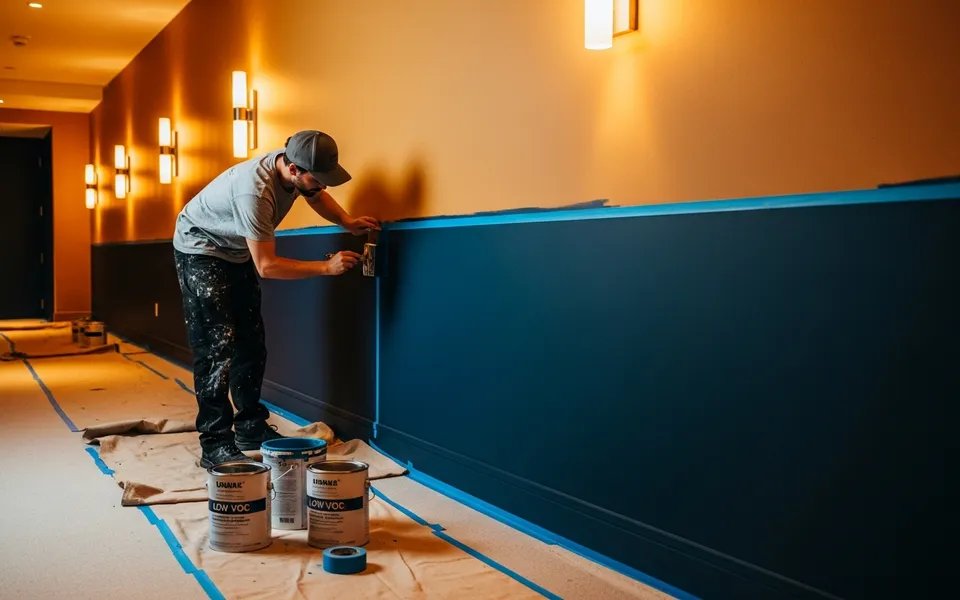
Interior painting for Toronto commercial buildings: scope, schedule, and cost factors
Interior painting for Toronto commercial buildings — hallway repaints, lobby refreshes, garage line work, and unit turnovers — runs on different rules than residential painting, with low-VOC products, evening crews, and photo-verified handoff being table-stakes.
Quick answer
Commercial interior painting in Toronto buildings spans hallway repaints, lobby refreshes, unit turnovers, and garage line work. The cost depends on surface prep, low-VOC product requirements, after-hours scheduling, and access constraints like concierge windows and elevator bookings. Property managers should expect quotes within 48 hours and photo-verified completion reports for every visit. Evening and weekend crews are standard, not an upgrade.
What 'commercial interior painting' covers in a Toronto building
Commercial interior painting in a Toronto building is not a single task — it's a category covering four distinct scopes, each with its own scheduling requirements, product specs, and access constraints. The four most common are hallway repaints (common corridor walls, fire door surrounds, and baseboards), lobby and amenity refreshes (higher-finish areas with strict aesthetic requirements), unit turnover painting (between tenancies or on move-in/move-out cycles), and garage line work (traffic markings, directional arrows, stall delineation).
Each of these has different implications for a property manager. Hallway repaints are high-volume and repetitive — a 30-storey building with two corridors per floor represents sixty-plus hallway runs, typically staggered over several months. Lobby work demands tighter tolerances and often requires board approval of the colour selection before a brush touches the wall. Unit turnovers are time-compressed, driven by the tenancy calendar rather than the building's maintenance schedule. Garage line work is specialized and requires road-marking products rated for vehicle traffic, not standard interior latex.
Understanding which scope you're quoting for matters before you even have the conversation with a contractor. A quote for hallway repaints scoped per linear foot of corridor will look very different from a lobby refresh scoped by finish quality and access, even if the raw square footage is similar. Confirm scope in writing — including floor coverage, paint system (primer plus one coat versus two finish coats), and whether trim and doors are included — before comparing bids.
Cost factors: surface prep, product, access, and scheduling
Surface preparation is the single largest driver of both cost and longevity in any commercial interior paint job, and it's also the factor most often underscoped in initial bids. High-traffic Toronto condo hallways accumulate scuffs, dents, skim-coat repairs, and basecoat bleed-through over years of normal wear. Prepping those walls properly — filling all holes, sanding transitions, priming bare patches, and cutting in clean lines around doors and fixtures — accounts for the majority of the labour on a quality job. A bid that skips or abbreviates surface prep will be lower upfront and will show the difference within eighteen months.
Product selection is driven partly by the building's requirements and partly by occupancy. Low-VOC and zero-VOC paints cost more per litre than standard formulations, but in an occupied building with continuous resident circulation, they're not optional — they're expected. Premium washable finishes (typically eggshell or satin in commercial corridors, semi-gloss on doors and trim) also carry a higher cost per litre but outperform flat finishes in scrub cycles by a wide margin. For a property manager making a capital expenditure decision, the right question is not 'what does the paint cost?' but 'how many years before the next repaint?'
Access constraints directly affect scheduling and, therefore, labour cost. A hallway repaint in a building with a concierge and a single service elevator needs to be coordinated around elevator booking windows, concierge handoffs, and resident notification timelines. After-hours crews working between 8 PM and 6 AM avoid disruption but add a premium over daytime rates. Weekend work is common for lobby refreshes where daytime traffic is unavoidable. A contractor who doesn't ask about your building's access protocols up front is giving you a quote for a different building.
Low-VOC requirements and resident sensitivity in occupied Toronto condos
Toronto condo residents have come to expect low-VOC interior painting as a baseline, not a premium. The reasons are practical: occupied corridors circulate air continuously through HVAC systems and elevator shafts, meaning paint fumes from a nighttime hallway repaint can reach units on multiple floors before the product fully off-gasses. A contractor using standard-VOC paint in an occupied building will generate complaints and may trigger a stop-work request from building management.
Low-VOC and zero-VOC formulations have improved substantially in the last decade and now match standard paints on washability, dry time, and colour range for most commercial interior applications. The additional cost per litre is real but modest — typically a 10–20% premium on product cost, which is a small fraction of the total job cost when you factor in labour, prep, and access. For a property manager, specifying low-VOC in the scope document is the correct default, not an optional add-on to negotiate.
Resident notification also matters. A standard protocol for hallway repaints in Toronto condos includes written notice to residents on the affected floors at least 48 hours in advance, and temporary posting of wet-paint notices at corridor entry points during work. Some buildings also require that residents with known respiratory sensitivities be notified directly. Confirm your building's notification requirements with management before scheduling — a missed notification step can create complaints that outlast the paint smell.
Scheduling around occupancy: evenings, weekends, and concierge windows
The GTA commercial interior painting calendar is driven by when buildings are not occupied, which for most Toronto condos means evenings after 8 PM and weekend mornings. High-traffic lobbies can only be worked when foot traffic is low — typically between midnight and 5 AM for buildings with active residents, or Saturday morning for buildings where weekend movement is lighter. Coordinating that window with crew availability, elevator booking, and surface dry times requires planning well in advance of the start date.
Concierge handoff is often the scheduling chokepoint. A service elevator access request that requires the concierge's active assistance can only be scheduled during concierge shift hours, which may not align with the after-hours work window. Some buildings solve this with a key-box arrangement for recurring contractor access; others require an on-duty staff member for every visit. Establish the access protocol in writing with the contractor before the job is scoped — it affects the cost, the timeline, and the number of nights required to complete the work.
Weather does not directly affect interior painting the way it affects exterior work, but it does affect crew scheduling indirectly. Interior crews who also do exterior work will often be pulled toward exterior projects during the May–October weather window, compressing the timeline for interior repaints in spring and fall. For property managers planning hallway repaints, the winter months (November through February) are often the most available window — exterior work slows, crews are available, and the disruption to summer-active residents is minimized. The interior painting service page can help you think through the right timing for your building.
Unit turnover painting: scope and timing for Toronto's September and January cycles
Toronto's rental market runs on two primary turnover cycles: September 1 (the academic and family move cycle) and January 1 (the winter lease cycle). For property managers overseeing units in a mixed-tenure building, these dates represent a compressed window — often 2–5 days between a move-out inspection and the next tenant's move-in — during which painting, patching, and refreshing must happen in sequence.
Unit turnover painting scope is typically lighter than a full repaint: spot-patching holes and scuffs, touching up paint on high-contact areas (around light switches, door surrounds, and baseboards), and a full repaint of feature walls or heavily damaged surfaces. The decision point for a full repaint versus touch-up is usually driven by how long the outgoing tenant occupied the unit and whether the paint colour matches the building's standard. A unit that's been touched up three times with slightly different white will need a full coat to look right.
Turnover painting pairs naturally with the building's other unit-readiness services — minor repairs, deep cleaning, and floor care — under a repairs and maintenance scope that runs on the same invoice as the painting work. For buildings with frequent turnover, bundling these services under a master service agreement means the contractor already knows the building's standard paint colour, the elevator booking protocol, and the concierge access process before the September rush begins. That institutional knowledge is worth more than any per-unit price difference. For the ongoing common-area cleaning program that complements the interior painting cycle — keeping freshly painted walls in good condition between repaints — see property manager-grade janitorial scope in Toronto. And for buildings whose exterior envelope also needs attention, exterior painting for Toronto commercial buildings covers the substrate and weather-window decisions that make exterior programs different from interior ones.
What a Toronto interior painting quote should include
A complete commercial interior painting quote for a Toronto building covers several elements that a residential painting quote typically omits. Scope should be specified in detail: which floors or units, which surfaces (walls only vs. walls, trim, and doors), and whether the price includes primer, one finish coat, or two. The product specification should name the paint brand and line, confirm VOC rating, and specify sheen level for each surface type. A quote that says 'low-VOC paint' without specifying the product is not verifiable.
The quote should include a written work schedule — a timeline showing which floors or areas will be done on which nights, with milestone dates for completion. For a multi-floor hallway repaint, this lets the property manager coordinate resident notifications floor by floor rather than issuing a building-wide notice. It also gives the property manager a basis for holding the contractor to the timeline. A written schedule is a deliverable, not a courtesy.
Photo-verified completion documentation should be part of the quoted scope, not a separate request. Every area completed should be documented with before and after photos, organized by floor or unit, and delivered in a format the property manager can file without reformatting. For a board that wants confirmation a lobbyrenovation was completed as specified, that photo record is the answer. Contact us to request a quote for your building's interior painting program — quotes arrive within 48 hours of the scoping conversation, and the written schedule is included at no extra cost. Interior painting also pairs cleanly with janitorial services for a combined common-area refresh program.
Frequently asked questions
Why is commercial interior painting more expensive than residential?
Commercial interior painting involves access constraints (concierge coordination, elevator booking), mandatory low-VOC product requirements, after-hours scheduling premiums, and surface prep on high-traffic walls that are scuffed and patched far more heavily than a typical residential wall. Pricing is scoped per project based on those variables — not per square foot at a flat rate. For a property manager, the right comparison is cost per repaint cycle, not cost per visit.
Do you paint occupied units?
Yes — with resident notification, low-VOC products, and evening or weekend scheduling to minimize disruption. Standard protocol includes written notice to affected residents at least 48 hours in advance, wet-paint notices posted during work, and a photo-verified completion handoff to the property manager. See our interior painting service page for full details on the process.
How long does a hallway repaint take in a Toronto condo?
Most Toronto condo hallway repaints run 1–3 nights per floor depending on corridor length, surface condition, and elevator access availability. A written work schedule is included with every quote so the property manager can plan resident notifications floor by floor rather than issuing a building-wide notice.
Can interior painting be combined with other building services?
Yes — under a master service agreement, interior painting runs on the same monthly invoice as janitorial and common area cleaning, repairs and maintenance, and the other services in your building's program. Unit turnovers in particular benefit from bundled painting, patching, and cleaning under one contractor who already knows the building's paint standard and access protocols.
Ready to quote your Toronto building's interior painting program?
Tell us about your building. Full quote in 48 hours, guaranteed.
Serving Toronto, Mississauga, Brampton, Vaughan, Markham, Richmond Hill and the entire GTA.